
How Do I Hire a Rockstar Patient Coordinator for My Cash-Pay Clinic? (The Recruiting Playbook)
Your patient coordinator is the person who turns inquiries into booked, paying patients — which makes this one of the highest-leverage hires in your entire clinic. Get it right and your conversion rate climbs; get it wrong and the leads your marketing produces die at the front line. This is the FAQ on recruiting a rockstar patient coordinator, drawn from the hiring playbook Real ADvice uses: the mistakes to avoid, who to look for, where to find them, how to screen, and the red flags that should stop a hire.
How do I hire a rockstar patient coordinator for my cash-pay clinic?
Run a structured recruiting process instead of rushing to fill the role.
Hire for a combination of will, skill, and alignment with your market.
Most importantly, treat the position as a revenue-generating investment rather than simply filling an empty seat.
The patient coordinator is a pivotal frontline team member.
They serve as the visual and virtual face of your clinic by:
- Handling inquiries
- Converting leads
- Representing your clinic on every call
Because so much revenue flows through this role, rushing the hire is one of the biggest mistakes you can make.
A strong patient coordinator demonstrates:
- Will — the hunger and drive to be the best
- Skill — the ability to hit the KPIs on your scorecard
- Alignment — genuine interest in your market and services
They should also be coachable, honest, and clear about what they want.
Finding that person requires a deliberate hiring process.
Build:
- A compelling job ad
- A strong sourcing strategy
- A screening process that tests real behaviors
- Interviews that reveal will, skill, and cultural fit
Treat this hire as seriously as any other revenue-driving investment.
That’s exactly what it is.
A great coordinator multiplies every lead your patient acquisition generates.
A weak coordinator becomes the leak that wastes them.
What are the common hiring mistakes to avoid?
Four mistakes consistently undermine hiring success:
- Rushing the hire
- Assuming it’s a high-churn role
- Recruiting externally without developing internal talent
- Posting weak, generic job ads
Rushing is the most expensive mistake.
Hiring the first available candidate to relieve the pressure of an open position usually costs far more than waiting for the right person.
Another mistake is assuming patient coordinator is naturally a high-turnover role.
When treated as a real career with growth opportunities and strong compensation, it doesn’t have to be.
That assumption often becomes a self-fulfilling prophecy.
Many clinics also recruit only from outside.
Instead, identify people you can develop internally or promote into the position over time.
Job ads deserve attention as well.
A generic posting attracts generic candidates.
By comparison, a clear and compelling job ad that highlights growth opportunities and earning potential attracts stronger applicants.
These mistakes all have one thing in common.
They feel like shortcuts.
Unfortunately, those shortcuts reduce the quality of the people you attract and retain.
Slow down.
Write a thoughtful job ad.
Plan for long-term growth and retention from the beginning.
Doing so gives you a much stronger pool of candidates.
What kind of candidate should I actually look for?
Evaluate candidates using two criteria:
- Sales experience
- Alignment with your offer and market
Rank applicants in this order:
- Sales experience and market alignment
- Market alignment without sales experience
- Sales experience without market alignment
- Neither sales experience nor market alignment
The ideal candidate has both.
For example, someone who has sold at a medspa and genuinely enjoys the products and patient population.
The next-best option is someone who believes strongly in your services because they’ve personally experienced aesthetics or HRT, even if they haven’t sold before.
Sales skills can be taught.
Passion for the market is much harder to develop.
Candidates with sales experience but no market knowledge rank next.
Finally, applicants with neither should be avoided whenever possible.
Alignment matters just as much as selling ability.
Look for additional indicators as well, including:
- Medical reception experience
- Office administration experience
- Medical assistant experience
- Hotel or hospitality experience
Hospitality backgrounds often produce excellent patient coordinators because they develop customer-service instincts.
Strong candidates also tend to:
- Have clean, proofread resumes
- Avoid frequent job changes
- Show career stability
Use these signals to prioritize applicants before scheduling interviews.
Where should I recruit a patient coordinator?
Work your recruiting channels in order of quality.
Start with the warmest sources before paying for colder ones.
Use this sequence:
- Facebook post
- Patient referrals
- Team referrals
- Indeed ads
- Recruiters
A Facebook post costs nothing and reaches people who already know and like your clinic.
Next, ask your patients.
Satisfied patients often know people who would fit your culture well.
Then ask your team for referrals.
Employees understand the role and rarely recommend someone who would reflect poorly on them.
Only after exhausting those options should you move to Indeed.
Recruiters belong at the end of the list because they’re typically the most expensive source.
Warm referrals consistently produce stronger candidates at lower cost.
Patient and employee referrals arrive with built-in trust and cultural alignment.
Cold applicants require much more screening.
Build the habit of recruiting in this order every time.
Over time, your referral pipeline becomes one of your strongest hiring assets.
How do I screen candidates efficiently before I waste time interviewing?
Use behavioral tests throughout the hiring process.
One of the simplest and most effective is asking candidates to text a specific number to schedule their interview.
That instruction quietly tests whether they can follow directions and communicate professionally.
The first screen is straightforward.
Message promising applicants and ask them to text your number to arrange a video interview.
Although it feels like logistics, it’s actually a behavioral test.
You’ll immediately see who communicates well.
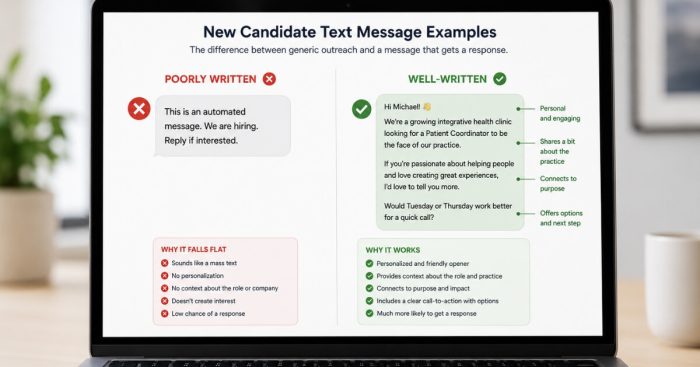
A strong candidate sends a message like:
“Hi, this is [Name]. I received a message on Indeed to contact this number to set up a video interview.”
A weaker candidate might simply text:
“I want to schedule interview.”
Some won’t even include their name.
If someone can’t communicate clearly in their very first interaction, they’re unlikely to communicate well with your patients.
When applicant volume is high, add another filter.
Ask candidates to submit a short introductory video explaining:
- Who they are
- Their professional goals
- Why they’re a good fit for the role
Anyone unwilling to complete that step doesn’t move forward.
Pair these behavioral screens with resume reviews.
Look for:
- Relevant experience
- Stable work history
- Clean, professional writing
Then sort applicants into three groups:
- Remove immediately
- Maybe
- Reach out now
That approach ensures your interviews are reserved for candidates who’ve already demonstrated core skills.
What should I ask in the interview, and what am I looking for?
Spend a few minutes building rapport.
Then move quickly into questions that reveal trajectory, motivation, and fit.
Listen carefully for will, skill, coachability, honesty, and income expectations that align with the role.
Keep rapport-building to roughly five minutes.
Then ask questions such as:
- What have you been doing over the past five years?
- What are your professional and personal goals?
- What stood out about this position?
- Why do you think you’re a good fit?
- What about our company resonates with you?
- What excites you about selling in this industry?
Afterward, explain the role clearly.
Then ask whether they’re comfortable performing every responsibility you’ve described.
Also ask directly:
“How much are you looking to earn monthly?”
A strong hiring process also includes a personality assessment, such as the DISC test, before a second interview with the decision-maker.
Pay close attention to what candidates reveal.
Look for:
- Hunger and drive to succeed
- Ability to achieve KPIs
- Coachability
- Honesty and integrity
- Confidence about what they want
- Natural rapport-building ability
- Clear explanations for previous job changes
- A compelling reason for making a career move now
Income expectations also matter.
Goals that are too low can actually be a warning sign because this is a commission-driven role.
You want someone motivated to earn.
Remember, you’re not simply filling a position.
You’re looking for someone hungry, coachable, and aligned enough to become a long-term asset.
What are the red flags that should stop a hire?
Watch for candidates who:
- Can’t describe a past failure
- Exaggerate their accomplishments
- Speak negatively about previous employers
- Are motivated only by money
- Can’t explain their job changes
- Have neither sales experience nor market experience
Each red flag tells you something important.
Someone who can’t identify a past failure may lack self-awareness or honesty.
Candidates who exaggerate or criticize former employers often struggle with accountability.
Applicants motivated only by money may leave as soon as another opportunity pays slightly more.
Likewise, someone who can’t explain their career moves may lack direction.
The biggest warning sign is the combination of no sales experience and no market experience.
You can often work with one missing piece.
Having neither is a genuine red flag.
Recognizing these warning signs gives you permission to say no.
When you’re understaffed, it’s tempting to explain them away.
Don’t.
A patient coordinator with the wrong attitude or motivation costs far more in lost patients and internal friction than an empty position ever will.
If you identify these red flags, tell the candidate promptly that the role isn’t the right fit.
Then continue searching for the right person.
That discipline is what ultimately leads you to a true rockstar hire.
FAQ’s About Hiring a Patient Coordinator
Should I pay a patient coordinator hourly or salary?
A common structure is hourly for the first 90 days.
After they’ve proven themselves, transition them to salary.
Typical compensation ranges from $40,000 to $60,000 per year plus commission.
The hourly trial period protects you while confirming the fit.
Moving to salary rewards strong performance.
Commission is equally important because it aligns compensation with booked patients and conversions.
Is patient coordinator really a high-churn role?
It doesn’t have to be.
Treating it as a high-turnover position often becomes a self-fulfilling prophecy.
When the role offers career growth, competitive pay, and commission, ambitious people stay.
Many clinics experience turnover because they underinvest in hiring, training, and compensation.
Improve those areas, and retention typically improves as well.
Build the role as a career, not just a job.
How much should I pay a patient coordinator?
A common salary range is $40,000 to $60,000 per year plus commission.
The exact amount depends on your market and compensation structure.
Lead with salary.
Then add commission tied to booked patients and conversions so incentives align with clinic goals.
Because this role directly generates revenue, paying well to attract and retain exceptional people often pays for itself many times over.
Should I require previous sales experience?
Sales experience is strongly preferred but isn’t always required.
Candidates with genuine passion for your market can often learn to sell successfully.
The ideal hire combines both sales experience and market alignment.
Avoid candidates who lack both.
That’s the combination most likely to struggle.
Experience in medical reception, administration, medical assisting, or even hospitality is also a strong advantage.
What’s the next step?
If your leads are dying at the front line, a better patient coordinator may be the answer.
Hiring one isn’t about luck.
It’s about following a proven process.
Avoid the four common hiring mistakes.
Prioritize market alignment alongside sales ability.
Recruit from warm sources first.
Screen candidates with behavioral tests.
Interview for will, coachability, and fit.
Finally, respect the red flags.
Following that process helps you hire the person who turns your marketing into booked patients.
On a strategy call we’ll help you build the recruiting process, the scorecard, and the compensation structure for a rockstar patient coordinator — and the training to make them great once hired.
It’s the same team-building work behind clinics like an HRT clinic we grew from $1M to $4M a year by building a team that closes without the owner.