
How Do I Define My Ideal Patient Avatar? (And Why It’s the Foundation of Every Marketing Dollar)
Before you write a single ad, film a single video, or build a single funnel, you need to know exactly who it’s all for. Your ideal patient avatar is the specific, highest-value patient your entire practice should be built around — and getting it right is the foundation that makes every marketing dollar work harder. This is the FAQ on defining that avatar, drawn from the framework Real ADvice uses to define the ideal patient before building any lead magnet, video, or nurture sequence.
What is an ideal patient avatar, and why does it matter?
Your ideal patient avatar is a detailed profile of the single best patient for your practice — the one with the highest lifetime value who stays longest and spends the most. It matters because everything you build should be geared toward them.
This isn’t a vague “target market.”
Instead, it’s a specific person with specific pains, desires, a deeper life mission, and defined demographics.
The reason to spend real time defining your avatar is simple. Your lead magnets, educational materials, videos, content, and nurture sequences should all focus on this patient.
If you don’t know exactly who that is, your marketing tries to speak to everyone and connects with no one.
Once you do know, every asset you create resonates with the exact person you most want to attract.
There’s also a business reason beyond messaging.
This patient generally has the highest lifetime value with your practice. They stay longer and spend more because everything you offer is geared toward their needs and goals.
Defining the avatar isn’t a branding exercise. It’s the foundation of profitable patient acquisition.
Get the avatar right, and you’ll attract more of the patients who are worth the most and cost the least to keep.
Why does defining my avatar make my marketing actually work better?
Because when every piece of marketing is built for one specific person, your message becomes powerful to exactly the right reader instead of generic to everyone.
Marketing that tries to appeal to all possible patients ends up bland and forgettable.
By contrast, marketing built around a precisely defined avatar speaks directly to that person’s real problems and desires. That’s what makes them stop, feel understood, and respond.
Your avatar becomes the filter for every marketing decision, including:
- What to put in a video
- What pain to lead an ad with
- What to write in a nurture email
When you know your avatar intimately, those decisions become easier and more consistent. As a result, your entire marketing system pulls in the same direction — attracting more of the same high-value patient.
The benefits also compound over time.
Because your content, offers, and follow-up all speak to one person, you attract more of that person. Those patients typically have the highest LTV, making your marketing more profitable and allowing you to invest more in reaching similar patients.
A fuzzy avatar produces fuzzy results.
By comparison, a sharp avatar creates a self-reinforcing engine.
That’s what separates medical practice marketing that converts from marketing that simply spends.
What do I actually need to know about my ideal patient?
Four things: their pains, their desires, their deeper mission, and their demographics.
The fuller and more specific each area is, the better your marketing works.
Each serves a different purpose:
- Pains are what’s bothering them right now.
- Desires are the outcomes they want instead.
- Mission is the deeper “why” behind those desires.
- Demographics are the concrete details — age, income, role, and location — that tell you who they are and where to find them.
Together, these four dimensions turn a vague “people who want to feel better” into a real person you can speak to directly.
The goal is depth.
“A 45-year-old who’s tired” isn’t enough.
Instead, build a detailed portrait of their brain fog, frustration with declining performance, desire to feel sharp and confident again, and the family and career reasons driving those goals.
That level of detail is rich enough to build an entire marketing system around.
The next sections break down each dimension using a hormone and functional-medicine patient as the worked example.
How do I identify my ideal patient’s pains?
List the specific symptoms and frustrations they’re living with — the concrete daily problems that would make them look for help.
For a hormone or functional-medicine practice, the ideal patient’s pains include:
- Brain fog
- Lack of consistent energy
- Physical fatigue they’re not used to
- Mental fatigue and not feeling as sharp as they’d like
- A higher body-fat percentage than they want
- Decreased libido or sexual performance
- Mood swings
Notice how specific these are.
Don’t settle for “they don’t feel well.” Instead, identify the exact experiences they’d describe to a friend.
That level of specificity lets your marketing say the thing they’re actually feeling, which is what earns their attention.
Your patient population may differ, but the exercise stays the same.
Get concrete about the real, felt problems.
The best source is your own patients.
Listen to the words they use to describe what’s wrong, then use those same words in your marketing.
When an ad or video names the pain a patient is living with in their own language, it feels like you read their mind.
That recognition is the beginning of trust.
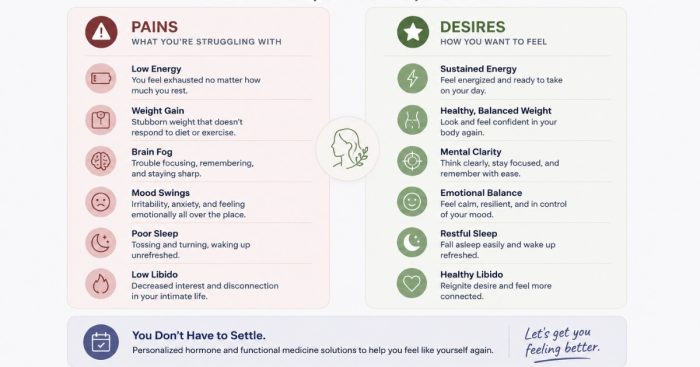
How do I identify my ideal patient’s desires and deeper mission?
Their desires are the specific improvements they want.
Their mission is what those improvements would let them do or feel in their larger life.
The mission is where the most persuasive marketing lives.
For that same hormone patient, common desires include:
- Mental acuity
- Reduced body fat
- Increased libido
- Consistent, accessible energy without caffeine or stimulants
- More physical stamina
- More muscle
- Emotional stability
These are the outcomes to promise and demonstrate.
Then go one level deeper to the mission — the reason those outcomes matter.
Examples include:
- Taking care of their family
- Having the energy to spend time with loved ones
- Excelling at their career
- Making time for hobbies and passions
- Regaining the physical and mental confidence they once had so they can be better partners
The mission is the emotional core of your messaging.
It transforms a features-and-benefits pitch into a message that genuinely moves people.
Patients don’t ultimately buy “increased testosterone.”
They buy becoming the energetic parent, the sharp professional, or the confident partner they want to be.
When your marketing connects treatment to that mission, it stops competing on clinical features.
Instead, it speaks to who the patient wants to become.
That’s the level where great marketing operates.
What demographics matter for my avatar, and how do I use all of this?
Pin down age, income, role, and the services they seek. Then build every lead magnet, video, offer, and nurture sequence around the full avatar so you attract more of exactly this patient.
For the hormone example, the demographic is typically:
- Men or women between 30 and 60
- Financially established (often $100k+ earners)
- Frequently business owners or athletes
- People with both the motivation and the means to invest in optimizing how they feel
These demographics tell you where to find your ideal patients and how to reach them.
Combined with their pains, desires, and mission, they complete the picture of a real, specific person.
Once the avatar is complete, it becomes the north star for everything.
Every lead magnet is designed around their pain.
Your videos answer their questions.
Each offer aligns with their goals.
Nurture sequences speak their language and reinforce their mission.
That focus makes your marketing resonate.
It also attracts more of the highest-LTV patients.
The avatar isn’t a document you complete and forget.
Instead, it’s the brief for your entire marketing system.
Keep every asset aligned with it, and you’ll build a practice full of your ideal patients.

FAQ’s About Defining Your Ideal Patient Avatar
Can I have more than one ideal patient avatar?
You can, but start with one and get it right before adding others.
A single, sharply defined avatar produces far better marketing than a blurry attempt to serve several audiences at once.
If your practice genuinely serves distinct high-value patient types, build a separate, complete avatar for each one.
Then tailor your content to each audience.
Resist the urge to water down your message by trying to speak to everyone simultaneously.
How do I find this information about my ideal patient?
Your existing patients are the richest source.
Talk to them, listen to how they describe their pains and goals, and read your reviews and consult notes for their exact language.
Market research beyond your own patient base also helps.
However, nothing beats the real words of the patients you already serve.
Build your avatar from evidence about real people, not assumptions about who you wish your patient was.
Does my ideal patient avatar ever change?
Yes.
Revisit it periodically because your services, your market, and the patients who thrive with you evolve over time.
Treat the avatar as a living profile rather than a one-time exercise.
As you learn more about your best patients, sharpen the avatar and let your marketing evolve with it.
Why should I build around the highest-LTV patient specifically?
Because that patient stays the longest and spends the most.
As a result, attracting more of them is the most efficient way to grow.
When everything you offer is geared toward their needs and goals, they retain and expand their care.
That makes each acquisition significantly more profitable.
Building around a low-value or one-off patient means working harder to replace churn.
Building around your highest-LTV avatar creates compounding growth.
What’s the next step?
If your marketing feels like it’s speaking to everyone and connecting with no one, you probably haven’t defined your ideal patient avatar sharply enough.
Map their pains, desires, mission, and demographics in real detail.
Whenever possible, use the exact words of your best current patients.
Then build every marketing asset around that one person.
That focus makes your marketing resonate and attracts more of the patients who are worth the most to your practice.
On a strategy call we’ll help you define your ideal patient avatar and align your offers, content, and nurture around them so you attract more high-LTV patients.
It’s the same foundational work behind clinics like an HRT clinic we grew from $1M to $4M a year by building everything around its ideal, high-retention hormone patient.