
How Do I Advertise Stem Cell, Hormone, and Regenerative Treatments Without Getting My Ad Account Banned?
Regenerative, hormone, and other “speculative” treatments are some of the most profitable services a cash-pay clinic can offer—and some of the hardest to advertise because Google and Facebook restrict naming them outright. The good news: you can advertise these treatments effectively and compliantly, and clinics make millions doing it. The trick is to advertise the condition, not the treatment. Here’s the FAQ on running Google and Facebook ads for restricted treatments without getting flagged or banned.
Can I even run ads for stem cell, PRP, or hormone treatments?
Yes—you just can’t name them. Both Google and Facebook restrict treatment names like stem cells, PRP, regenerative medicine, HRT, TRT, and hormone therapy. You can, however, advertise the conditions those treatments address.
For a long time, it seemed like advertising these treatments wasn’t possible at all. Done properly, it absolutely is. Clinics generate millions of dollars in revenue from these campaigns.
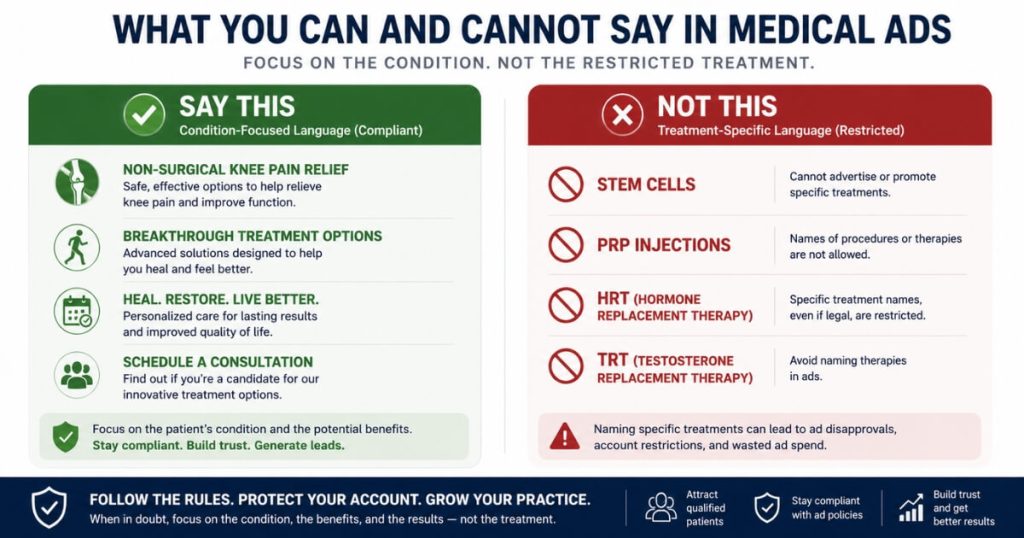
What you cannot do is say:
- Stem cells for knee pain
- PRP
- Hormone replacement therapy
- TRT
- The treatment by name
What you can do is talk about the condition and the outcome:
- Non-surgical knee pain solution
- Breakthrough treatment for knee pain
- Non-surgical facelift
The platform’s restriction is on the treatment label, not on the problem you solve.
This condition-first approach isn’t a loophole. It’s how compliant medical advertising works across both platforms, and it’s the backbone of effective regenerative medicine marketing. Master it and you can advertise services your competitors assume are un-advertisable.
What can I say in the ad, and what will get me flagged?
Say the condition and the outcome; never say the treatment name. “Non-surgical knee pain solution” is fine. “Stem cells for knee pain” is not.
Keep the language focused entirely on the problem the patient has and the result they want. Approved-style phrasing talks about knee pain, neuropathy, fatigue, low energy, or weight—the conditions. Restricted phrasing names the modality: stem cells, PRP, regenerative medicine, HRT, TRT, hormones, or any treatment by name.
This applies everywhere the platform reads your words:
- Campaign names
- Ad set names
- Ad copy
- Internal labels inside the ad account
Don’t name a campaign “Stem Cell Campaign,” because that signals to the platform what it’s about. Instead, name it by the condition or the targeting.
Condition-first ads have a side effect worth understanding. Because they speak to the problem rather than a specific treatment, they reach people a little earlier in the buying process. That means the offer and the follow-up have to do more work. It also means a much larger, compliant audience you can capture and educate.
How do I set up Facebook ads for these treatments safely?
Start with a properly configured Business Manager. Then run a simple radius-targeted lead-generation campaign using Facebook’s native lead forms.
The Business Manager setup matters for a specific reason. If you ever run into trouble with Facebook, having done things the right way earns you more grace and makes account recovery far more likely.
Once that’s in place, keep the campaign simple.
- Set the objective to lead generation.
- Use Facebook’s native lead forms so you don’t need a landing page or complex pixel setup.
- Target a radius around your clinic.
- Aim for an audience of roughly 150,000 to 250,000 people while staying tight on radius in a major city.
- Choose male or female depending on the treatment.
At the ad level, talk about the condition only, exactly as above.
Facebook isn’t the highest-quality lead source. The leads come in earlier in the buying cycle. However, it’s the easiest and cheapest way to start generating volume. Clinics with a real sales process to work those leads have made millions from it.
The key is a strong offer and a strong image. People won’t read much, so let the headline, the image, and the offer do the work. This works across pain, hormones, weight loss, aesthetics, and more. It also pairs naturally with med spa marketing for aesthetic verticals.
How do I set up Google Ads for restricted treatments?
Optimize for leads, build your keyword list around the condition, structure a strong offer, and use a value ladder so patients can enter at different price points.
Google works well for these treatments if you do it properly. It’s even stronger when you have a value ladder—multiple ways to treat the same condition—so a searcher can become a customer at any entry point.
The same naming rule applies. Google still won’t let you say stem cell treatment, PRP, hormones, or HRT. Keep campaign, ad set, and ad names focused on the condition, not the modality.
Set the campaign to optimize for leads. Then set up conversion tracking so every thank-you-page submission is tracked accurately.
Use Google’s Keyword Planner (under Tools & Settings) to build a keyword list around condition terms like “non-surgical knee pain treatment.” Then structure your offer.
Examples include:
- A free 15- or 20-minute phone consultation
- A lead magnet such as an educational ebook
Google Ads are mostly text, so you don’t need custom design. You can even draft headline and description variations with an AI tool and choose the strongest ones.
This condition-first, value-ladder approach is central to pain management marketing, where a knee-pain searcher might be a fit for several treatment options.
What should the landing page and thank-you page say?
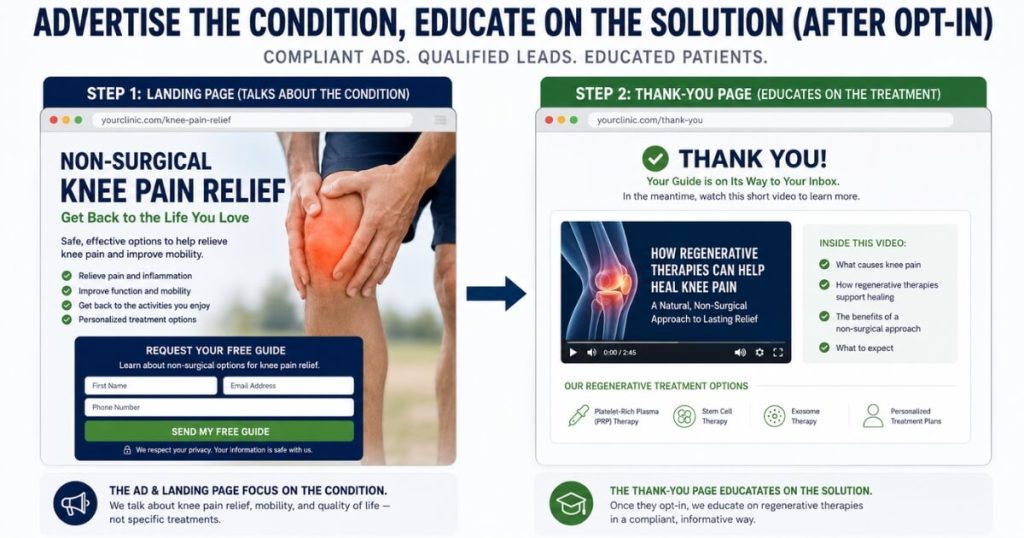
The landing page talks only about the condition. The thank-you page is where you educate about the actual treatment.
Keep the landing page clean and condition-focused.
If you embed a form:
- Place it in the upper third of the page.
- Keep it simple.
- Ask only for name, email, phone, and ZIP code if needed.
- Avoid pop-ups.
Most importantly, don’t mention the specific treatment on the landing page. Talk about:
- The condition
- The struggles it causes
- The fact that non-surgical solutions exist
Don’t mention stem cells, hormone therapy, or the treatment itself. The landing page’s job is to capture a condition-motivated lead compliantly.
The thank-you page is the safe place to educate. It can be essentially a clone of the landing page with an educational video that finally explains what you actually do and what treatment you can offer.
By the time someone reaches the thank-you page, they’ve already opted in. That’s where you connect their condition to your treatment and warm them for the follow-up call.
Then work the lead. Fast, systematic follow-up is what turns these earlier-stage leads into booked patients. It’s also the difference between a compliant campaign that makes money and one that simply spends it.
Why does condition-first advertising actually work better?
Because it keeps your accounts safe, reaches a bigger audience, and pairs perfectly with a quiz or offer that qualifies patients by their symptoms.
Beyond compliance, focusing on the condition is simply good marketing. Patients search and think in terms of their problem:
- “My knee hurts.”
- “I’m exhausted.”
- “I can’t lose weight.”
They don’t think in terms of the treatment name, which they may not even know yet.
Meeting patients at the condition captures far more demand than advertising a modality only the already educated would search for. It also sets up the rest of your funnel—a symptom quiz, a free consult, or an educational offer that qualifies the patient and moves them toward the right treatment.
The clinics that win with restricted treatments treat the platform rules as a design constraint, not a wall. Elite Pain Doctors, a pain and regenerative clinic, added over $2 million in revenue in 10 months. That kind of result comes from advertising the condition, capturing the lead compliantly, educating on the thank-you page, and following up relentlessly.
FAQ’s About Advertising Restricted Treatments
Can I run ads for stem cell or hormone treatments?
Yes, but you can’t name them. Google and Facebook restrict treatment names like stem cells, PRP, regenerative medicine, HRT, TRT, and hormone therapy. Instead, advertise the condition—”non-surgical knee pain solution” or “breakthrough treatment for knee pain.” That’s compliant and reaches more patients.
What language gets a medical ad flagged?
Naming the treatment or modality:
- Stem cells
- PRP
- Regenerative medicine
- HRT
- TRT
- Hormones
- Any treatment by name
This applies to ad copy, landing pages, and even campaign and ad-set names. Condition-and-outcome language (knee pain, neuropathy, non-surgical solutions) is what keeps you compliant.
Where can I finally talk about the actual treatment?
On the thank-you page, after the prospect has opted in. Keep the ad and landing page focused on the condition. Then use the thank-you page—often with an educational video—to explain what you do, what treatment you offer, and to warm the lead for your follow-up call.
Is Facebook or Google better for these treatments?
Both work.
- Facebook is the cheapest and easiest place to start. Native lead forms and radius targeting generate earlier-stage leads that require a strong sales process.
- Google captures higher-intent condition searches and works especially well with a value ladder and conversion tracking.
Many clinics run both, always advertising the condition and never the treatment name.
What’s the next step?
If you’ve been told your best treatments can’t be advertised—or you’ve had an ad account flagged or shut down—the problem is usually the language, not the strategy. Book a strategy call. In 60 minutes we’ll map compliant Google and Facebook campaigns for your restricted treatments, structure the condition-first offer and funnel, and show you how to capture and convert those leads without risking your accounts.
If it’s a fit, we’ll build the campaigns with your team.