
How Do Systems and a CRM Help a Cash-Pay Clinic Book Patients Faster?
Most cash-pay clinics lose patients not because the leads are bad, but because the path from inquiry to booked visit is slow, manual, and inconsistent. A lead comes in, sits in an inbox, gets a callback two days later, and by then they’ve booked with someone else. A CRM pipeline plus a defined call flow fixes that — and the speed gains are bigger than owners expect. Here’s the FAQ on how systems help a clinic book patients faster.
How do systems actually help a cash-pay clinic book patients faster?
By removing the guesswork and the gaps — every lead lands in a defined pipeline stage with a clear next action, and every call follows a structure that moves the patient toward booking.
When a clinic runs on memory and sticky notes, speed is impossible: nobody’s sure who was contacted, what was said, or what happens next. When it runs on a CRM pipeline, a new lead is instantly visible, assigned, and moving. One clinic we work with put its pipeline and call flow into GoHighLevel, and the reception team said it was one of their biggest wins of the quarter — “we booked him faster than we’ve ever booked a new doctor.” The system didn’t just speed up patient booking; it sped up everything the front desk touched.
The core idea is simple: a booking is the end of a process, and processes that are defined move faster than processes that are improvised. Build the pipeline and the call flow once, and every lead after that moves through the same fast, reliable path. This is foundational medical practice marketing the systems layer underneath every ad and every campaign.
What is a “pipeline,” and why does it speed up booking?
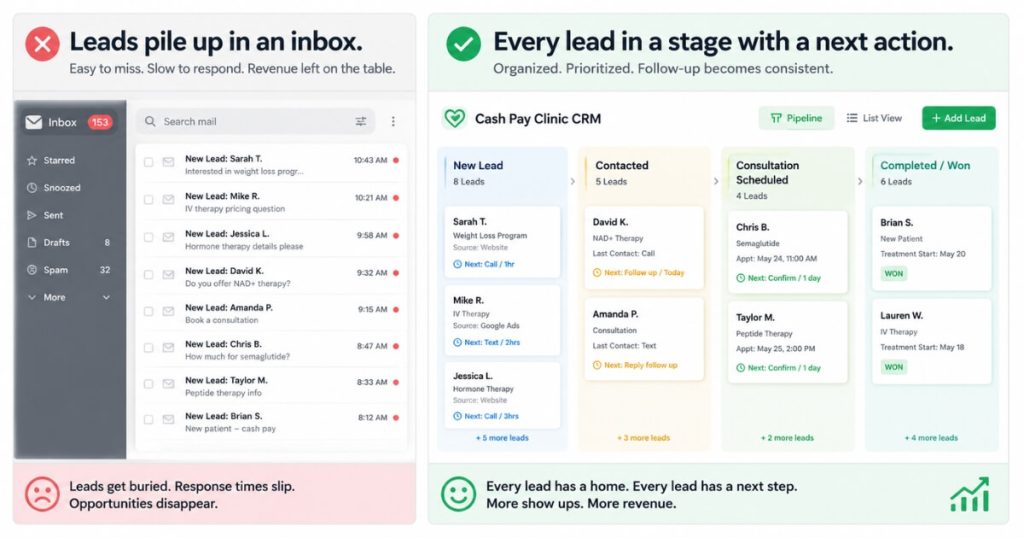
A pipeline is a visual board where every lead sits in a stage — new, contacted, discovery call booked, showed, converted — so nothing falls through and everyone knows the next action.
The speed comes from eliminating the two things that slow clinics down: leads getting lost, and staff not knowing what to do next. In a pipeline, a lead can’t vanish into an inbox because it’s a card sitting in a stage, visibly waiting. And the front desk never has to think “what now?” — the stage tells them. That means faster first contact, faster follow-up, and far fewer leads that quietly die because nobody circled back.
Speed to first contact is decisive in cash-pay medicine, where a motivated patient is often reaching out to several clinics at once. The clinic that responds first and books first usually wins. A pipeline makes fast, consistent response the default instead of a heroic effort.
Why does the discovery-call flow matter so much?
Because a structured call converts more inquiries into booked visits — and does it in less time.
A discovery call that follows a defined flow — understand the patient’s goal, confirm fit, explain the path, book the next step — converts far better than an improvised chat. The Prime Medicine reception team pointed to the discovery-call flow alongside the CRM as the reason booking got so fast: the call had a shape, so staff weren’t winging it, and patients got a clear next step every time. A good call flow is a repeatable asset; every team member can run it, and it produces consistent results whether the owner is there or not.
It also protects revenue. Without a flow, callers get inconsistent answers, hesitate, and drift away. With a flow, the call reliably ends in a booked appointment — which is the entire point of picking up the phone.
Can systems help onboard a new provider faster too?
Yes — and this is where the payoff surprises owners.
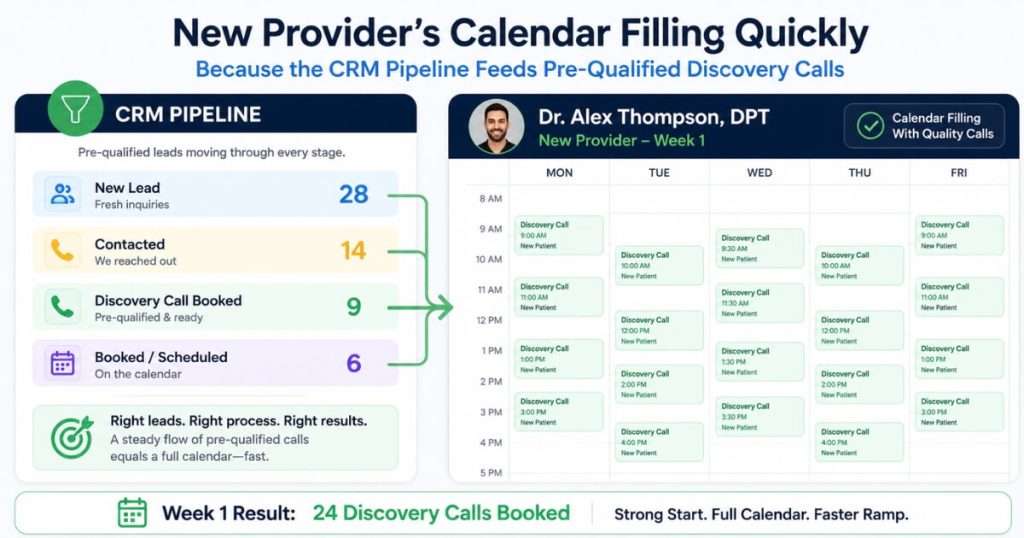
When you add a provider, their biggest early risk is an empty calendar. A working pipeline solves that: the moment the new provider comes on, the system routes pre-qualified discovery calls and bookings straight onto their schedule. That’s why the clinic above “booked him faster than they’d ever booked a new doctor” — the pipeline was already producing booked patients, so the new provider inherited a full calendar instead of building one from scratch.
This changes the economics of hiring. A provider who ramps to a full schedule in weeks instead of months is profitable far sooner, which makes adding capacity a much easier decision. We helped a longevity and functional medicine clinic, VYVE Wellness, add more than 100 inbound calls a month the kind of consistent, systematized flow that lets a clinic staff up confidently.
Why do front-desk teams resist these systems, and how do I get buy-in?
They resist because change feels like more work — until they see it makes their day easier, at which point they become the biggest advocates.
The owner above noted that the front desk is “usually so reluctant to implement that stuff,” and yet this team was “stoked,” because the system removed friction from their actual jobs. That’s the pattern: resistance comes from fear of added complexity, and buy-in comes the moment the team experiences fewer dropped balls and less chaos. The way to win them over isn’t a mandate — it’s showing them the wins quickly, letting them feel the relief of a lead that can’t get lost.
Get the front desk on your side and the whole system compounds, because they’re the ones running it every hour. A reluctant team will quietly work around a CRM; an enthusiastic one will make it hum.
What should I put in place first?
Two things: a lead pipeline with defined stages, and a written discovery-call flow — in that order.
Start with the pipeline, because it makes every lead visible and stops the leaks. Then add the call flow, because it turns those visible leads into booked visits consistently. You don’t need to systematize the entire clinic at once; you need the path from “inquiry” to “booked” to be fast and reliable, and everything else can follow. NuLevel Wellness raised its call answer rate from about 63% to 98% and quadrupled inbound calls to over 2,400 a month routing, intake, and follow-up.
Once that path is solid, more marketing actually converts, new providers ramp fast, and the owner can step back knowing booking doesn’t depend on them being in the building.
FAQ’s About Using Systems and a CRM to Book Patients Faster
How does a CRM help a cash-pay clinic book patients faster?
A CRM puts every lead in a visible pipeline stage with a clear next action, so leads don’t get lost and staff always know what to do next. That produces faster first contact and follow-up, which matters because the clinic that responds and books first usually wins the patient.
What is a lead pipeline?
A pipeline is a visual board where each lead moves through defined stages — new, contacted, discovery call booked, showed, converted. It prevents leads from vanishing into an inbox and gives the front desk a clear next step at every stage, which is what makes booking fast and consistent.
Can a CRM help a new provider fill their schedule faster?
Yes. A working pipeline routes pre-qualified discovery calls and bookings onto a new provider’s calendar from day one, so they inherit a full schedule instead of building one from scratch. One clinic booked a new provider faster than it ever had because the system was already producing booked patients.
How do I get my front desk to actually use a new system?
Show them the wins quickly. Front-desk teams resist because change feels like more work, but they become advocates once they experience fewer dropped leads and less chaos. Buy-in comes from felt relief, not a mandate — an enthusiastic team makes the system hum.
What’s the next step?
If leads are piling up in an inbox, callbacks are slow, and booking depends on whoever happens to be at the front desk that day, you don’t have a lead problem — you have a systems problem. Book a strategy call. In 60 minutes we’ll map the pipeline and discovery-call flow your clinic needs to book patients faster, ramp new providers quickly, and stop losing motivated patients to slow follow-up.
If it’s a fit, we’ll build it with your team.