
How Much Do a Logo and Branding Actually Matter When Launching a Cash-Pay or DPC Practice?
Every month we watch new cash-pay and DPC founders burn three weeks debating fonts while the things that actually move money sit broken — a payment link nobody recognizes, a Google listing that tells patients the wrong thing, an invoice with someone else’s name on it. This article is the honest branding hierarchy, pulled straight from our consulting calls with two practices launching right now: what to decide in 48 hours, and what to obsess over from day one.
How important is a logo when starting a cash-pay or DPC practice?
A logo is a get-to-good, one-week decision — it will not bring you a single patient, and waiting on it should never delay your launch.
On a recent consulting call, a physician launching a direct primary care and functional medicine practice had a logo she loved from a design contest platform (think 99designs), but the brand guide — fonts, colors, the full style kit — was still being finished by a designer working overseas.
Our move was simple: we started building the website sitemap the same day, without it.
Colors and fonts drop into a website in an afternoon. The page architecture — services, conditions treated, booking flow — takes weeks and is what actually produces patients.
For a DPC or functional medicine launch, the pages that print money are the condition pages: Hashimoto’s, thyroid dysfunction, hormone imbalance.
Those patients know their problem, not your solution, and they search the problem. Building that architecture is the heart of functional medicine & longevity clinic marketing, and it does not need your final font to start.
Your logo has three jobs: stay legible at phone size, work in a horizontal layout, and not embarrass you. Hit those three and move on.
Which branding decisions actually cost a new practice money?
The invisible ones — the name on your payment link, your text messages, and your invoices. That’s where weak branding literally stops cash from arriving.
A virtual urgent care practice we work with on the Gulf Coast had every automation firing correctly: booking confirmations, follow-up texts, review requests, and a payment link texted to every patient after their visit.
Then we checked the numbers. Not a single one of the previous week’s appointments had paid through the link.
The links were delivered. Patients ignored them.
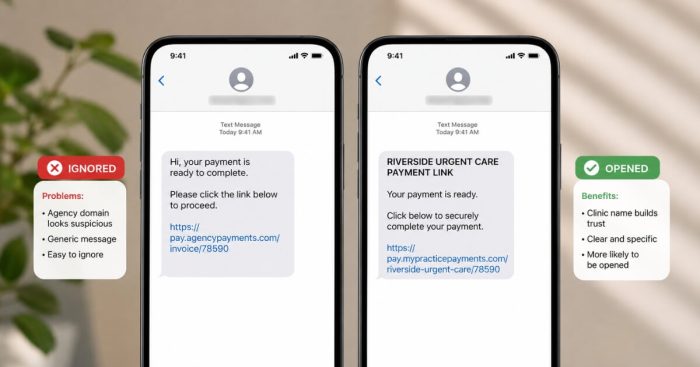
The diagnosis was pure branding. The payment link was hosted on our agency’s domain instead of the clinic’s, and the message read like every other piece of automated noise on a patient’s phone.
People read the first five words of a text and decide whether it’s real.
The fix took one call: put the clinic’s name in all caps as the very first line — “[CLINIC NAME] URGENT CARE PAYMENT LINK” — and rebrand the link to the clinic’s own domain.
The same physician applied the identical logic to labs. His lab vendor’s base men’s health panel costs the practice about $150, and he insisted the invoice come branded from the practice — not the vendor.
From booking to receipt, the patient should see exactly one brand.
If a patient can’t instantly tell a payment request is from you, they will ignore it — politely, and indefinitely.
Should my practice name say exactly what I do?
Yes. A name (or descriptor bolted onto it) that states the category out-earns a clever one, because patients act on instant recognition, not investigation.
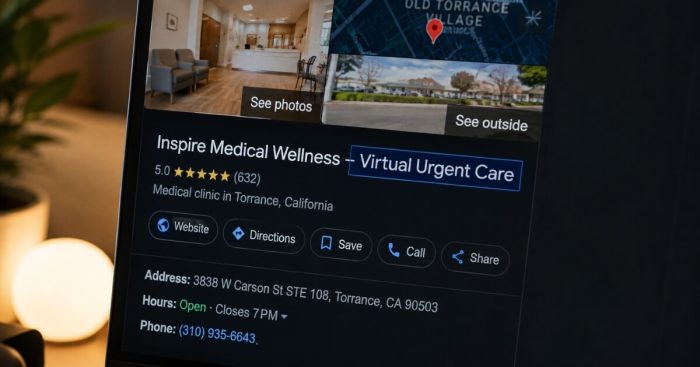
The same virtual urgent care taught us this the hard way. About 90% of its bookings were local patients finding the practice through its Google Business Profile.
However, locals kept assuming they had to show up in person because “urgent care” means a building with a waiting room.
The listing description said “virtual” plainly. Nobody reads descriptions.
So we changed the one field everyone does read: the listing name itself. It was renamed to end in “– Virtual Urgent Care.”
That’s the pattern for naming a new practice.
Spend a day, not a month: the name should say or strongly hint at the category, survive being spoken over the phone, have a clean domain available, and clear a basic trademark search.
Then bolt a descriptor onto it everywhere the category is ambiguous — the Google listing, the website header, and the text messages.
If patients have a preconceived notion about what your category means, your name is the only thing loud enough to correct it.
What branding should I decide fast — and what should I obsess over?
Decide in 48 hours each: name, descriptor, logo, colors, fonts, and domain. Obsess indefinitely over how your brand shows up at the money moments — the listing, the booking flow, the payment link, and the invoice.
The launch-phase split we give every new cash-pay practice:
- Name + descriptor — one day. Category-clear beats clever.
- Logo — one week, contest platform budget. Good enough is done.
- Colors and fonts — take whatever the designer delivers. Never let the style guide block the sitemap.
- Domain and email — same day as the name. Everything patient-facing lives on it, including payment links.
- The money moments — obsess forever. Every payment request, booking confirmation, lab invoice, and prescription notification carries your name first.
Notice the asymmetry: the things founders obsess over are one-time decisions with near-zero revenue impact, while the things they ignore are recurring transactions where the brand either builds trust or blocks payment.
This is the unglamorous half of medical practice marketing. Nobody screenshots a payment link to admire the design, but it’s the single touchpoint that decides whether you collect tonight or chase payment for a month.
How do I get payment collection working from day one at a new cash-pay practice?
Four moves: one branded payment link per visit, texted with your clinic’s name in the first five words; a payment-before-prescription policy; failed-payment alerts; and one named human who chases stragglers weekly.
The branded link and the all-caps header solve recognition.
The policy line solves urgency: “Your prescriptions will be sent to the pharmacy once your payment link is completed.”
That single sentence, suggested by the physician on our call, converts a polite request into a same-day action. The patient wants the medication tonight, not eventually.
Then assume some links still go unpaid, because they will.
At the urgent care practice, the founding physician went back through one week of unpaid visit balances and recovered about $1,000 with what he described as minimal effort. It was money already earned, sitting uncollected because nobody was assigned to ask.
Give that job to a person, on a schedule.
Finally, get notified when recurring payments fail.
One membership patient’s card had been silently declining for three months after a fraud replacement. She was mortified, not delinquent, and the practice never got an alert.
A failed-payment notification would have caught it in a day.
At launch, you don’t need a sophisticated billing stack. You need to know, immediately, every time money that should have arrived didn’t.
When does branding actually start to matter for growth?
After launch — when “brand” stops meaning your logo and starts meaning accumulated proof: reviews, published content, patient outcomes, and a message patients can repeat back.
The practices that win in cash-pay markets don’t out-design their competitors; they out-prove them.
A functional medicine and longevity clinic we work with increased website leads by 900% and added 100+ inbound calls per month within four months — not by redesigning a logo, but by making every page say precisely who the clinic helps and how.
At the far end of the same road, Dr. Joy Kong became the #1 stem cell expert on YouTube, hired four more doctors, and scaled herself out of day-to-day operations — a brand built through years of published proof, not a style guide.
So run the sequence in order.
Week one: lock the name, the descriptor, and a good-enough logo.
Day one of seeing patients: make every transactional touchpoint unmistakably yours.
Then spend the next five years building the only brand asset patients actually buy — evidence that you get people better.
FAQ’s About Logo and Branding for a New Cash-Pay Practice
How much should a new cash-pay practice spend on a logo?
A few hundred dollars on a design contest platform like 99designs is plenty for launch.
The logo’s job is credibility at phone size, not patient acquisition — no patient has ever booked a consultation because of a mark.
Spend the savings on your website’s condition and service pages, which actually generate bookings.
Should I wait for my brand guide before building my practice website?
No.
Start the sitemap and page architecture immediately — services, conditions treated, booking flow — and drop the fonts and colors in when the designer delivers them.
One DPC launch we’re supporting started its sitemap while the brand guide was still being finished overseas. Styling a finished site takes an afternoon, while page architecture takes weeks.
Why are patients ignoring my payment links?
Because they don’t recognize the sender.
If the link lives on a third-party domain and the text reads like generic automation, patients skim the first five words and move on.
Put your clinic’s name in all caps as the first line of the message, host the link on your own domain, and tie it to something they want — like prescriptions being released to the pharmacy once payment is completed.
Should I add a descriptor like “Virtual Urgent Care” to my Google Business Profile name?
Yes, when your category is ambiguous.
One virtual urgent care we work with found roughly 90% of bookings came from local patients via its Google listing.
However, locals assumed they had to come in person until the listing name itself was changed to end in “– Virtual Urgent Care.”
The name is the one field every searcher reads. Descriptions get skipped.
Should a new practice put lab prices on its website?
No.
Publish the panels you offer, but present one recommended panel with a consultation instead of a pick-your-own lab menu.
Letting patients self-select tests creates indecision, while a single recommended option is easier for both the patient and the front desk.
Also, make sure the lab invoice is branded to your practice, not your lab vendor, so the patient sees one brand from booking to receipt.
What’s the next step?
If you’re launching a cash-pay, DPC, or functional medicine practice and you’re stuck polishing a brand guide while nothing collects money yet, book a strategy call.
In 60 minutes we’ll map your launch-branding hierarchy — what to lock this week, which transactional touchpoints to brand before your first patient, and how to set up payment collection so day one revenue actually lands in your account.