
How Does a Medical Practice Show Up in Google’s AI Overviews?
In three months, one cash-pay regenerative medicine practice in West Fargo, North Dakota was shown inside Google’s AI-generated answers 1.51 million times. Not 1.51 million visitors. Not 1.51 million leads. One and a half million moments where a patient asked Google a question and this practice’s content was part of what the answer was built from. Most practice owners have never looked at that number, because it does not behave like any metric they were taught to watch. Here’s how a medical practice earns visibility inside AI Overviews — and why the same content gets quoted back by ChatGPT and Perplexity.
How does a medical practice show up in Google’s AI Overviews?
You show up in an AI Overview by publishing pages that answer one specific patient question directly.
Use plain language, with real numbers attached to named people and places. That is the raw material an AI answer is assembled from.
An AI Overview is not a ranking. It is a synthesis.
Google’s model reads candidate pages and extracts sentences that cleanly answer the question. It then builds an answer with source links attached.
Nothing about that process rewards a brochure.
A page promising “cutting-edge regenerative solutions delivered with compassionate care” contains no extractable answer. There is nothing useful for the model to lift.
By contrast, consider this: “Shockwave therapy is typically delivered in six sessions, each about fifteen minutes, with no anesthesia and no downtime.”
That sentence contains four extractable facts.
At Everest Regenerative Medicine, where 1.51 million Google AI impressions were recorded in three months, the content focused on questions patients asked before they were ready to book.
What does a treatment cost? Does it hurt? How long does recovery take? Does insurance cover it? What happens if it does not work?
That is research-phase language. It is also the kind of language that can trigger AI Overviews.
Google does not typically need to generate an AI answer for a simple query like “med spa near me.” A detailed question such as “how long does shockwave therapy take to work for knee pain” gives it much more to synthesize.
Practices harvesting AI visibility write the second kind of page.
The mechanism also transfers beyond Google.
ChatGPT, Perplexity, and other assistants can retrieve sources, extract useful information, and cite them.
Therefore, there is no need to create an entirely separate content discipline for each platform.
Publish the clearest, most specific, and most obviously sourced answer to a patient’s question. That gives your content a better chance of becoming source material.
Everything Real ADvice does in SEO for cash-pay regenerative medicine clinics now considers both audiences: the human skimming the page and the model looking for something worth quoting.
What is an AI impression, and why isn’t it the same as a click?
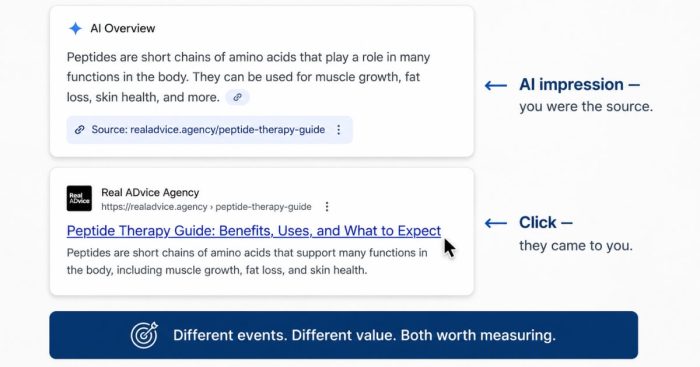
An AI impression means your page was surfaced as part of a Google AI-generated answer.
A click means a patient left that answer and came to your website. The first can happen far more often than the second.
The distinction matters because the value is different.
A click is a visitor you now control. They are on your page, your offer is in front of them, and your form is one scroll away.
An AI impression is influence without possession.
The patient got their answer without visiting you, while your content received exposure as a source.
Judge that impression by conversion rate and it will look worthless.
AI visibility does not convert like a click does. Any agency telling you otherwise is selling you something.
Instead, it can influence the part of the decision that happens before anyone is ready to convert.
Cash-pay patients research heavily. A large out-of-pocket decision can involve weeks of reading, comparison, and second-guessing before the phone rings.
During those weeks, your name either appears repeatedly in the information they encounter, or it does not.
By the time they search your practice name directly or ask an assistant “who does this near me,” their shortlist may already be forming.
The value of an AI impression is being a source during the period when a patient is still deciding whether the treatment is real.
Run the numbers alongside each other and the shape becomes clearer.
During the same engagement, the first ten weeks of SEO produced 5.14 million search impressions, 66,200 organic clicks, and an average search position of 4.
The AI layer added 1.51 million AI impressions across three months.
The clicks are the traffic. The impressions are the reputation.
You need both, and you should not ask the second to behave like the first.
Do AI Overviews reduce clicks to my website?
Often, yes.
The patient may get an answer without leaving the results page. That is the trade: you can lose some top-of-funnel visits while gaining repeated placement as a source during the research phase.
The practices hurt most are those whose only content consists of thin answers to simple questions.
If the only useful information on a page is a two-line definition, an AI Overview can reproduce that definition. The patient then has little reason to visit the site.
Nothing meaningful was taken from you there. The page was never worth much of a visit in the first place.
Pages that still earn clicks go beyond the definition.
They explain what the protocol looks like session by session, what it costs in that market, which provider performs it, and what happens when it does not work the first time.
The larger mistake is treating the missing visit as the whole story.
A patient who reads an answer without clicking may still see your practice named as a source of information.
That is a different asset from a session in your analytics.
It is also why impressions and clicks should not be judged on the same scale.
During the first ten weeks of SEO, this practice recorded 5.14 million search impressions and 66,200 organic clicks.
The gap between those figures was not automatically a leak.
It represented the research phase happening in public, with the practice’s content appearing throughout it.
What makes a page quotable enough for an AI answer to pull from?
A page is quotable when a sentence can be lifted out, placed into another paragraph, and remain true and useful without the surrounding page.
Test most marketing copy against that standard and it fails quickly.
Marketing copy is often written to persuade in context. It leans on the paragraph above it, the photo beside it, or an implied comparison with a competitor.
Pull one sentence out and it collapses into vapor.
Quotable writing is different.
It is self-contained, specific, and dull in the way a good reference book is dull. It names the treatment, number, and condition it applies to.
Question-shaped content creates that structure naturally.
Start with a heading that matches the literal question a patient asks. Then answer it directly in the first sentence before adding the supporting substance.
That is not merely a stylistic preference.
It makes the answer easier for a model to identify on the page. It also serves human readers who are skimming for the same information.
Specificity is the second half.
Vague authority is not authority. “Results vary by patient” is unlikely to become the useful fact an answer needs.
Real figures attached to named entities are different.
That is why Orthobiologics Associates generating $309,590 in cash-pay revenue in 10 months from SEO with zero ad spend is a citable claim, while “our SEO clients see great returns” is not.
Write the number. Name the practice, city, and timeframe.
That is the whole trick, and almost nobody does it.
Is optimizing for ChatGPT and Perplexity different from optimizing for Google?
Not meaningfully.
All of them can retrieve source pages, extract useful answer spans, and cite sources. Therefore, clear pages built around specific patient questions can perform across these environments without entirely separate content strategies.
What differs between assistants is the interface, not the basic content requirement.
Some show citations prominently beside the answer. Others place them behind links or answer through a chat interface.
None of that changes what makes a sentence worth pulling.
The question a practice owner should ask is whether anything on the website can survive being quoted out of context.
That single test is useful across all of them.
This is also why there is nothing separate to buy here.
You cannot simply purchase organic placement inside an AI-generated answer the way you purchase a paid search position.
Likewise, a product sold as separate “ChatGPT optimization” on top of otherwise unchanged content may simply charge you twice for overlapping work.
The pages that produced 1.51 million Google AI impressions across three months were not special AI pages.
They were ordinary articles answering questions patients were typing, written clearly enough for a machine to identify the answer and a person to understand it.
Do schema markup and entity consistency actually change whether you get cited?
Schema and entity consistency can help machines interpret your content and identify the business behind it.
However, neither replaces useful, authoritative content.
Structured data can explicitly describe elements such as an article’s headline, publisher, publication date, and canonical page.
That reduces ambiguity about what the page represents.
Entity consistency serves a related purpose.
Your practice name, city, provider name and credentials, address, and phone number should appear consistently across your website and relevant profiles.
For example, “Everest Regenerative Medicine” in West Fargo, North Dakota, with Dr. Arden Beachy named as the physician, should remain consistent wherever those details appear.
Multiple conflicting versions can make entity identification less clear.
This work is unglamorous and inexpensive. Yet it can strengthen the patient acquisition process by making your practice easier for both patients and systems to identify.
How do you measure AI visibility in Google Search Console?
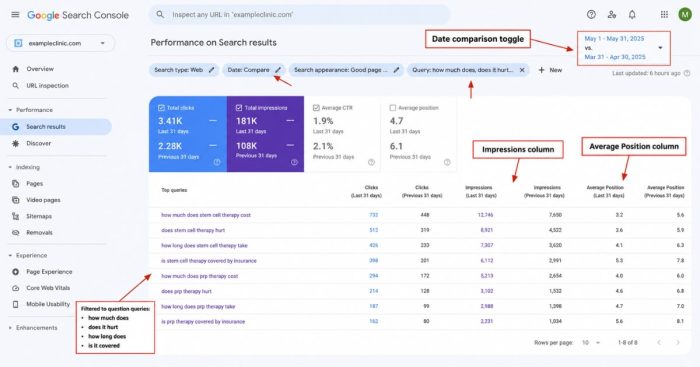
Search Console is useful for monitoring the search visibility surrounding question-shaped content.
Watch impressions, average position, clicks, and the queries producing them over time.
Open the Performance report and examine queries containing question language such as “how,” “does,” “is,” “what,” “why,” “cost,” “hurt,” “long,” and “covered.”
Review that segment separately from branded searches, which naturally behave differently.
If question-query impressions are climbing while clicks remain flat, do not immediately conclude the content is failing.
You may still be early in the search ramp.
There is no fixed timeline for when visibility begins. It depends on your existing content, competition, domain history, and how established the practice is online.
In the case we track most closely, the first ten weeks of SEO produced 5.14 million search impressions and an average search position of 4.
Separately, 1.51 million Google AI impressions were recorded across three months.
The attribution caveat matters.
AI-answer reporting and attribution remain incomplete. No dashboard can reliably tell you that a patient booked because an assistant named your practice six weeks earlier.
So measure both leading and lagging indicators.
Watch search visibility and question-query performance. At the front desk, also pay attention to callers who already understand the treatment, know roughly what it costs, or say they have been researching it.
You can’t scale a practice you can’t measure.
The practices that understand this are measuring the research phase as well as the booking.
Ready to make your practice one of the sources AI answers get built from?
AI answers are built out of pages that answer one question plainly, with specific numbers attached to named entities, published by a practice a machine can identify as a single real business.
That is the entire requirement.
Brochure copy does not qualify, no matter how much it cost to write. Likewise, no amount of schema will rescue a page with nothing quotable on it.
The practices earning visibility inside AI answers right now are the ones that wrote the pages patients were already searching for.
The results at Everest also reflect both Real ADvice’s work and the practice’s own clinical and sales execution, not marketing alone.
If you want to know where your practice actually stands, book a 60-minute strategy call.
We review your Search Console data — impressions, average position, and whether your question-query segment is moving.
Then we audit your existing content for anything extractable and check your schema and entity consistency across your site and listings.
Finally, we map which patient questions in your market still have no good answer published.
You leave with the specific list, whether or not you work with us.