
How Many Times Should I Follow Up With a Lead? (The 8-Touch Chase Sequence for Regenerative & High-Ticket Clinics)
Most clinics follow up with a new lead once or twice, hear nothing, and quietly give up—leaving the majority of their conversions on the table. High-ticket cash-pay leads, especially in regenerative medicine, rarely convert on the first touch; they convert on the fifth, sixth, or eighth, once trust and proof have accumulated. This is the FAQ on how many times to follow up and what to say each time, built from a real regenerative-medicine chase sequence that runs eight structured touches across phone and email—including the breakup message that reopens cold leads.
How many times should I follow up with a lead?
Follow up far more than most clinics do. A real chase sequence includes at least eight structured touches across multiple channels before you consider a lead cold.
Many clinics stop after one or two attempts. That’s exactly why so many high-ticket leads are wasted.
A regenerative lead who requested an evaluation is already interested. However, interest doesn’t always mean they’ll answer your first phone call. Instead, people often:
- Get busy
- Forget to respond
- Become distracted
- Need more time before making a decision
A missed call isn’t the same as a “no.”
Successful clinics understand this. Instead of giving up, they continue showing up with a planned sequence of phone calls, emails, and valuable follow-up messages.
Each touch serves a purpose.
Rather than simply asking if the lead is still interested, every contact provides something useful that builds trust.
Eight touches are not excessive when every message adds value.
Instead, they are often the difference between:
- A lead disappearing forever
- A lead finally booking once timing and trust align
Following up this consistently is one of the highest-return activities in regenerative medicine marketing because you’ve already paid to generate the lead.
The follow-up determines whether that investment produces revenue—or disappears.
Why do most clinics stop following up too early?
Most clinics stop because a couple of unanswered calls feel like rejection.
No one wants to appear pushy.
Unfortunately, many teams quit right before the majority of conversions would have happened.
The psychology is understandable.
A typical sequence looks like this:
- Call the lead.
- No answer.
- Send an email.
- Receive no reply.
- Assume they’re no longer interested.
The reality is very different.
An unanswered phone call usually means:
- Bad timing
- A busy schedule
- A forgotten voicemail
- Life simply getting in the way
It rarely means the lead has made a final decision.
In fact, many patients who ignore the first two contacts end up booking after the sixth or seventh touch because that’s when your message finally reaches them at the right moment.
There’s another reason follow-up stops early.
Without a documented process, follow-up depends entirely on memory.
Busy clinics naturally prioritize today’s appointments over yesterday’s leads.
As a result:
- Calls get forgotten.
- Emails never get sent.
- Leads quietly disappear.
The solution is simple.
Build a written follow-up sequence with scheduled touches.
Once follow-up becomes a system instead of a personal habit, far fewer leads fall through the cracks.
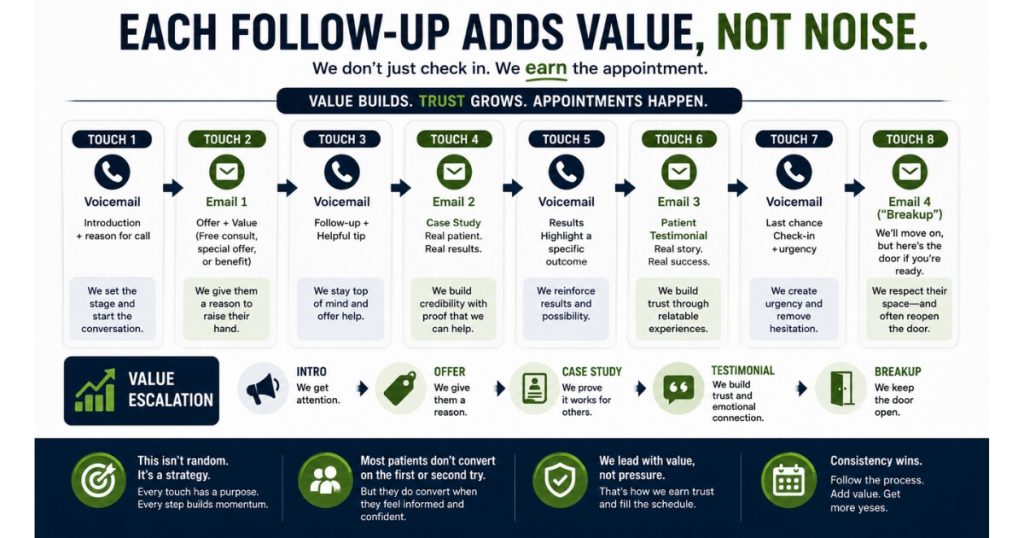
What should a multi-touch chase sequence look like?
Alternate communication channels while increasing the value of each touch.
Instead of repeatedly saying “just checking in,” every message should give the lead a new reason to respond.
A proven regenerative medicine follow-up sequence looks like this:
- Warm voicemail plus an immediate email thanking them for requesting an evaluation.
- Phone call.
- Voicemail referencing the previous email.
- “Your name came to mind” message tied to another patient’s success story.
- Case study related to their condition.
- Testimonial screenshot and supporting email link.
- Personal voicemail explaining why you genuinely believe this treatment can help.
- Breakup message.
Notice the pattern.
Different channels serve different purposes.
- Phone calls create human connection.
- Voicemails build familiarity.
- Emails deliver proof through links, testimonials, and case studies.
Meanwhile, the value steadily increases.
Early touches focus on:
- Thanking the lead.
- Acknowledging their goals.
Later touches provide:
- Real patient stories.
- Clinical outcomes.
- Social proof.
- Educational resources.
Every contact answers the same question:
“Will this work for someone like me?”
That structure keeps eight touches feeling helpful instead of repetitive.
It’s also the foundation of converting the high-intent leads your patient acquisition already produced.
What do I say in each follow-up so it doesn’t feel annoying?
Lead with value every single time.
Never send another empty message that simply says:
- “Just checking in.”
- “Circling back.”
- “Wanted to touch base.”
Those phrases add nothing.
Instead, every touch should provide something the patient actually wants.
For example:
- A patient success story.
- A case study.
- A testimonial.
- Educational information.
- A relevant treatment result.
Early follow-ups remind patients about the outcomes they originally wanted, such as:
- Walking without pain.
- Reducing numbness.
- Repairing damaged tendons.
Later touches introduce stronger proof.
For example:
- A case study involving someone with their exact condition.
- Before-and-after results.
- Patient testimonials.
- Videos showing treatment outcomes.
Each message strengthens your credibility a little more.
As a result, persistence begins to feel like genuine care instead of unwanted pressure.
A patient receiving helpful evidence over several weeks doesn’t feel chased.
They feel understood.
That’s exactly what hesitant, high-ticket patients need before making an important decision.
Do “breakup” messages actually work to re-engage cold leads?
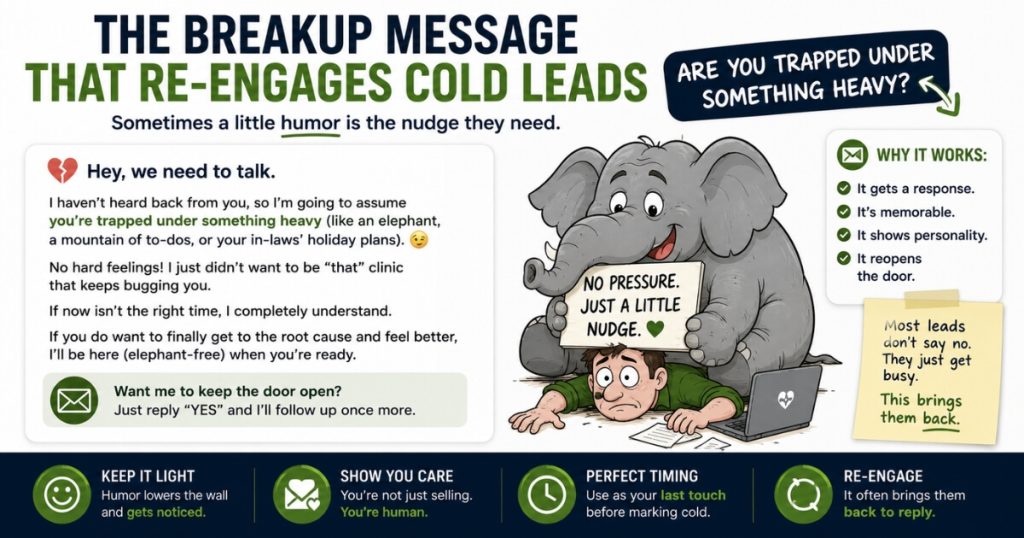
Yes. A warm, slightly humorous breakup message is often one of the highest-response touches in the entire sequence because it gives a cold lead an easy, low-pressure reason to reply.
The regenerative sequence finishes with two versions.
One is playful:
“My guess is you’re not getting back to me for one of four reasons…”
The fourth reason?
They’re “trapped under something heavy and cannot reach the phone.”
The humor lowers the pressure and often earns a response.
The second version is more sincere:
“I’m concerned I’ve offended you with my persistence; if so, I apologize… but if you’re still looking for a solution, give me a call.”
Although the tone is different, both messages accomplish the same goal.
Instead of continuing to chase the lead, they shift the decision back to the patient.
Breakup messages consistently outperform expectations because they:
- Remove pressure.
- Give permission not to respond.
- Make replying feel natural.
- Create a sense of finality that often prompts action.
It’s the psychology of loss.
Ironically, telling someone you’ll stop reaching out often motivates them to restart the conversation.
A breakup message isn’t giving up.
Instead, it’s one final, well-designed opportunity that reopens surprisingly large numbers of cold leads.
Should I use phone, email, or text—and in what mix?
Use all three channels.
Each one does a different job.
- Phone calls create human connection.
- Voicemails build familiarity.
- Emails deliver proof, testimonials, and links.
- Texts create immediacy and quick responses when appropriate.
No single communication channel reaches everyone.
Different patients naturally respond in different ways.
For example:
- Some always answer phone calls.
- Others rarely answer calls but read every email.
- Others respond almost instantly to text messages.
Using multiple channels dramatically improves your chances of connecting.
It also prevents fatigue.
Eight phone calls alone can feel overwhelming.
Eight emails alone are easy to ignore.
Alternating channels keeps every interaction fresh while giving patients multiple opportunities to engage on the platform they prefer.
The winning formula is simple:
- Be persistent.
- Add value every time.
- Use multiple communication channels.
That’s what separates clinics that consistently convert high-ticket leads from clinics that simply generate them.
FAQ’s About Following Up With High-Ticket Leads
How long should the chase sequence run?
Long enough to complete eight or more touches, typically spread across two to four weeks.
A typical cadence looks like this:
- Immediate voicemail and email after the inquiry.
- Phone call the following day.
- Additional proof-driven emails and voicemails over the next several weeks.
- Finish with one or two breakup messages.
The objective isn’t to overwhelm the lead.
Instead, it’s to stay consistently present until timing and trust finally align.
Won’t following up eight times annoy my leads?
Not if every message adds value.
People become annoyed by repetitive follow-up that says nothing new.
Instead, every touch should include something worthwhile, such as:
- A relevant case study.
- A patient testimonial.
- Educational content.
- A success story.
- A genuinely helpful offer.
When every interaction teaches or reassures the patient, persistence feels attentive rather than aggressive.
The breakup messages at the end also provide anyone who truly isn’t interested with a respectful way to end the conversation.
Should I automate the chase sequence?
Yes.
Automate the framework while keeping the human interactions personal.
Automation works well for:
- Email delivery.
- Task reminders.
- Follow-up scheduling.
- CRM workflows.
Meanwhile, personal phone calls and voicemails should still come from a real team member.
That combination ensures:
- No lead gets forgotten.
- Every prospect receives consistent follow-up.
- Human relationships remain authentic.
Automation solves the biggest problem most clinics have—stopping after only one or two attempts.
What’s a good re-engagement message for a lead who’s gone cold?
Use a warm breakup message that gives the lead permission either to reply or to close the conversation.
Both styles work well.
A humorous version:
“Are you trapped under something heavy?”
A sincere version:
“If I’ve been too persistent, I apologize—but if you’re still looking for relief, I’m here.”
Both approaches consistently outperform another generic:
“Just checking in.”
They change the emotional dynamic and make responding feel easy rather than pressured.
What’s the next step?
If your clinic follows up once or twice and then moves on, you’re converting only a fraction of the high-ticket leads you’re already paying to generate.
Instead, build a documented eight-touch chase sequence that:
- Uses multiple communication channels.
- Delivers value in every interaction.
- Escalates proof throughout the sequence.
- Ends with a thoughtful breakup message.
Most clinics never reach touches five through eight.
That’s exactly where many of the highest-value conversions happen.
It’s not more leads you need.
It’s a follow-up system that doesn’t quit too early.
If you’d like help building the exact chase sequence for your clinic and specialty, we’ll help you install the process from start to finish so no lead falls through the cracks. It’s the same follow-up discipline behind clinics like a pain and regenerative practice where we added more than $2 million in revenue in 10 months.