
How Many Calls Should My Google Business Profile Get Every Month? (The Per-Location Benchmark We Use)
Almost every clinic owner has looked at their Google Business Profile dashboard and had no idea whether the numbers on it were good.
There is no industry-published benchmark, so owners either ignore the data or assume whatever they’re getting is normal.
Here’s the threshold we hold every location to, where it comes from, and what to do when a location is under it.
How many calls should my Google Business Profile get every month?
At least 50 organic calls per location per month, excluding anything driven by paid ads.
Below 50, the listing needs attention.
That number is a floor, not a target.
It’s the level at which a Google Business Profile is doing the basic job of converting local intent into a phone call. That’s someone searching for your specialty in your city and deciding to contact you.
Clinics above it have a listing that is at least functioning.
Clinics below it almost always have something structurally wrong. That could be the wrong primary category, a thin or missing service list, or too few photos.
It could also be a review profile that hasn’t moved in a year. Or the listing simply isn’t ranking in the local pack for the searches that matter.
It also scales per location.
If you run three locations, you’re measuring three separate numbers. It’s normal for one to be dramatically healthier than the others.
Averaging them across the practice hides exactly the problem you’re trying to find.
It’s the same way a blended ad account average hides a dead market.
How many website clicks should my Google Business Profile generate?
100 or more per location per month, again excluding ads.
Calls and clicks measure two different intents, which is why we track both.
A call is someone ready to talk now.
A click is someone doing research. They’ll read your site, compare you to two competitors, and come back later.
A location producing plenty of calls but almost no clicks usually has a listing that reads as a phone number rather than a practice.
There are no photos worth exploring, no services listed, and nothing that invites a look.
The reverse pattern — lots of clicks, few calls — is more common in cash-pay medicine.
Usually, it means the listing is doing its job while the website or the phone experience isn’t closing.
That’s a different fix entirely.
It’s also the reason to measure both numbers rather than one.
Use these as diagnostics, not vanity metrics.
The question is never, “is 63 calls good?”
It’s, “is this location above or below the floor, and if it’s below, which of the six fixable things is wrong?”
What do I fix first if my Google Business Profile is below the benchmark?
In this order: primary category, service list, photos, reviews, posts, then hours and information accuracy.
Primary category comes first because it determines which searches you’re eligible to appear in at all.
Cash-pay practices routinely pick a category that describes what they are rather than what patients search for.
The two aren’t the same.
If you’re a regenerative pain practice categorized as “medical clinic,” you’re competing in the wrong pool.
Service list comes second.
It’s the cheapest ranking and relevance signal available, yet most clinics leave it half-filled.
List every service you offer by the name a patient would use.
Photos come third.
Volume and recency both matter. Profiles with real interior, exterior, team, and equipment photos outperform profiles with a logo and a stock waiting room.
Reviews come fourth.
Specifically, pay attention to review recency and response rate.
A profile with 200 reviews where the last one is eight months old reads as stale. Meanwhile, 40 reviews with several in the past month reads as busy.
Posts come fifth.
A weekly post is a small signal, but it’s a signal of activity. It also costs almost nothing when you’re already producing content.
Hours and information accuracy come last, but never skip them.
A wrong holiday hour or an old phone number quietly wastes every other improvement.
Clinics running structured medical practice marketing treat the Business Profile as an owned asset with a monthly checklist, not as a thing they claimed once in 2019.

Should the benchmark include calls from my Google Ads?
No.
Strip ad-driven calls out entirely, or the number tells you nothing.
This matters more than it sounds.
Paid call extensions and location extensions can inflate the call count on a profile substantially.
That means a clinic spending on local ads can be sitting at 90 calls a month while its organic listing is producing 20.
The owner concludes the listing is healthy and stops investing in it.
Then the ad budget pauses, and the phone goes quiet.
Separate the two in reporting from the beginning.
Organic profile performance is an asset that compounds and keeps producing when you stop paying.
Paid performance is a rented result.
Both are legitimate. Conflating them is how practices end up with a permanent ad dependency they mistook for local presence.
A regenerative practice we work with generates 26 organic website leads a month — a figure that means something precisely because it’s measured with ads excluded.
My Google Business Profile calls are fine but patients aren’t booking. What’s broken?
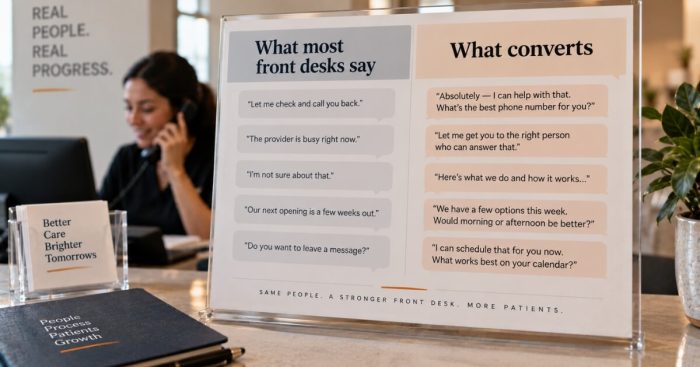
Almost always the first eight seconds of the phone call — specifically what your front desk does when a caller asks about hours or pricing.
The single most revealing question a prospective patient asks is, “what are your hours?”
It is almost never a question about hours.
It’s a person saying, “I want to come in, help me,” and they’ve reached for the least vulnerable question available.
What happens next determines whether they become a patient.
The failure sounds like this: “We’re open eight to five, Monday through Friday.”
The caller says thank you.
The front desk says you’re welcome.
Call ends.
Patient lost.
Nobody in the building knows it happened because, on the report, it looks like a call that came in and got answered.
What converts sounds like this: “Are you a new patient or a current patient?”
Then, for a new patient: “Great, let me welcome you to our office. Would morning or afternoon work better for you? Today or tomorrow?”
Two questions, a warm frame, and an assumptive close on the appointment.
Same eight seconds, completely different outcome.
Every question a caller asks should be answered briefly and then converted with a question.
Answer, then ask.
If your front desk only answers, they become an FAQ line and the caller controls the entire conversation.
How do I audit my front desk without standing over them?
Record inbound calls and score one thing at a time.
Start with the hours question.
Pull ten recorded calls and listen only for how each one handled a scheduling-adjacent question.
Score them pass or fail.
That’s it.
Not tone, not friendliness, and not seven categories on a rubric — one behavior.
Coaching a single behavior works. Coaching a person on their overall phone presence does not.
Then be realistic about the ceiling.
Roughly one clinic in twenty has a genuinely gifted salesperson at the front desk, and those practices win with or without help.
Everyone else is working with a good, well-intentioned person who is average on the phone.
That means the job of marketing is to generate demand strong enough that an average communicator still converts.
That’s the honest version of the strategy: make it so patients are effectively beating down the door, so a five-out-of-ten conversation still ends in a booking.
That’s not a knock on front desk staff.
It’s an argument for scripts, recorded-call coaching, and not building a growth plan that depends on hiring a unicorn.
A pain management practice we work with grew monthly revenue by more than $40,000 while improving team retention — retention and scripting compound together because a team that stays gets better at the same twelve conversations.
FAQ’s About Google Business Profile Call Benchmarks for Clinics
How many calls per month should a healthy Google Business Profile produce for a clinic?
At least 50 organic calls per location per month, with paid ad-driven calls excluded.
That’s a floor rather than a goal.
Below it, the listing usually has a structural problem. That could be the wrong primary category, a thin service list, few photos, stale reviews, or poor local pack visibility for the searches that matter.
How many website clicks should a clinic’s Google Business Profile generate?
At least 100 per location per month, excluding ads.
Calls and clicks measure different intents.
Calls are patients ready to talk. Clicks are patients researching.
Tracking both tells you whether a weak result is a listing problem, a website problem, or a phone-handling problem.
Should paid ad calls count toward my Google Business Profile benchmark?
No.
Ad-driven calls can substantially inflate a profile’s call count and mask a weak organic listing.
That can lead owners to stop investing in an asset that would keep producing after the ad budget stops.
Report organic and paid separately from the start.
What should I fix first on an underperforming Google Business Profile?
Primary category first because it determines which searches you can appear in at all.
Then the service list, photos, review recency and response rate, weekly posts, and finally hours and information accuracy.
Most clinics skip the service list entirely.
It is one of the cheapest relevance signals available.
What should my front desk say when a caller asks about our hours?
Answer briefly, then convert with a question.
A workable script: “Are you a new patient or a current patient?”
Then, for a new patient: “Great, let me welcome you to our office. Would morning or afternoon work better for you? Today or tomorrow?”
The hours question is rarely about hours.
It’s usually a patient saying they want to come in.
What’s the next step?
If you’ve never measured your Google Business Profile against a benchmark, pull last month’s numbers for each location right now.
Look at organic calls and website clicks, with ads excluded, and compare them to 50 and 100.
That comparison alone will tell you whether your problem is visibility or conversion.
On a 60-minute strategy call, we’ll review each location’s profile against the benchmark.
We’ll identify which of the six fixes applies to yours and listen to how your inbound calls are actually being handled.
Most practices find the gap is not where they assumed it was.