
How Long Does SEO Take to Work for a Regenerative Medicine Clinic?
Ten weeks after launch, one cash-pay regenerative medicine practice in West Fargo, North Dakota had logged 66,200 organic clicks, 5.14 million impressions and an average search position of 4. Not twelve months. Ten weeks. The number every practice owner has been told — “SEO takes about a year” — is a national average built from national competition, and it says almost nothing about a defined geography, a cash-pay niche and a research-heavy patient. The catch is that results arrive in a fixed order, and revenue is last in line. Here’s how long SEO actually takes for a regenerative medicine clinic, and what the ramp looks like month by month.
How long does SEO take to work for a regenerative medicine clinic?
In a defined local market with a cash-pay niche, the first measurable movement can show up in weeks, not months.
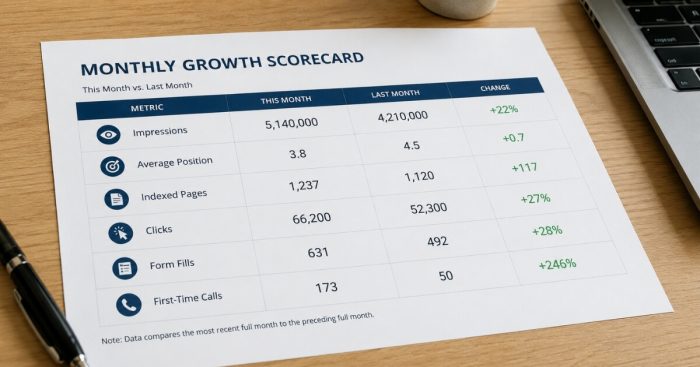
At Everest Regenerative Medicine, ten weeks from launch produced 66,200 organic clicks, 5.14 million impressions and an average search position of 4.
Be precise about what that does and does not mean.
It does not mean 66,200 people wanted an injection in West Fargo. Instead, the site was answering a large volume of question-shaped searches.
Patients wanted to know what a treatment costs, whether it hurts, how long recovery takes, and whether it works for a specific joint.
Google decided this site was the best available answer often enough to put it near the top of the page.
Volume like that can arrive quickly because few competitors in the niche are fighting hard for those questions.
Clinics compete for “stem cell therapy near me.” Meanwhile, they ignore the two hundred questions a patient asks before ever typing that phrase.
The twelve-month rule of thumb comes from markets where that is not true.
Think national e-commerce, insurance, legal, or anything where a thousand well-funded sites fight over the same phrase.
Apply that benchmark to regenerative medicine marketing for cash-pay clinics and you get a badly wrong answer.
The competitive density is a fraction of those national markets, and the geography is bounded.
Instead, expect faster movement at the top of the funnel and a slower, more honest lag before that movement becomes deposits.
Leads can move inside ninety days in a bounded market like this. However, they follow the traffic rather than arriving with it.
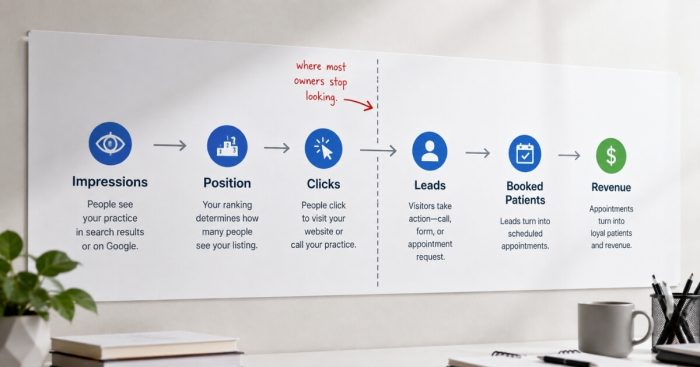
In what order do SEO results actually arrive?
SEO results arrive in a fixed order: impressions first, then average position, clicks, leads, booked patients, and finally revenue.
You cannot skip a stage or reorder it.
Impressions move first because Google is testing you.
The moment a page gets indexed, Google starts showing it for different queries, often on page three or four.
Nothing about that feels like a win.
Yet it is one of the most important early signals you have. Impressions tell you Google understands the topic and is willing to consider your page for it.
Average position moves next as those test placements either earn clicks or do not.
Clicks then follow position.
A page at position 14 is nearly invisible. Move that same page to position 4, and the situation changes dramatically.
The click curve is brutally steep. Therefore, moving up within page one can multiply traffic without adding a single new visitor to the internet.
Only after clicks do leads move. Booked patients follow leads, while revenue comes last.
Collections can trail the consultation by days or weeks. For a treatment plan or membership, the delay may be even longer.
At Everest, the same nine-month engagement that produced those SEO numbers took website leads from 5.5 a month to 54 a month.
Both things are true at once.
The traffic arrived early, while the lead number is a nine-month average that includes the quiet months at the start.
This is why owners quit in month three.
They watch the last number in the chain, see it flat, and conclude the program is broken while the earlier stages are moving correctly.
Marketing results arrive in a fixed order. Owners who watch only the end can miss what is happening upstream.
Why does it feel like nothing is working in months two and three?
It feels like nothing is working because the number most owners check — monthly collections — is mathematically the last one to move.
It is also the noisiest.
Think about how much has to happen before a dollar arrives.
Someone searches. Your page gets shown. It ranks well enough to earn a click.
Next, the visitor must trust the page enough to fill out a form or call.
Your front desk then has to answer, qualify, and book that person. The patient must show up and say yes to a cash-pay plan.
Each step has its own conversion rate. Each also takes real calendar time.
A form fill in week six can easily become a collected payment in week fourteen.
If your only instrument is the bank balance, you are reading a signal that is weeks stale. It is also blended with everything else happening in the practice.
Variance creates another problem.
A single high-ticket case can swing one month’s revenue enough to hide a genuine trend in either direction.
That makes monthly revenue a poor early diagnostic, even though it is the number that matters most at the end.
You can’t scale a practice you can’t measure.
During the first ninety days, however, the most important question is not whether revenue has moved. It is whether the four stages ahead of revenue are behaving correctly.
What does the month-by-month ramp look like — and what made this one fast?
A realistic ramp typically starts with technical setup in month one.
Impressions and indexing follow in month two. Position and clicks can move in months two through four, followed by leads in months three through six.
Revenue trails all of it by roughly another thirty to sixty days.
Month one is unglamorous, but it is where the timeline is won or lost.
The work includes crawlability, site speed, page structure, functioning tracking, and the first wave of content. Expect little visible movement.
Month two is typically when pages get indexed and impressions start climbing.
At this stage, you may see large impression counts against poor average positions. That is the correct shape.
During months two through four, average position typically compresses and the click curve starts paying you.
Ten weeks from launch falls at the front edge of that window. That is where a figure like 66,200 clicks becomes possible if the publishing cadence is heavy enough.
Months three through six are typically when form fills and first-time calls separate visibly from baseline.
Revenue follows rather than moving alongside them.
Now for the conditions that can make the ramp move this fast.
A domain with existing history starts with trust already banked rather than from zero. Therefore, a brand-new domain should expect a slower climb in average position.
A site rebuilt for conversion before traffic arrives also puts clicks onto pages designed to generate form fills instead of onto a brochure.
Finally, a heavy publishing cadence creates more opportunities to rank for question-shaped searches. That is what can push impression volume into the millions rather than the thousands.
Results also reflect the practice’s own clinical quality and sales execution, not marketing alone.
A brand-new domain in a saturated metro with three competitors already publishing weekly will take longer. Anyone who says otherwise is selling.
The ordering itself is not unique to one practice.
Orthobiologics Associates generated $309,590 in cash-pay revenue in 10 months from SEO with zero ad spend — the same sequence playing out over a longer window.
Which leading indicators should you define before you start?
Define five leading indicators before launch: impressions, average position, indexed pages, organic clicks, and form fills plus first-time calls.
Then review them on the same day every month so you grade the stage you are actually in.
Impressions and indexed pages are your month-one and month-two report card.
If impressions remain flat after thirty days of published content, something may be technically wrong. Find it now rather than in month seven.
Average position becomes your month-two through month-four report card.
For example, a page moving from position 22 to 9 is progress even if it has not produced meaningful traffic yet.
Organic clicks are your month-three check.
By months four and five, focus more heavily on form fills and first-time calls.
Those calls must be tracked separately from total call volume.
Total inbound calls include refill requests, billing questions, and existing patients. As a result, a practice can look busy while new-patient demand remains flat.
At Everest, the separation mattered.
First-time patient calls went from 50 to 173 a month across the 9-month engagement while total inbound calls rose by a comparatively modest 44%.
Write the target for each indicator down before you begin.
A benchmark set after the fact is not a benchmark. It is a rationalization.
Review the numbers monthly rather than weekly. Weekly SEO data is mostly noise, while monthly reviews are frequent enough to catch problems when they are still cheap to fix.
Together, these indicators show whether the program is working before revenue moves.
Climbing impressions in month two, improving positions in month three, and rising clicks in month four can show that the system is progressing even if the bank account has not noticed yet.
Apply the same discipline across every channel and you have a patient acquisition system: defined leading indicators, reviewed on a schedule, with someone accountable for each number.
Do I need to rebuild my website before starting SEO?
In most cases, yes. It is also one of the biggest levers on how quickly the ramp pays.
Traffic landing on a site built as a brochure converts at a fraction of traffic landing on pages designed to produce a form fill.
That gap does not appear in your impression counts or average position. Those stages can move either way.
Instead, a weak site quietly costs you at the handoff between clicks and leads. That is the one stage most owners never instrument.
Rebuilding first also lets you address crawlability, site speed, page structure, and tracking in the same pass.
As a result, early indexing can move quickly rather than stalling for a quarter.
The sequencing matters as much as the decision.
Rebuild while impressions are still the number you are grading, not after clicks are already arriving.
A rebuild during month four means you are throwing away traffic you just spent three months earning.
So if you are going to rebuild, do it in month one alongside the technical setup.
Then let the first wave of content land on pages already built to convert.
Should I run Google Ads while SEO is ramping?
Usually, yes.
Ads buy you demand during the exact months when organic traffic is still moving through impressions and position.
The problem with the SEO ramp is the gap between the stages that move early and the stage that pays.
Ads can help close that gap.
They provide a controllable lead flow to keep the schedule full through months one to four.
That is also the period when owners often talk themselves out of a working SEO program because collections have not caught up yet.
Running both channels means you are not betting the practice’s cash flow on one channel during its quietest phase.
There is also a second benefit, and it is arguably the bigger one.
Ads tell you which offers and messages convert within days rather than months.
That gives you useful information before committing a heavy publishing cadence to those topics.
Learn what patients respond to through paid traffic. Then point your content at those interests.
That is far cheaper than writing six months of pages around positioning you have never tested.
Ready to see what your clinic’s SEO ramp would actually look like?
This is for cash-pay practice owners who are somewhere inside the ramp right now.
You may be a few months in, watching collections, and wondering whether the program is behind schedule or exactly where it should be.
SEO for a cash-pay clinic is not slow. It is sequenced.
Impressions come first, followed by position, clicks, leads, booked patients, and revenue.
Judge the program based on the stage you are actually in.
On a 60-minute strategy call, we look at where your practice sits in that sequence.
We examine what your site is getting shown for and where it ranks. Then we determine whether your pages are built to convert the traffic you already have.
We also look at how first-time patient calls and form fills are tracked separately from total call volume.
From there, we map a realistic month-by-month ramp for your domain, metro, and competitive density.
That includes an honest assessment of whether your practice is likely to move faster or slower than the case above.
You leave with the leading indicators written down and a target for each one.