
How a Local Men’s Health Clinic Competes With Hims for TRT Patients (Without Outbidding Them)
On a strategy call with a men’s and women’s health clinic we consult with in Mississippi, the owner named the problem every local TRT clinic faces.
The national telehealth brands have effectively unlimited ad budgets — as he put it, Hims “has figured out how to sell a generic drug at a thousand percent profit margin.”
You will not win a bidding war against that.
Here’s the playbook we’re running instead: real budgets, real cost-per-click numbers, and a keyword flank the big brands can’t follow you into.
Can a local TRT clinic actually compete with Hims on Google Ads?
Yes — but not by bidding harder on the same keywords.
You compete by going around them.
On this clinic’s Google campaign, the obvious high-intent keyword — “TRT near me” — was eating the budget alive.
It cost roughly $15 a click, which at a $50 daily budget buys only three clicks a day.
We call those “one-click wonders.”
Meanwhile, adjacent searches cost closer to $5 a click, and the national brands aren’t touching them.
The move isn’t abandoning high-intent terms entirely.
It’s refusing to let them consume the whole budget while cheaper, unclaimed demand sits next door.
That’s the core discipline of men’s hormone clinic marketing for a local practice: find the demand the giants ignore and own it at a fraction of the cost.
What keywords should a men’s health clinic bid on instead of “TRT near me”?
“Primary care for men” — because almost nobody is marketing it, and it’s what a surprising share of your patients actually want.
The insight came from the clinic’s own patient base.
At patient number 20 in their newest location, the owner noticed something: “at least a third of our patients probably aren’t even getting testosterone.”
They’re managing diabetes and getting checkups.
As the owner put it, “people want a doctor… in a place that’s tailored for men.”
The TRT keyword war ignores those men completely.
So the play is a separate ad group on men’s primary care keywords, where clicks run around $5 because nobody’s bidding.
It’s also a place where Hims — a telehealth pill brand, not a doctor’s office — structurally cannot follow.
The local clinic’s unfair advantage is being an actual place with an actual physician.
The keyword strategy simply points the ad budget at the demand that advantage wins.
How much should a cash-pay men’s clinic spend on paid ads?
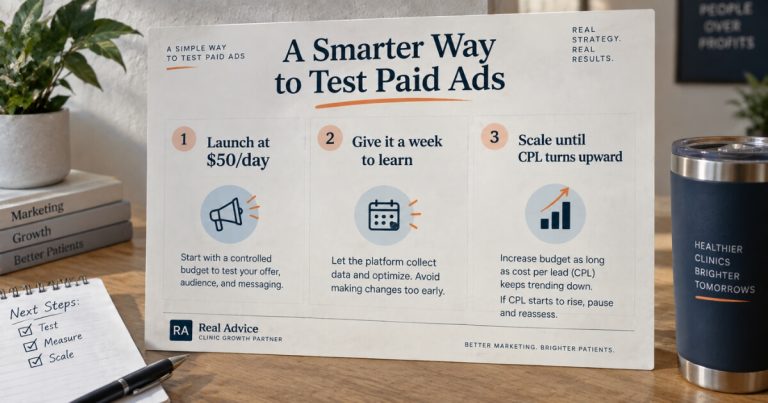
This clinic runs $50 a day per campaign — about $1,500 a month per platform.
And it treats the first week as a learning period, not a verdict.
When the Madison campaign launched, it spent $100 over two days with zero leads.
That’s normal: “It’s just learning. Give it a week or so.”
Owners who panic and rebuild campaigns after 48 hours never let the algorithm find their buyers.
The scaling rule is one metric: keep increasing spend until the cost per lead goes up rather than down.
Rising CPL means the local market’s active demand is saturated for now.
At that point, put the next dollar into a new campaign, platform, or market instead.
The clinic’s endgame makes the point: five ad campaigns, each generating 10–12 new patients a month.
Then those campaigns are ready to be dropped into every new location as a replicable system.
Should a men’s clinic run the same ads on Facebook and TikTok?
Yes — identical creative on both, three to five short videos per campaign, so the platforms compete on data.
This clinic’s plan is to film 3–5 short videos from prepared scripts.
They’re not read verbatim — “the stories that the scripts tell are real stories.”
Then run the same set on Meta and TikTok at matching budgets and let performance decide.
One structural note in TikTok’s favor for health brands: it’s significantly more lenient about what you can and can’t say in ads.
That’s a real constraint for hormone and weight-loss claims on Meta.
Paid social for high-ticket cash-pay services is proven when the offer and follow-up are right.
We generated $2 million in revenue from Facebook ads for an orthopedic surgical practice with exactly this test-creative-and-scale discipline.
What happens to ad leads if the follow-up system is broken?
They evaporate — and the clinic blames the ads.
Before the ad budget question even came up, this clinic found a list of men whose labs qualified them for treatment.
They received one text message that then got archived.
Nobody followed up, and none of them came in.
The fix was an automated “text-text-call” sequence in the CRM: instant text on inquiry, second text after 24 silent hours, then a human phone call as the third and final touch before moving on.
That system is the difference between ads that “don’t work” and a patient acquisition machine that converts the demand you’re already paying for.
This is the same lesson behind every clinic we’ve scaled.
The ads buy the lead.
The follow-up buys the patient.
FAQ’s About Competing With Hims and Marketing a Local TRT Clinic
How can a small TRT clinic compete with Hims and other telehealth giants?
By refusing the bidding war.
National brands own expensive high-intent keywords like “TRT near me” — roughly $15/click in this clinic’s market.
A local clinic wins by building ad groups on adjacent, nearly-free demand.
In this case, “primary care for men” costs around $5/click.
Then lean on the one asset telehealth can’t copy: a real physician in a real place tailored for men.
Why is my new Google Ads campaign getting no leads?
If it’s days old, it’s learning.
This clinic’s new campaign spent $100 in its first two days with zero leads, which was expected.
Give a new campaign about a week before judging it.
Rebuilding campaigns every 48 hours resets the learning and guarantees poor results.
When should a clinic stop increasing its ad budget?
When the cost per lead goes up rather than down as spend rises.
That’s the saturation signal.
The market’s active demand is spoken for, and the next dollar belongs in a new campaign, platform, or location rather than the same auction.
Should my clinic advertise on TikTok or Meta?
Run identical creative on both and let the data decide.
This clinic launched both at $1,500/month each.
TikTok’s practical advantage for men’s health is that it’s significantly more lenient about health-related ad claims than Meta.
How many times should we follow up with an ad lead?
Three automated touches: a text the moment the inquiry arrives, a second text after 24 hours of silence, and a human phone call as the final attempt.
After that, move on.
And make sure no qualified lead ever dies in an archived inbox.
That’s exactly how this clinic was losing lab-qualified patients before the system existed.
What’s the next step?
If you own a men’s health or TRT clinic and you’re watching national brands outspend you on every obvious keyword, book a strategy call.
In 60 minutes, we’ll map your market’s keyword arbitrage — what the giants are overpaying for, what they’re ignoring, and what your follow-up system needs before you scale a dollar of spend.