
How a CRM Can Transform Your Cash-Pay Healthcare Business (From Spreadsheet Tracking to a $4M Practice)
“I was literally keeping things on a spreadsheet of how to track and how to follow up with patients.”
That’s how one of the fastest-growing hormone clinics we’ve ever worked with was running its patient follow-up.
Years later, the same owner said of the CRM that replaced it: “We would never have survived without it.”
Here’s the FAQ on what a CRM actually does for a cash-pay healthcare business — and why it’s usually the difference between a practice that plateaus and one that scales.
What does a CRM actually do for a cash-pay healthcare business?
It puts every lead, every patient, and every follow-up task in one system that runs whether or not anyone remembers to check the spreadsheet.
A CRM (customer relationship management platform) tracks each inquiry from the moment it comes in.
It records which ad or search result generated the inquiry, whether anyone called back, and what was said.
It also tracks when the next touch is due and whether the person booked, showed, and paid.
In a cash-pay practice, that matters more than in an insurance practice.
That’s because every patient chose to spend their own money.
And the clinic that follows up first and follows up consistently is usually the clinic that gets them.
The owners of Eternity Health Partners, an HRT clinic, described the before-and-after in one sentence.
They were tracking patient follow-up on a spreadsheet.
We told them, “no problem — we’re going to build you a CRM.”
And in their words, “that was a huge game changer… we would never have survived without it.”
Why isn’t a spreadsheet enough to track patient follow-up at a growing clinic?
Because a spreadsheet only knows what someone remembers to type into it.
And it never reminds anyone to do anything.
A spreadsheet has no automation.
It doesn’t fire a text to a new lead within five minutes.
It doesn’t assign a follow-up task when a consultation no-shows.
It also doesn’t show the owner how many inquiries came in this week, where they came from, or how many became paying patients.
At 10 leads a month, a diligent front desk can fake it.
At 60, things start slipping through the cracks.
And in cash-pay medicine, a slipped lead isn’t just a lost co-pay.
It’s potentially a lost $1,000-a-month membership or a lost $5,000 treatment package.
The failure mode is invisible.
The clinic keeps generating leads, the spreadsheet keeps growing, and nobody can say which leads died or why.
That’s why we treat the CRM as the foundation of a predictable patient acquisition system.
It’s not an optional upgrade you add after marketing works.
It’s part of why marketing works.
How did a CRM help a hormone clinic grow from $1M to $4M a year?
By making follow-up and patient tracking a system instead of a memory.
That way, the clinic could absorb more volume without dropping patients.
As inbound volume climbed to around 60 new patient calls and 40 website leads a month, every inquiry landed in a pipeline.
Each one had a defined next step, an owner responsible for that step, and a timestamp.
That’s the part most clinic owners miss.
The growth story wasn’t simply “more marketing.”
It was that when more marketing came, nothing leaked.
Doubling lead flow into a spreadsheet mostly doubles the number of leads that fall through the cracks.
Doubling lead flow into a working CRM doubles revenue.
What should a cash-pay clinic track inside its CRM?
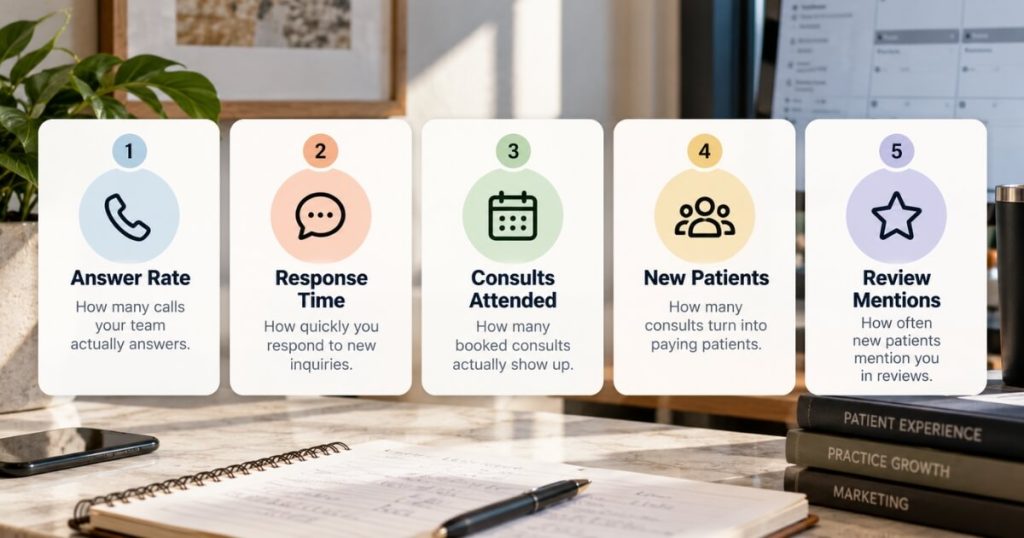
Five things, at minimum: lead source, pipeline stage, next follow-up task, show rate, and patient value.
Lead source tells you which marketing channel is actually producing paying patients, not just clicks.
Pipeline stage tells you where people stall.
The stages should follow the patient journey:
New inquiry → Contacted → Booked → Showed → Paid → Member.
Next, every follow-up task needs a due date and an assigned person.
That single field separates clinics that convert from clinics that simply “stay busy.”
Show rate exposes whether your booking process is working or leaking.
And patient value — what each patient has actually paid — connects the whole system back to revenue.
Set up this way, the CRM feeds the weekly numbers review in about thirty minutes.
That review should include cost per acquired patient, inquiry-to-paid conversion, average revenue per patient, churn, and net new patients.
If you can’t pull those numbers in half an hour, the practice doesn’t just have a tracking problem.
It has a system problem the CRM hasn’t been built to solve yet.
Do I need a CRM before spending more on marketing?
Yes. Spending more on marketing before follow-up is systematized mostly buys you more leaked leads.
This is the order-of-operations mistake we see most in cash-pay medicine.
The owner feels the plateau, assumes it’s a lead problem, and increases ad spend.
Meanwhile, inquiries are still being tracked by hand.
The extra spend produces more inquiries, but manual follow-up becomes overwhelmed.
As a result, conversion drops, and the owner concludes, “ads don’t work for my clinic.”
The ads were fine. The bucket had holes.
The reverse order is what produces outsized returns.
That’s a conversion rate that’s only possible when every lead is tracked, tasked, and followed up on schedule.
Fix the system first, and every marketing dollar afterward works harder.
It’s the same sequencing we apply across all of our medical practice marketing engagements: infrastructure first, then fuel.
Should I build a custom CRM or buy an off-the-shelf one?
Buy the platform; build the configuration.
The value isn’t in the software itself. It’s in the pipelines, automations, and scripts configured around how a cash-pay practice actually converts.
Generic CRM software doesn’t know what a hormone consultation is or how a membership works.
It also doesn’t know that a lead who filled out a quiz at 9 p.m. should receive a text within minutes.
What transformed Eternity Health Partners wasn’t the logo on the login screen.
It was a CRM configured around their patient journey.
That included automated speed-to-lead responses and follow-up task sequences for the front desk.
It also included pipeline stages matching how their patients actually buy and reporting the owners could review on a Friday.
So the real question isn’t build versus buy.
It’s whether the person configuring the system understands cash-pay patient behavior.
A well-configured mainstream platform beats a custom-coded system and an unconfigured “best” platform every time.
FAQ’s About CRMs for Cash-Pay Medical Practices
What is a CRM in a medical practice context?
A CRM is the system that tracks every lead and patient relationship.
It records where each inquiry came from, every call and text, each person’s current stage, and the next follow-up step.
It manages the revenue side of the practice: turning inquiries into booked, paying, and returning patients.
Can a CRM replace my EMR?
No. They do different jobs.
The EMR holds clinical records and charting.
Meanwhile, the CRM manages leads, follow-up, scheduling flows, and marketing communication.
A cash-pay practice needs both.
And the practices that scale keep the CRM as the front-of-house system feeding the EMR, not the other way around.
What’s the first sign a clinic has outgrown spreadsheet tracking?
When nobody can say how many leads came in last week and what happened to each one.
If answering that takes more than a few minutes, follow-up is already leaking.
The same applies when the answer depends on one person’s memory.
And that leak grows with every new marketing dollar.
Will my front desk actually use a CRM?
Yes, if it assigns clear tasks instead of adding data entry.
The test of a good CRM build is whether the front desk opens it to know what to do next.
That includes which leads to call and which patients to rebook.
Staff should use the CRM to guide their work, rather than filling it out afterward just to satisfy the owner.
Does a CRM help with patient retention or just new leads?
Both.
The same automation that follows up with a new inquiry can flag a member whose visits are slipping.
It can also trigger reactivation campaigns for lapsed patients and schedule follow-up sequences after treatment.
In membership-model clinics, that’s where most of the lifetime value lives.
What’s the next step?
If your practice is still tracking leads and follow-up on a spreadsheet — or you have a CRM that nobody actually uses — book a strategy call.
In 60 minutes, we’ll map your patient journey from first click to paying patient.
We’ll show you exactly where leads are leaking today.
Then, we’ll lay out the CRM pipeline, automations, and follow-up cadence we’d build for your specialty.
It’s the same foundation we built before scaling an HRT clinic from $1M to $4M.