
The Hardest Part of Scaling a Profitable Medical Practice: Hiring Another You (And Why It Happens Around $100K a Month)
There’s a specific moment in every successful cash-pay practice when growth stops being about getting more patients.
Instead, it becomes about something much more uncomfortable.
You’re the provider. You’re profitable — probably around $100K a month.
And the next move is to take a piece of those profits and hire another you.
Here’s why that step is the hardest one in the entire scaling journey, and how to get through it without stalling.
What is the hardest part of scaling a profitable medical practice?
Hiring another you.
That means finding a second provider talented enough to deliver your standard of care.
And then paying for that provider out of profits you’ve gotten used to keeping.
This challenge usually appears around the $100K-a-month mark.
The practice is highly profitable, and the owner is still the main provider.
Meanwhile, every additional patient has to fit into the owner’s schedule.
At that point, the constraint isn’t leads, advertising, or the front desk.
It’s provider capacity.
And the only way to increase that capacity is to hire expensive clinical talent.
That’s why plenty of practices remain at this plateau for years.
The move that unlocks the next stage is also the one that feels the worst to make.
Spending more on marketing feels productive.
Hiring another provider feels risky.
But only one of those decisions actually raises the ceiling when your schedule is already full.
Why does hiring a second provider feel so uncomfortable even when you’re profitable?
Because it’s a double hit.
You put less money into your bank account, and you’re not sure the new provider will deliver the same results for patients.
That’s the exact discomfort, and both sides deserve attention.
First, there’s the financial concern.
You want to hire talented clinical professionals.
But talented providers are expensive.
As a result, the monthly profit you’ve gotten used to keeping shrinks as soon as the new provider starts.
Then, there’s the clinical concern.
And for many owners, that’s even scarier.
You’ve built your reputation on your patient outcomes.
Now, you’re trusting someone else to deliver those same results.
That’s incredibly uncomfortable.
So what do most owners do?
They delay the hire.
Unfortunately, that quietly turns the practice into a very well-paid job with a hard growth ceiling.
The owners who break through this stage treat the temporary profit dip as tuition, not a loss.
Every one of those hires was a bet that patient outcomes could be systematized.
And every one paid off.

When is a cash-pay practice actually ready to hire another provider?
When the practice is consistently profitable enough that a portion of its profits can cover the hire.
For many cash-pay practices, that happens around $100K a month in revenue.
The math is the readiness test.
If you’re generating roughly $100K a month and maintaining healthy profits, you may be able to fund a quality provider.
And you can do it without betting the entire business.
What you’re really buying is capacity and freedom.
You’re buying the ability to stop seeing every patient personally.
That gives you more time to focus on running and growing the business instead of working inside it.
However, timing matters.
If you hire before sufficient patient demand exists, you’ve added expensive payroll without enough work to support it.
But if you wait too long, growth becomes limited by your personal calendar.
And no amount of medical practice marketing can push patients through a schedule that has no available appointments.
Demand generation and provider capacity have to grow together.
Unfortunately, capacity is usually the half that owners postpone.
Why do you need a second additional provider soon after the first?
Redundancy.
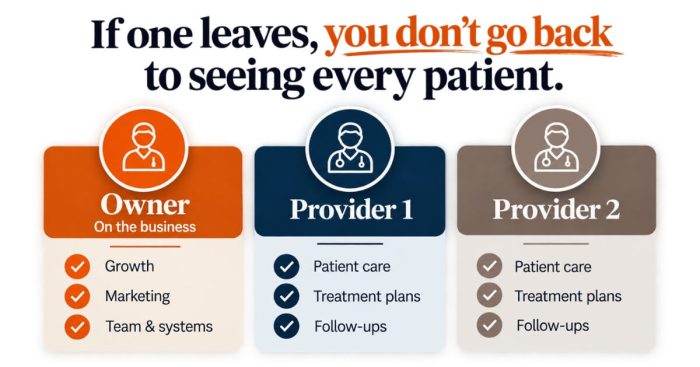
If your only other provider leaves for any reason, you’re right back to seeing all the patients yourself.
This is the part almost nobody plans for.
You fight through the discomfort of hiring your first additional provider.
Then, you finally step out of the clinical schedule and experience some freedom.
But now you’re one resignation away from losing all of it.
That’s why the real move is going from having one additional provider to having another one relatively quickly.
Two providers besides you create operational redundancy.
If one leaves, the departure becomes a hiring problem rather than an existential business problem.
But with only one provider besides you, a two-week resignation notice can change everything.
Suddenly, you’re back in every exam room.
And the business development work you finally had time to do comes to a stop.
That’s not much fun.
More importantly, it’s avoidable.
Treat your second additional provider hire as part of the same project as your first.
Don’t leave it as something you’ll think about someday.
How do you protect patient outcomes when you stop being the main provider?
Hire for talent, document your protocols, and continue owning the standard of care even after leaving the clinical schedule.
The fear that “nobody will deliver my result” is legitimate.
But it’s also solvable.
You hired expensive clinical talent precisely because you want to maintain a high standard of care.
Now, your responsibility begins to change.
Instead of personally delivering every patient outcome, you need to define and monitor the standards your providers follow.
That means implementing written clinical protocols, regular chart reviews, outcome tracking, and ongoing case discussions.
These systems help ensure patients receive consistent care, regardless of which provider they see.
The owner who leaves the clinical schedule doesn’t abandon quality.
Instead, they move from delivering care one visit at a time to overseeing it across the entire practice.
That’s a fundamental shift in how the business operates.
And it’s what allows a clinic to grow beyond the owner’s personal capacity.
The outcomes held because the standard of care became systematic rather than dependent on one person.
FAQ’s About Hiring a Second Provider at a Cash-Pay Practice
What revenue level justifies hiring another provider at a cash-pay practice?
Around $100K a month in consistently profitable revenue.
At that level, a portion of the practice’s profits can often fund a quality clinical hire without endangering the business.
However, revenue alone isn’t the deciding factor.
The practice also needs enough patient demand to support another provider.
When the owner’s calendar is full and demand continues growing, provider capacity usually becomes the main constraint.
That’s when hiring another provider can unlock the next stage of growth.
Why do profitable practice owners delay hiring a second provider?
Two reasons.
First, hiring another provider visibly reduces the owner’s monthly take-home profit.
Second, owners worry that the new provider won’t deliver the same patient outcomes.
Both concerns are legitimate.
However, delaying the decision can turn a profitable medical practice into an owner-dependent job with a fixed ceiling.
The longer you wait, the longer your personal schedule limits the business.
How many providers does a cash-pay practice need before the owner can step back?
At least two additional providers besides the owner.
One provider gives you freedom.
Two give you insurance.
If your only additional provider leaves, you’re suddenly responsible for seeing every patient again.
And the time you gained to work on the business disappears.
That’s why you should plan the second additional hire as part of the same growth project as the first.
The goal isn’t simply to replace yourself temporarily.
It’s to build a practice that can operate without depending entirely on your clinical schedule.
Does hiring providers mean the owner stops influencing clinical quality?
No.
The owner’s role shifts from personally delivering care to overseeing the standard of care.
That includes documenting protocols, reviewing charts, tracking patient outcomes, and discussing cases with the clinical team.
These systems help maintain consistency as the practice adds providers.
For example, Dr. Joy Kong added four doctors while continuing to grow her regenerative medicine practice.
The key is making clinical quality a repeatable system rather than something only the owner can deliver.
Should I spend on marketing or a provider hire first?
It depends on what’s limiting your growth.
If your schedule is full and you’re personally handling every patient, provider capacity should come first.
Spending more on marketing won’t help if there’s nowhere to book the additional patients.
However, if a new provider would sit idle because patient demand is too low, focus on building demand first.
At the $100K-a-month plateau, provider capacity is often the bigger constraint.
The goal is to scale marketing and clinical capacity together so neither becomes a bottleneck.
What’s the next step?
If your practice is profitable, generating around $100K a month, and you’re still personally seeing every patient, your next stage of growth requires a structural decision.
Not just another marketing campaign.
Book a strategy call, and we’ll run the capacity math with you.
We’ll map the provider hiring timeline, including the redundancy hire most owners never plan for.
Then, we’ll show you how demand generation should support those hires.
The goal is to fill your new provider’s schedule as quickly as credentialing allows, without putting unnecessary pressure on your existing team.