
How Do I Grow Revenue at My Regenerative Medicine Clinic When Nobody’s Searching for PRP or Stem Cells? (The PRP Gateway and Outcome-Based Ad Strategy)
Regenerative medicine has a strange marketing problem: the treatments work, but almost nobody searches for them by name, and the ad platforms won’t let you bid on the terms that do get searched. So clinics rank #1 for “PRP” in their city, generate plenty of visits, and still watch revenue sit flat because patient flow and revenue are two different things.
This is the FAQ on growing a regenerative clinic anyway, drawn from a performance review where the answer wasn’t more traffic. Instead, it was converting existing traffic, advertising the outcome instead of the modality, and using a low-cost entry offer to manufacture demand.
How do I grow revenue at my regenerative medicine clinic when patient flow is up but revenue is flat?
Focus on converting the patient flow you already have into higher-value treatments.
Patient growth alone doesn’t automatically increase revenue.
For example, one regenerative clinic experienced significant year-over-year growth in first-time visits.
January increased from 22 to 31 visits.
February climbed from 13 to 36.
March rose from 18 to 35.
Despite that increase in patient volume, overall revenue remained relatively flat.
That pattern points to a conversion problem rather than a demand problem.
Specifically, high-ticket services such as stem cell procedures, body contouring, hair restoration, and orthobiologic treatments weren’t converting at the pace the additional traffic should have produced.
Instead of measuring visit count alone, track revenue per patient.
Then build a deliberate patient journey that guides new patients toward higher-value services.
More patients only create more revenue when a predictable percentage move up the value ladder.
That’s the foundation of effective regenerative medicine marketing.
Can I run Google Ads for PRP, stem cell, or peptide therapy?
Usually not.
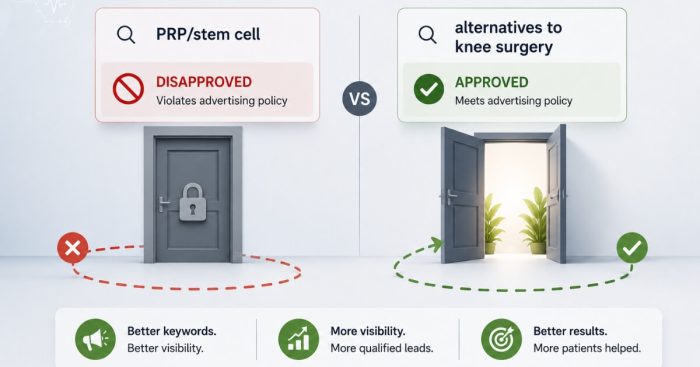
Because these treatments fall into FDA-sensitive categories, Google frequently restricts advertising for terms such as “PRP” and “stem cell therapy.”
Fortunately, there’s a better strategy.
Advertise the outcome instead of the treatment.
Rather than bidding on the procedure itself, target the problems patients actually search for, including:
- Non-surgical knee treatment
- Alternatives to knee surgery
- Alternatives to ACL surgery
- Alternatives to MCL surgery
- Alternatives to PCL surgery
Next, send those visitors to a landing page focused on pain relief rather than regenerative science.
For example, a message like “Stop letting pain get in the way of what you love” connects much more naturally with patient intent than an explanation of orthobiologics.
Before launching the campaign, expect Google’s review process to take additional time.
FDA-sensitive categories almost always receive manual approval.
Ultimately, the strategy is straightforward.
Patients rarely search for PRP.
Instead, they search for ways to avoid surgery.
Meet them where they are.
That’s also why pain management marketing overlaps so closely with regenerative medicine marketing.
Both approaches begin with the patient’s pain—not the procedure.
How do I create demand for regenerative medicine when nobody’s searching for the modality?
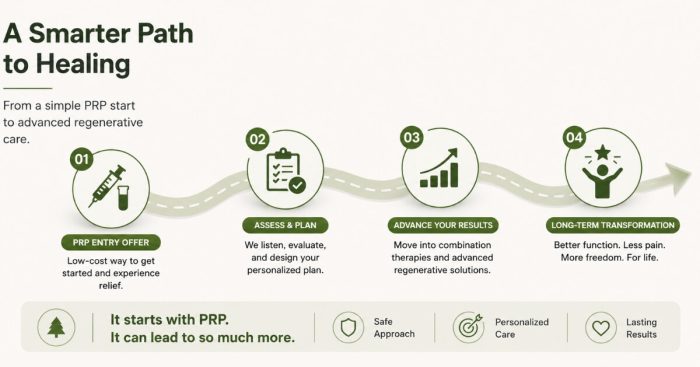
Create demand with a low-cost entry offer instead of waiting for patients to discover treatments they don’t yet understand.
A buy-one-get-one-free PRP joint injection works particularly well.
The economics make the offer attractive.
The materials typically cost around $150.
Once the patient’s blood has already been drawn and processed, providing a second injection requires very little additional time or expense.
As a result, PRP becomes an inexpensive gateway into the regenerative patient journey.
After patients experience results and develop trust, they’re much more receptive to higher-ticket recommendations.
Remember, most patients think about pain—not platelets.
That’s why demand often needs to be created rather than captured.
A gateway offer connects with the patient’s immediate problem.
From there, it opens the door to the broader range of regenerative services your clinic provides.
Instead of relying on FDA-restricted advertising, you’re building relationships that naturally progress toward higher-value care.
Why am I ranking #1 for my regenerative treatments but still not getting calls?
Because ranking first doesn’t automatically create demand.
In many cases, very few people search for the treatment name in the first place.
Regenerative clinics frequently rank at the top for keywords with extremely low search volume.
For example, one North Dakota market generated only about 10 monthly searches across the entire state for “peptides for joint pain.”
Some of those searches likely came from the clinic itself.
PRP-related keywords showed similarly limited demand despite holding the top organic position.
As a result, ranking #1 produced very few phone calls.
Before assuming your SEO should generate patients, verify actual search volume with a tool such as Google Keyword Planner.
Then compare those numbers with your expectations.
If search demand is minimal, shift your focus toward the outcome-based phrases patients genuinely search for.
Likewise, build entry offers that create demand directly instead of depending on treatment-name searches.
Ultimately, rankings only matter when real search volume exists.
Otherwise, a #1 position becomes a vanity metric rather than a revenue driver.
Which services should I advertise at my regenerative medicine clinic, and which should I avoid?
Focus your advertising budget on services with affordable clicks, strong buying intent, and a clear path to higher-value care.
At the same time, be cautious with services that generate expensive traffic.
For example, body-contouring campaigns often perform efficiently.
One clinic averaged approximately $4.66 per click.
Many patients also plan body-contouring procedures months in advance, making these campaigns worthwhile even during slower summer seasons.
Similarly, outcome-based joint-pain campaigns attract highly motivated patients looking for alternatives to surgery.
Those patients often become strong candidates for additional regenerative treatments.
Hair restoration tells a different story.
Clicks averaged around $15, with minimum bids near $6 and top-of-page bids approaching $25.
That means just four clicks can cost roughly $100.
Unless your close rate is exceptionally high, that advertising cost becomes difficult to justify.
Instead, allocate budget according to both click cost and downstream revenue potential.
Don’t spend heavily simply because you want a service to grow.
Also, don’t assume Meta advertising will solve a weak regenerative funnel.
In 2026, Meta has generally produced disappointing results for this category.
What numbers should I track to know if my regenerative clinic is actually growing?
Track productivity metrics first.
Then use activity metrics only when you need to diagnose a problem.
The numbers that matter most include:
- Leads booked
- Appointments attended
- Monthly revenue
Those measurements tell you whether the business is actually growing.
For example, if 22 leads produce five booked appointments, the booking number is the metric that deserves your attention.
The number of outbound calls only becomes useful when you’re trying to understand why productivity slowed.
Otherwise, activity metrics can create the illusion of progress while revenue remains unchanged.
Just as importantly, establish one consistent method for counting appointments.
Don’t mix new-patient visits with follow-up appointments or pull totals from different reports.
For example, one clinic discovered a discrepancy of 180 versus 229 appointments simply because two reports counted visits differently.
Consistent reporting makes month-to-month comparisons meaningful.
More importantly, it allows you to distinguish between a demand problem and a conversion problem.
That distinction determines which part of the business actually needs improvement.
FAQ’s About Growing a Regenerative Medicine Clinic
Should I keep my aesthetics ad campaign running through the slow summer?
Yes.
Keep it running.
Google Ads only spends your budget when people actively search, so slower months naturally produce lower spend rather than wasted money.
For example, one body-contouring campaign averaged a cost of approximately $4.66 per click while continuing to generate patients planning procedures for the fall.
Meanwhile, consider adding an outcome-based joint-pain campaign during the summer.
Doing so helps capture additional demand while aesthetic searches temporarily slow.
Do Meta ads work for regenerative medicine in 2026?
Generally, no.
Meta has become a relatively weak channel for regenerative medicine marketing.
The combination of FDA-sensitive topics and discovery-based targeting makes consistent performance difficult.
Instead, prioritize outcome-based Google Search campaigns and gateway PRP offers.
Treat Meta as an experimental channel rather than the foundation of your marketing strategy.
How does the PRP gateway offer lead to high-ticket revenue?
The gateway offer introduces patients to regenerative medicine through a low-cost first step.
Once patients experience positive results and begin trusting your clinic, they’re much more open to higher-value recommendations.
For example, a buy-one-get-one-free PRP joint injection costs relatively little to fulfill.
Material costs are approximately $150, and the second injection adds very little additional expense once the blood has already been processed.
The gateway builds trust.
Higher-ticket regenerative procedures generate the long-term revenue.
What does a strong regenerative conversion rate look like?
Strong regenerative clinics consistently convert qualified leads into booked, paying patients.
Most often, growth comes from improving the patient journey rather than generating additional traffic.
When clinics maintain a clean pipeline, respond quickly, and intentionally guide patients from an entry offer into higher-value services, the same traffic that once produced flat revenue begins producing measurable growth.
What’s the next step?
If your regenerative clinic is busier than ever but revenue hasn’t increased, the problem usually isn’t traffic.
Instead, it’s the gap between patient flow and patient value.
Focus on converting existing traffic into higher-ticket care.
Advertise the outcome instead of FDA-restricted treatment names.
Use an affordable PRP gateway offer to create demand.
Finally, stop chasing #1 rankings for keywords that almost nobody searches.
Those four changes consistently produce more revenue than simply buying additional clicks.
During a strategy call, we’ll review your patient flow, evaluate your high-ticket conversion rate, and assess your advertising strategy.
Then we’ll identify exactly where revenue is being left behind.
It’s the same process behind a regenerative clinic where we generated $309,590 in cash-pay revenue in 10 months at a 79.4% conversion rate and a pain and regenerative practice where we added more than $2 million in 10 months.