
Do Google Local Services Ads Work for a Cash-Pay Medical Practice? (Two Calls, Two Patients — and the Call Script That Converts Them)
On a weekly strategy call with a cash-pay weight-loss clinic, we pulled up their two most recent Google Local Services Ads calls. Both callers booked. Both showed. Both paid. Two for two — at roughly $100 a call. LSAs are one of the most underused channels in cash-pay medicine, partly because most clinics don’t know they qualify and partly because the budgets behave strangely. Here’s what we’ve learned running them, and the call-handling that turns the calls into members.
Do Google Local Services Ads work for a cash-pay clinic?
Yes.
When the calls are answered well, LSA leads convert at rates most channels can’t match.
In this review, the clinic went two-for-two:
- Two calls
- Two paying patients
Local Services Ads are the pay-per-lead units that appear above traditional Google Search Ads with the Google Guaranteed badge.
Unlike standard Google Ads, you don’t pay for clicks.
Instead, you pay for phone calls.
Because of that, the economics change completely.
A $100 call that books at your normal conversion rate can become one of the least expensive patients you’ll ever acquire.
For example, one of the callers we reviewed:
- Asked about weight-loss injections
- Booked an appointment
- Attended the visit
- Became a new member
Meanwhile, the second caller:
- Called twice
- Told the front desk, “I’ll be there in 30 minutes.”
- Arrived
- Paid
Ultimately, the channel rewards clinics that already answer the phone quickly and professionally.
That’s why we view LSAs as an amplifier for an existing patient acquisition system—not a replacement for one.
After all, if your calls go to voicemail, LSAs simply make voicemail more expensive.
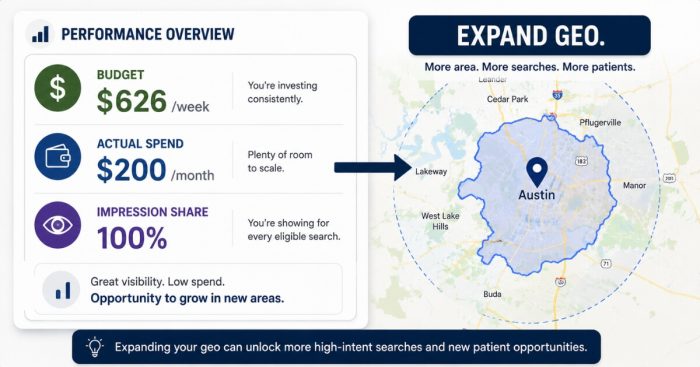
Why is my LSA budget barely spending?
Because you’ve already maxed out your impression share.
In other words, you’re showing for nearly every relevant search in your market.
The only remaining way to grow is to become eligible for more searches.
This clinic’s weekly budget was $626, or approximately $100 per day.
However, actual spend was only about $200 for the entire previous month.
Naturally, the owner’s first reaction was that something had to be broken.
The account data told a different story.
Both Top Impression Rate and Absolute Top Impression Rate were essentially maxed out.
As a result, the ads were already appearing:
- For the right searches
- At the top of the page
- Throughout the clinic’s service area
There simply weren’t additional searches available to purchase.
That’s very different from a traditional Google Ads account that refuses to spend.
Consequently, it also requires a different solution.
You can’t bid your way into more volume when you’ve already captured nearly every impression.
Instead, expand what you’re eligible to appear for, such as:
- Additional geographic areas
- More service categories
Understanding which situation you’re dealing with prevents unnecessary spending.
How do I expand LSA geography without wasting spend?
Expand into nearby suburbs your patients already travel from.
Skip markets that don’t fit.
Then review performance within days—not months.
During this strategy call, we expanded the clinic’s Local Services Ads coverage in real time.
Specifically, we added:
- Plantation
- Sunrise
- Sunny Isles
- Aventura
- Hallandale
- Hollywood
- North Miami
Each location passed two simple tests:
- Do patients realistically travel from there?
- Does the demographic fit a cash-pay offer?
By contrast, areas that failed either test—even if they were geographically close—were intentionally excluded.
The account already provided evidence that expansion made sense.
For example, before targeting Sunny Isles directly, the clinic had already received qualified callers from that area.
Therefore, when your impression share is already maxed out and your existing calls convert well, expanding geography becomes one of the safest growth opportunities.
As discussed during the call:
“If we were spending the budget, getting calls for $100, and booking at the same rate we’re booking now, that’s not a problem.”
After expanding, review the data within a few days.
Keep what works.
Then remove what doesn’t.
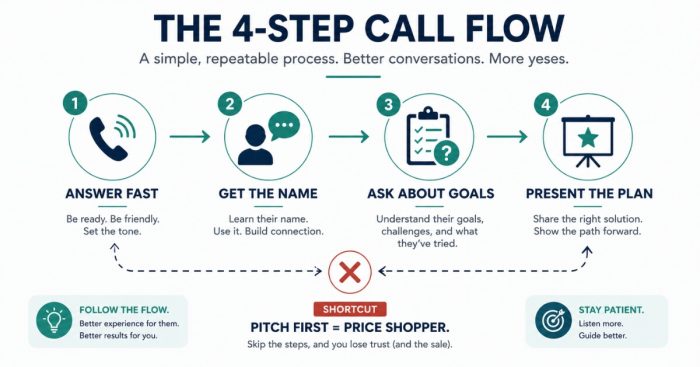
How should my front desk answer an LSA call about weight-loss shots?
Start by getting the caller’s name.
Next, learn their goals.
Only after that should you present the offer.
In short, control the conversation instead of pitching into it.
We reviewed an actual recorded call.
The caller asked:
“Do you offer weight-loss shots?”
The team member responded quickly.
His tone was excellent.
His enthusiasm was genuine.
His product knowledge was strong.
However, he then made the mistake that costs clinics the most money.
Rather than learning about the caller, he immediately began pitching.
He explained:
- Medication options
- B12 add-ons
- Supplements
- The full program
All before learning:
- The caller’s name
- Their situation
- Their goals
As a result, emotional buyers become logical shoppers.
Very quickly, the conversation turns into:
“Okay… how much is it?”
Now it’s a pricing conversation.
Instead, follow this sequence.
Begin with:
“Absolutely, we offer those — who am I speaking with today?”
Then move into discovery.
Ask questions like:
- Were you looking for semaglutide or tirzepatide?
- Would this be your first time taking it?
- What are you hoping to accomplish?
Your role is to guide the conversation.
Instead of acting like someone reading menu prices over the phone, position yourself as a weight-loss consultant.
The offer itself was already strong:
- Around $350 for the first month of semaglutide
- Blood work included
- EKG included
- First injection included
- B12 included
- Supplements included
- Around $475 for tirzepatide
Once the discovery process happens first, the offer is presented to someone who’s already invested in the conversation.
That’s the conversion layer of GLP-1 & weight loss clinic marketing.
The advertisement generates the phone call.
The discovery sequence converts the caller into a patient.
Even with the imperfect conversation we reviewed, the patient still booked, showed up, and paid.
Good offers can overcome imperfect calls.
They simply perform even better when the sequence is followed.
How do LSAs fit alongside Google Ads and SEO?
Think of LSAs as one of three local demand-capture layers.
However, all three depend on your operations being aligned behind them.
This clinic runs every channel simultaneously.
On Google Ads, we had just removed a group of keywords that were spending money and generating clicks without producing conversions.
When the landing page converts well and the offer is strong, non-converting keywords usually indicate searchers who simply aren’t ready to buy.
Therefore, those keywords came out.
One important note:
Holiday weeks—such as Black Friday—are the wrong time to evaluate paid advertising performance.
During those periods, advertising costs increase across nearly every auction.
Instead, allow campaigns to continue learning without making unnecessary changes.
Meanwhile, the clinic ranks #1 on SEO for a branded peptide search in its city.
That single ranking generated four inbound calls in one week.
Unfortunately, all four callers were turned away.
The reason was simple.
The provider on staff wouldn’t prescribe the treatment the website ranked for.
As a result, the real lesson became obvious.
Marketing and medicine have to sell the same menu.
Before scaling any acquisition channel, confirm your providers are willing to deliver exactly what your website and advertisements promise.
To solve the issue, the clinic brought on a physician who prescribes the complete program.
Multi-channel demand capture is how practices scale quickly.
For example, it’s the same architecture that helped a wellness medspa from zero to $6.7M added in one year with 3,727 new patients across paid channels.
Likewise, it’s the same discipline that allowed a regenerative practice book 79.4% of its leads without any ad spend at all.
FAQ’s About Google Local Services Ads for Clinics
How much does an LSA call cost for a medical practice?
Costs vary by market and service category.
However, approximately $100 per call is a realistic planning number.
When those calls convert into patients, they become one of the strongest cost-per-patient opportunities available in paid media.
In this example:
- Two calls
- About $100 each
- Two paying weight-loss members
As a result, that level of efficiency is difficult for most paid channels to match.
How is an LSA different from a regular Google Ad?
Local Services Ads operate on a pay-per-lead model.
By comparison, traditional Google Ads operate on a pay-per-click model.
LSAs:
- Charge when someone calls.
- Appear above standard search ads.
- Display the Google Guaranteed badge.
Traditional Google Ads send visitors to your landing page.
By contrast, LSAs send phone calls directly to your front desk.
My LSA budget won’t spend — is something broken?
Probably not.
First, check your impression share.
If you’re already appearing for nearly every relevant search within your service area, there simply isn’t additional search volume available to purchase.
Instead of increasing the budget, expand:
- Geographic coverage
- Service categories
Doing so creates additional opportunities for your ads to appear.
How do I track whether LSA calls become patients?
Import your LSA leads into your CRM on a regular basis.
Next, tag every lead by source.
Then listen to the recorded calls.
In fact, call recordings are one of the fastest coaching tools available because they reveal exactly where the front desk succeeds—or where the opportunity is lost.
What should the front desk never do on an inbound ad call?
Never pitch before discovery.
Instead, learn the caller’s name and goals first.
Quoting prices and explaining the full offer too early turns an emotional buyer into a logical price shopper.
The sequence should always be:
- Name
- Goals
- Offer
What’s the next step?
If your clinic isn’t running Google Local Services Ads—or they’re active but the budget won’t spend, and nobody has reviewed a recorded call in months—book a strategy call.
In 60 minutes we’ll:
- Check your LSA eligibility.
- Review your impression share.
- Map the geographic areas worth adding.
- Score one of your real inbound calls against the discovery sequence that converts.