
What’s a Good Return on Ad Spend for a Cash-Pay Clinic — and When Is It Safe to Scale?
A cash-pay clinic spent $2,700 on ads in a month and pulled in about $25,000—roughly ten dollars back for every dollar in. That’s the kind of number that makes owners want to pour money in, and also the kind that raises the real question: what’s actually a good return, and when is it safe to scale? This is the FAQ on reading your ad performance honestly, including why great returns come from the “boring stuff done right” and why ads expose your offer rather than fix it.
What’s a good return on ad spend for a cash-pay clinic?
A healthy target is several dollars back for every dollar spent, and it’s very achievable. Well-run cash-pay clinics can see returns as high as roughly 10:1 when the entire system is working together.
Here’s a real example.
A clinic spent:
- $2,700 on advertising
- Generated approximately $25,000 in revenue
That’s roughly a 10x return.
This wasn’t the result of a lucky campaign or a viral advertisement.
Instead, it happened because:
- The offer resonated.
- The intake process worked.
- The follow-up converted patients.
Together, those pieces created a repeatable system.
What counts as a “good” return will always depend on factors like:
- Your average patient value.
- Your profit margins.
- Your service mix.
However, the underlying principle stays the same.
Your advertising should consistently produce a healthy return.
If it doesn’t, the issue is rarely the advertisement alone.
Knowing your true return tells you which situation you’re in:
- A machine that’s ready to scale.
- A system that needs repairs first.
A clinic consistently producing a 10:1 return has earned the opportunity to spend more.
A clinic operating below breakeven should pause and fix the leaks before increasing its budget.
Reading return on ad spend accurately is one of the foundations of smart medical practice marketing. It turns the question of “Should I spend more?” into simple math instead of guesswork.
What metrics actually tell me my ads are working?
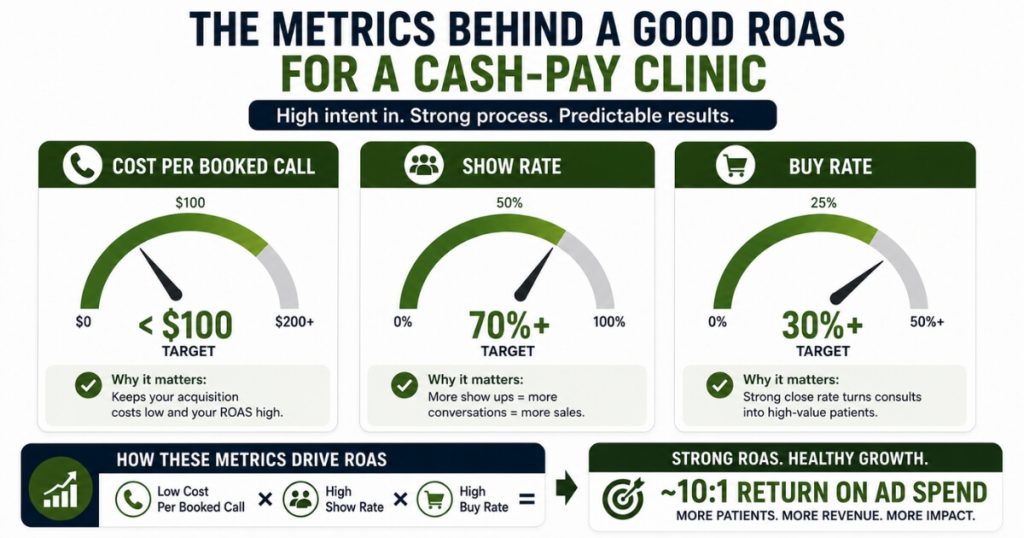
Three simple metrics tell the real story:
- Cost per booked call.
- Show rate.
- Buy rate.
These aren’t exciting numbers.
They’re simply the “boring stuff done right” that consistently produces outstanding returns.
In the clinic generating roughly a 10:1 return, the key numbers looked like this:
- Cost per booked call stayed below $100.
- Patients actually showed up for their appointments.
- The offer converted those appointments into paying patients.
Every stage matters.
A low cost per booked call means:
- Your ads are reaching the right people.
- Your targeting is efficient.
A strong show rate tells you:
- Your booking process works.
- Your reminder system works.
- Patients stay committed.
A strong buy rate tells you:
- Your consultation converts.
- Your offer resonates.
Miss just one of these numbers and the return begins to fall apart, regardless of how attractive the advertisements look.
That’s why constantly chasing a “better ad” usually misses the real issue.
The return is created by the funnel—not the advertisement.
Track these three metrics consistently:
- Cost per booked call.
- Show rate.
- Buy rate.
Once you know those numbers, you’ll immediately know:
- Whether you’re ready to scale.
- Where your funnel is leaking.
- Which part of the system needs attention.
Those three metrics become the dashboard that tells you whether you have a scaling opportunity or a repair job.
Why do ads “expose the offer” rather than fix it?
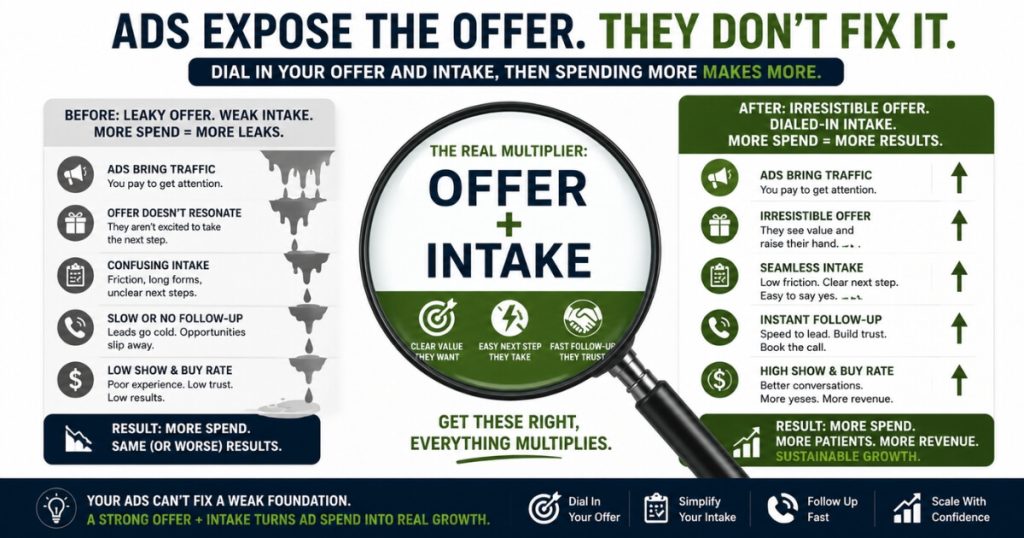
Because advertising simply amplifies whatever system it points toward.
A strong offer becomes stronger.
A weak offer fails faster.
This is one of the hardest lessons clinic owners learn.
Ads don’t repair broken systems.
They reveal them.
For example, if your clinic has:
- A weak offer.
- A poor intake process.
- Low consultation close rates.
…then spending more money simply creates more opportunities for those weaknesses to appear.
The advertisement actually succeeded.
It generated traffic.
The problem happened after the click.
That’s why so many clinic owners conclude:
“Ads don’t work for us.”
In reality, the ads probably worked exactly as intended.
They simply exposed a system that wasn’t converting.
Fortunately, the opposite is also true.
Once your:
- Offer,
- Intake,
- Follow-up,
…are all working together, advertising becomes an amplifier.
Instead of spending more and losing more, spending more simply produces more revenue.
That’s why ads should never be viewed as a fixer.
They’re a magnifier.
When performance drops, resist the temptation to rewrite the advertisement first.
Instead, ask:
- Is the offer compelling?
- Is the intake process leaking?
- Is the consultation converting?
Most of the time, the answer lies after the click—not before it.
When is it safe to scale my ad spend?
It’s safe to scale once the numbers consistently work.
When your offer converts, your intake performs, and your return remains repeatable, increasing budget becomes far less risky.
Scaling shouldn’t begin because you’re hoping advertising will finally work.
It should begin because you’ve already proven the economics.
Before increasing budget, you should know:
- Your average cost per booked call.
- Your typical show rate.
- Your average buy rate.
Once those numbers stay consistent over time, you’ve built a predictable formula.
At that point, increasing ad spend simply means running the same successful formula more times.
That’s what makes scaling feel predictable instead of stressful.
Scaling too early creates the opposite outcome.
If you don’t yet know your funnel metrics, increasing budget becomes speculation.
More spend simply magnifies uncertainty.
Instead:
- Dial in your offer.
- Confirm your booked-call costs.
- Protect your show rate.
- Verify your buy rate.
- Watch the numbers hold steady for several weeks.
Only then should you confidently increase budget.
The clinics that scale profitably aren’t gambling.
They’ve earned the right to scale by proving the math first.
Why isn’t a great return about having a clever ad?
Because the ad is the smallest part of the machine.
The return is actually created by the offer, the intake process, and the follow-up—all of which happen after the click.
Many clinic owners obsess over ad creative because it’s the most visible part of marketing.
However, the clinic generating roughly a 10:1 return didn’t succeed because of a brilliant advertisement.
Instead, it succeeded because it had:
- A cost per booked call under $100.
- Patients who actually showed up.
- An offer that consistently converted consultations into paying patients.
None of those outcomes comes from the advertisement itself.
A mediocre advertisement pointing toward a well-built system will almost always outperform an amazing advertisement pointing toward a leaky one.
That’s because revenue is created during conversion—not during the impression.
The ad has one simple job:
Bring qualified people into a system that’s ready to convert them.
That realization changes where your effort should go.
Rather than endlessly rewriting headlines and changing images, improve the parts that actually produce revenue:
- Build an offer that resonates with your ideal patient.
- Improve the intake process.
- Strengthen appointment confirmations.
- Improve consultation conversion.
- Refine follow-up.
Those improvements make every advertisement perform better.
Instead of chasing the next clever campaign, build a machine that consistently converts.
That’s the backbone of a real patient acquisition system.
How do I actually get to a 10:1 return?
Build the system in the correct order.
Start with a compelling offer.
Then create an efficient path to a booked appointment.
Protect your show rate.
Finally, make sure your consultation consistently converts into paying patients.
Each step builds on the previous one.
A strong process looks like this:
- Build an offer that genuinely resonates with your highest-value patient.
- Keep your cost per booked call low by creating an efficient intake process.
- Protect your show rate with confirmations, reminders, and, when appropriate, a card on file.
- Improve your consultation so more booked appointments become paying patients.
When those four pieces work together, a 10:1 return becomes the natural outcome of the system.
Notice what’s missing from that list.
Nowhere does it say:
“Find a better ad.”
That’s because exceptional returns come from the offer and the funnel—not the advertisement itself.
We’ve watched this process compound at scale.
For example, a medspa we scaled to $6.7M in a year across 3,727 new patients achieved those results with multi-channel advertising pointing toward a system that was already built to convert—not because of one clever campaign.
FAQ’s About Return on Ad Spend and Scaling
What if my return on ad spend is below breakeven?
Stop scaling and fix the funnel first.
A below-breakeven return usually means your advertising has exposed one of three problems:
- A weak offer.
- A leaky intake process.
- A consultation that doesn’t convert.
Review your:
- Cost per booked call.
- Show rate.
- Buy rate.
Those three numbers will tell you exactly where the leak exists.
Don’t increase budget until you’ve repaired it.
Pouring more money into an unprofitable funnel simply accelerates the losses.
The ad usually isn’t the problem.
The system behind it is.
Is a 10:1 return realistic for my vertical?
Yes, it’s realistic for many cash-pay specialties when the system is fully dialed in.
The exact return depends on factors such as:
- Average patient value.
- Service pricing.
- Profit margins.
Higher-ticket treatments can often produce outstanding returns even with relatively expensive leads because one new patient covers a significant amount of advertising spend.
Rather than chasing the exact number 10:1, focus on building a consistent, repeatable return that justifies additional investment.
Should I scale a winning campaign fast or slowly?
Scale gradually.
First, confirm that the return remains consistent over several weeks.
One excellent month can simply be an outlier.
A return that repeats over time becomes a formula.
Increase budget in measured increments while continuing to monitor:
- Cost per booked call.
- Show rate.
- Buy rate.
Sometimes those numbers shift as volume increases.
Steady scaling allows you to catch those changes early before they become expensive.
What’s a good cost per booked call for a cash-pay clinic?
The answer depends on your average patient value and margins.
However, the clinic producing roughly a 10:1 return maintained a cost per booked call under $100, making it a useful benchmark for many cash-pay clinics.
Ultimately, the right number is whichever cost still produces a healthy overall return after accounting for:
- Show rate.
- Buy rate.
- Revenue per patient.
Track cost per booked call closely.
It’s often the earliest warning sign that advertising efficiency is changing and one of the first metrics to review whenever return on ad spend begins to decline.
What’s the next step?
If you’re wondering whether it’s time to spend more on advertising, the answer comes down to one thing:
Does the math consistently work?
A strong return—like turning $2,700 into $25,000—comes from:
- A compelling offer.
- An efficient intake process.
- A strong show rate.
- A consultation that consistently converts.
It doesn’t come from finding one clever advertisement.
Prove those numbers first.
Confirm the return stays consistent over time.
Once you’ve done that, increasing budget becomes a predictable growth strategy instead of a gamble.
Skip those fundamentals, and increasing spend simply exposes the leaks faster.
On a strategy call we’ll review your actual numbers—including cost per booked call, show rate, and buy rate—and tell you whether your clinic is ready to scale or whether your funnel needs attention first. It’s the same work behind clinics like an orthopedic surgical practice where we added $2M in revenue from Facebook ads by building a system worth scaling.