
How to Build a GLP-1 Weight Loss Patient Journey That Survives the 4-Month Drop-Off
Every cash-pay weight loss clinic eventually discovers the same pattern: patients start strong, reorder three or four times, and then quietly disappear — usually right around month four.
This article is the whiteboard session we run with weight loss clinics to fix it, drawn from a real strategy call.
We’ll cover the order-stage pipeline, the follow-up cadence, the stale-patient automations, and the maintenance offer that turns a four-month patient into a lasting one.
Why do weight loss patients drop off around month four?
Because patients are reaching their visible goals, and the clinic hasn’t positioned anything after that.
In our client data, the big drop-off consistently lands after the fourth medication order. Meanwhile, weight loss programs mostly run six months and under.
At one multi-location weight loss clinic we work with, the pattern was explicit.
Patients reordered consistently through month three. Then, a big drop-off happened at month four.
Importantly, many of those same patients returned months later after regaining weight.
Meanwhile, a couple dozen patients had stayed continuously from day one on a maintenance dose.
That’s not churn randomness. It’s a journey design problem.
Patients leave when they feel “done,” and they come back when the problem returns.
So we design the journey for six months, expecting attrition, with two deliberate exits.
The first is a maintenance path for patients at goal weight. The second is a re-engagement loop for everyone who goes quiet.
Retention isn’t about preventing the drop-off. It’s about owning what happens on both sides of it.
What should a GLP-1 patient journey look like from consult to maintenance?
Map it as explicit stages:
Consult scheduled → Consult attended → Meds received → Repeating 30-day order cycle → Goal reached → Maintenance or upsell.
The front of the journey should be fast.
Start with a free initial consultation. For in-person patients, medication can be provided the same day, typically as four pre-filled weekly syringes.
Virtual consultation patients schedule a pickup.
From there, the journey becomes a repeating cycle.
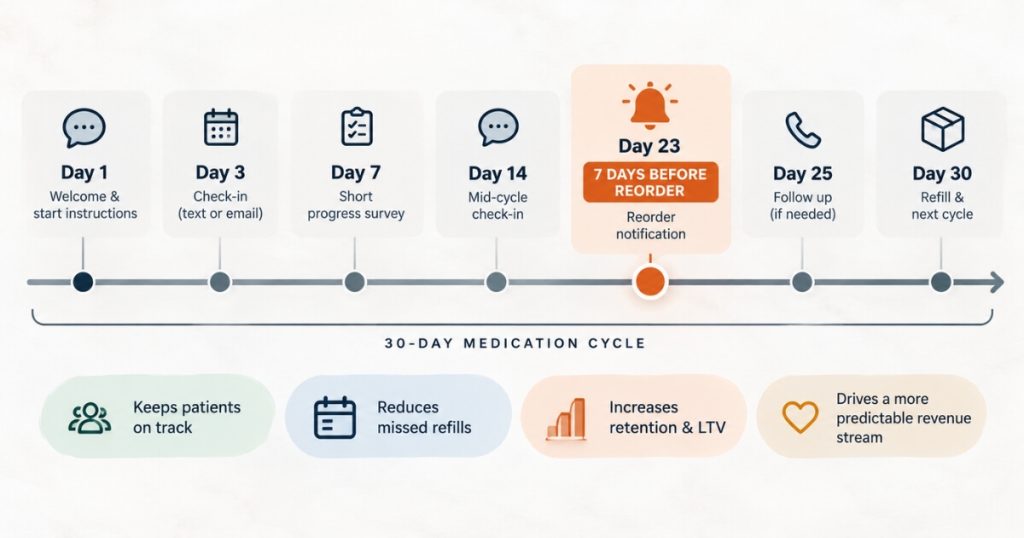
Roughly every 28–30 days, the patient needs a follow-up visit and a reorder.
That cycle, repeated four to six times, IS the program.
This means the clinic’s revenue and the patient’s results both depend on how reliably the cycle repeats.
Writing the journey out stage by stage matters more than it looks.
Once each step has a name, you can attach automation to it.
That includes reminders, check-ins, and tasks instead of relying on whoever remembers.
When we run this exercise on a whiteboard with clinic teams, the reaction is almost always the same.
The journey existed, but only in one person’s head and a color-coded spreadsheet.
How do I stop patients from stretching their medication past four weeks?
Get ahead of the reorder.
Seven days before their medication runs out, send a proactive message offering priority scheduling for their next visit.
Clinics see it constantly: the four-week supply quietly becomes five or six weeks as patients stretch doses.
Auto-billing and shipping can create their own problems.
Bill without shipping, and patients are rightly angry. Rely on patient-initiated refills, and you’ve put the schedule entirely in their hands.
Instead, the fix is proactive timing.
A message like “our records show you’re running low — want priority scheduling for your follow-up?” lands a week before the gap starts.
It tells patients you’re paying attention and frames the reorder as care, not billing.
Pair it with education at handoff.
Include a care card in every medication bag with two QR codes: one linking to a dosing and self-administration video, and another to book the next visit.
NuLevel Wellness Medspa, a weight loss practice that grew by $6,708,600 in revenue and 3,727 new patients in one year, ships every order with exactly that kind of QR postcard.
One code links to a dosing video, while the other links to refill ordering.
Small artifact, big effect: fewer confused calls and faster reorders.
What follow-up cadence keeps weight loss patients engaged without pestering them?
A light, structured rhythm works best.
Start with a check-in about one week after the first injection. Follow up again at two weeks.
Then, send a four-week touch only if the next visit isn’t already scheduled.
The one-week message is clinical care: “how did your first injection feel?”
It catches problems early.
Meanwhile, the two-week check-in maintains presence.
The four-week touch is conditional.
Check the schedule first, and only message patients who haven’t rebooked.
That conditionality is what separates follow-up from pestering.
And pestering is a real risk.
When one clinic layered a monthly newsletter on top of its texts, a handful of patients asked off the email list while staying patients.
The lesson isn’t “don’t communicate.”
It’s that every touch needs a job, and touches without jobs get cut.
The cadence can be automated while still feeling personal.
Use short, conversational messages sent on schedule, with staff handling the replies.
Patients experience a clinic that remembers them.
Meanwhile, the team experiences a system that doesn’t depend on anyone’s memory.
How do I track weight loss patient retention in my CRM?
Build the pipeline around order counts, not vague statuses.
The structure should look like this:
First order → Due for 2nd → 2nd completed → Due for 3rd → 3rd completed → Due for 4th → 4th completed → Maintenance.
This is the structure we build in the CRM for weight loss clients.
It beats a “membership” pipeline because it mirrors how the patient actually progresses.
Thirty days after an order, automation moves the patient to “due for next order.”
And if any opportunity sits stale for 30 days, the system automatically creates a staff task to follow up.
The process is half automated and half human.
Automation guarantees nobody silently disappears. Meanwhile, the team supplies the judgment.
The hidden gem is the “4th order completed” column.
Those patients have effectively reached their goal, which makes that column your upsell and resell list.
That includes maintenance dosing, other services, and the next program.
Most clinics treat those patients as gone.
However, the pipeline treats them as the most qualified audience the practice has.
This is the operational side of GLP-1 & weight loss clinic marketing that ad campaigns can’t substitute for.
Acquisition fills the pipeline, but the pipeline design decides what a patient is worth.
What should happen when a patient reaches their goal weight?
Give them a designed “now what.”
That means maintenance or microdosing education, a clear offer for staying, and a re-engagement loop for patients who leave anyway.
The month-four patient isn’t lost.
They’re at a decision point nobody prepared them for.
So fill that gap deliberately.
Create content that answers “I’ve reached my goal — now what?”
Provide education on why quitting cold turkey makes weight regain more likely.
Then, introduce a maintenance or microdose option as a way to help patients protect their results, where clinically appropriate.
One practical note from inside these clinics: if your microdose costs the same as your full starting dose, patients notice.
A distinct maintenance price point makes the decision to stay easier.
And for patients who go quiet anyway, don’t archive them.
Use a best-judgment re-engagement touch one to two months later, excluding anyone who explicitly discontinued.
This recovers a surprising number of patients because some are already watching the weight come back.
The ones who return after regaining are also the strongest candidates for maintenance framing.
They’ve now personally experienced why stopping cold didn’t work.
FAQ’s About GLP-1 Weight Loss Patient Journeys and Retention
How long does the average cash-pay weight loss patient stay?
Plan for six months and under, with a marked drop-off after the fourth monthly order.
A minority stay far longer, often patients who transition to a maintenance dose.
Designing for the six-month reality, with maintenance and re-engagement paths, outperforms pretending everyone stays a year.
What’s the best CRM pipeline structure for a weight loss program?
Use order-count stages: First order, Due for 2nd, 2nd completed, and so on through 4th completed, then Maintenance.
Automate the time-based moves so patients shift to “due” after 30 days.
Also, automatically create a staff task whenever a patient sits stale for 30 days at any stage.
That way, no one falls through the cracks.
Should I auto-bill weight loss patients monthly?
Be careful.
Auto-billing without auto-shipping angers patients whose cards get charged while they’re stretching doses.
However, relying entirely on patient-initiated refills puts your revenue schedule in the patient’s hands.
If you bill on a cycle, require a signed membership agreement that makes the every-30-days charge explicit.
Then, pair billing with proactive scheduling.
How many follow-up touches is too many?
Every touch needs a job.
A one-week clinical check-in, a two-week check-in, and a conditional four-week “you haven’t rebooked” message form a full cadence for a 30-day cycle.
If patients start unsubscribing or ignoring messages, consolidate rather than adding volume.
For example, consider a single three-week touch instead.
How do I win back weight loss patients who stopped coming?
Wait one to two months, then check in with a soft message.
Exclude anyone who explicitly discontinued care.
Many lapsed patients are quietly regaining weight and respond to a low-pressure invitation to restart.
This works especially well when a microdose or maintenance option makes returning feel like a plan rather than an admission.
What’s the next step?
If your weight loss program’s revenue graph shows the same cliff at month four — or your follow-up still lives in a color-coded spreadsheet — book a strategy call.
In 60 minutes, we’ll whiteboard your patient journey end to end.
We’ll design the order-stage pipeline and follow-up cadence for your clinic.
Then, we’ll map the maintenance offer that keeps goal-weight patients from disappearing.
It’s the same journey-design work we run for weight loss practices like the medspa that added $6.7M in a single year.