
What Does the GLP-1 Patient Journey Look Like (and How Do I Keep Them Past Goal Weight)?
GLP-1 weight-loss programs are one of the fastest revenue streams a cash-pay clinic can add—and one of the leakiest. Most clinics lose the patient the moment they hit goal weight. The clinics that build lasting revenue from GLP-1 map the whole patient journey up front and set expectations from day one for what comes after the scale hits its target. Here’s the FAQ on what that journey looks like and how to keep patients past goal weight.
What does the GLP-1 patient journey actually look like?
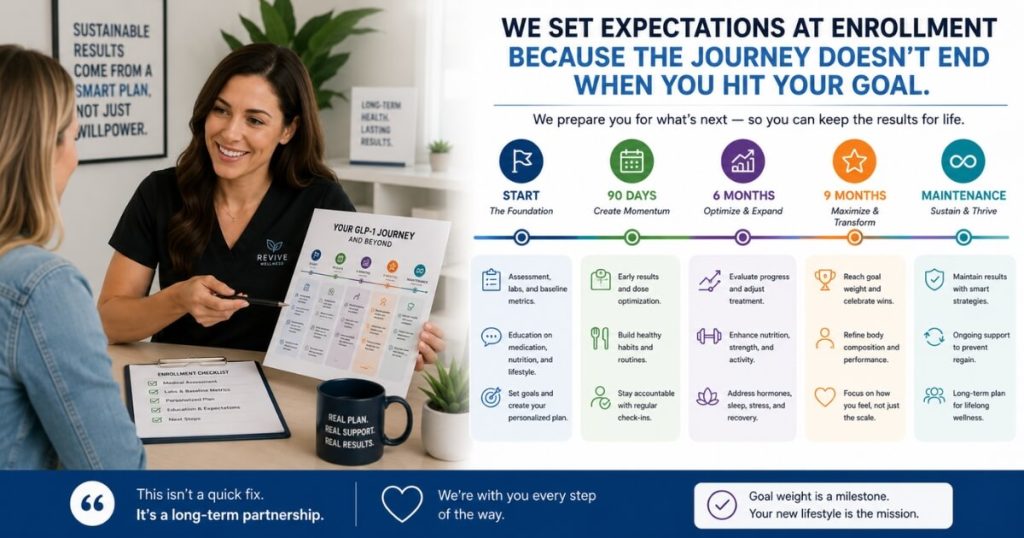
It’s a series of milestones—the initial sale, then the 90-day, 6-month, and 9-month marks. Each milestone is a chance to re-engage the patient and reset expectations, not just refill a prescription.
Thinking in milestones matters because a GLP-1 patient’s experience changes over time.
- The initial sale is about starting safely and building early momentum.
- The 90-day mark is where early results should be landing and where adherence either solidifies or slips.
- The 6-month mark is often near or at goal weight for many patients. It’s also the highest-risk moment for drop-off.
- The 9-month mark and beyond is where the relationship becomes maintenance, cross-sell, and long-term care.
Each milestone is a planned touchpoint, not an afterthought.
Mapping the journey this way turns a transactional prescription into a program. It gives your team a script for what to do at each stage. It also gives the patient a sense that they’re on a guided path rather than just buying medication. This is the foundation of durable GLP-1 & weight loss clinic marketing. The retention economics only work when the journey is designed.
Why do expectations set at the start matter so much?
Because the expectations you set with the patient at enrollment are everything. They determine whether the patient sees goal weight as the finish line or as a milestone on a longer journey.
If a patient enrolls believing the program ends when they hit their target, they’ll leave when they hit it. That’s exactly what you told them would happen. If instead you set the expectation up front that the journey includes reaching goal weight and then maintaining it—and that maintenance is its own phase with its own value—the patient plans to stay. The single biggest lever on GLP-1 retention is the conversation you have before the patient ever starts.
This is why the initial sale isn’t just about closing. It’s about framing. Explain the full arc:
- The ramp
- The results
- The goal
- The maintenance phase that protects those results
A patient who understands from day one that keeping the weight off is part of the program doesn’t treat goal weight as an exit. Setting that frame is the cheapest retention tool you have.
Why do so many GLP-1 patients drop off at goal weight?
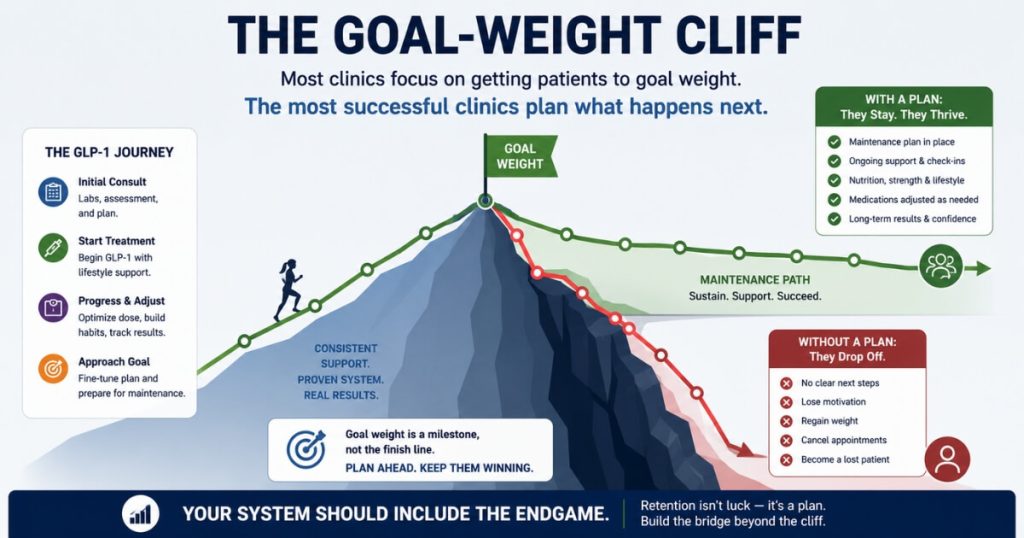
Because nobody planned for what happens after. The program was built to get them to goal weight, not to keep them past it.
The goal-weight cliff is the defining retention problem in GLP-1. A patient hits their target, feels successful, and—with no maintenance path laid out—concludes they’re done and stops. The clinic loses a patient who was, until that moment, recurring revenue. It’s not that the patient failed. It’s that the program never defined a next chapter, so hitting the goal became the natural stopping point.
The fix is to design the maintenance phase before the patient ever needs it and introduce it early. Patients need to understand that:
- Keeping weight off is an ongoing effort.
- A lower maintenance protocol exists.
- Staying with you protects the investment they’ve already made.
When maintenance is presented as a planned, valuable part of the journey rather than an upsell at the end, far more patients continue. NuLevel Wellness, a weight-loss and hormone medspa, added $6.7M in a year by building systems around retention and follow-up, not just acquisition.
What systems do I need to run the GLP-1 journey well?
A CRM is non-negotiable. You need every patient, every milestone, and every follow-up tracked and automated in one place.
The journey only works if someone—or something—is reliably triggering the right touch at the right milestone. That’s impossible on memory and sticky notes across dozens or hundreds of patients. A CRM lets you build the intake, tag each patient by where they are in the journey, and automate the check-ins at:
- 90 days
- 6 months
- 9 months
That way, no one falls through the cracks at exactly the moment they’re most likely to drop. Intake forms and the whole pipeline should live in one system.
If you don’t yet have a large team, this is where your front desk carries the journey, with the CRM doing the heavy lifting on reminders and sequencing. Staff then assist with the selling and transactional moments. The point is that the journey is systematized, not dependent on anyone remembering. Reliable follow-up at each milestone is the core of a strong patient acquisition and retention engine.
How do I turn a GLP-1 patient into long-term revenue?
By using the later milestones to move the patient into maintenance and to cross-sell the services that fit where they are in their health journey.
By the 6-to-9-month range, a GLP-1 patient has trust, results, and a relationship with your clinic. That makes them an ideal candidate for the next appropriate step. That might be:
- A lower-cost maintenance protocol
- Hormone optimization
- Peptide therapy
- A broader wellness or longevity program
The weight-loss journey becomes the front door to a longer, higher-value relationship, provided you’ve set it up that way from the start and the timing is clinically appropriate.
This is how a GLP-1 program stops being a churn-and-burn revenue spike and becomes a durable base. The patient who stays for maintenance and adds a second service is worth many times the patient who leaves at goal weight. An HRT clinic we grew from $1M to $4M a year runs roughly 250 active members on exactly this logic—a designed journey that keeps patients in a recurring relationship rather than a one-time transaction.
FAQ’s About the GLP-1 Patient Journey
What are the key milestones in a GLP-1 patient journey?
The initial sale, then the 90-day, 6-month, and 9-month marks.
Each is a planned touchpoint:
- Starting safely and building momentum.
- Solidifying adherence and early results.
- Approaching goal weight (the highest drop-off risk).
- Transitioning into maintenance and long-term care.
Treating them as milestones turns a prescription into a program.
Why do GLP-1 patients quit at goal weight?
Because most programs were built to get patients to goal weight, not to keep them past it. With no maintenance path defined, hitting the target becomes the natural stopping point. Designing and introducing a maintenance phase early—and framing goal weight as a milestone rather than the finish—is what prevents the drop-off.
How do I set GLP-1 expectations to improve retention?
At enrollment, frame the full journey:
- Ramp
- Results
- Goal weight
- Ongoing maintenance that protects those results
A patient who understands from day one that keeping the weight off is part of the program plans to stay. A patient who thinks the program ends at goal weight will leave when they get there.
Do I need a CRM to run a GLP-1 program?
Effectively, yes. Tracking every patient, milestone, and follow-up across a growing program is impossible on memory alone. A CRM lets you automate the 90-day, 6-month, and 9-month check-ins while keeping intake and the whole pipeline in one place. That prevents patients from falling through the cracks at the moments they’re most likely to drop.
What’s the next step?
If your GLP-1 program is bringing patients in but losing them at goal weight, you’re leaving most of the revenue on the table. Book a strategy call. In 60 minutes we’ll map the full GLP-1 patient journey for your clinic—the milestones, the expectations to set at enrollment, the maintenance path, and the CRM automations behind it. The goal is simple: help patients stay past goal weight and become long-term revenue.
If it’s a fit, we’ll build the journey and the systems with your team.