
What Should My Team Say to Turn a Functional-Medicine Inquiry Into a Paying Patient? (The Discovery-Question Script)
The leads your functional-medicine marketing generates are only worth what your team does with them on the phone—and most teams either pitch too early or wing it entirely. The clinics that convert use a discovery-question script that gets the patient to articulate their own problem, admit they need help, and see the value before a price is ever mentioned. This FAQ walks through that script, built from a real functional-medicine clinic’s new-patient talk track, including the exact questions to ask and the three-step offer that lets the patient sell themselves.
What should my team say to turn a functional-medicine inquiry into a paying patient?
Ask questions first.
Don’t pitch.
Run a structured discovery conversation that encourages the patient to describe their problem and goals before presenting any solution.
The more the patient talks and the less your team talks, the higher the conversion tends to be.
A strong opening might sound like this:
“What we’ve found works best, to get our patients the best results, is to ask a few clarifying questions before we get you scheduled.”
This opening does two things:
- It asks permission.
- It establishes a consultative tone instead of a sales conversation.
From there, every question has a purpose.
Your team should uncover:
- The patient’s main concern.
- What they’ve already tried.
- What hasn’t worked.
- How motivated they are to solve the problem.
By the time you present your program, the patient has already explained why they need help.
Your offer becomes the solution to a problem they described—not a sales pitch they expected.
This approach is the foundation of converting functional-medicine leads and an essential part of an effective patient acquisition process.
The script is often the difference between:
- A patient who books.
- A patient who says they’ll “think about it.”
What discovery questions should I ask before scheduling a functional-medicine patient?
Use a consistent sequence of discovery questions.
A proven order includes:
- How did you hear about us?
- What are you hoping to accomplish?
- How long have you been dealing with this?
- What have you already tried?
- What has worked?
- What hasn’t worked?
- When were you hoping to get started?
Each question serves a specific purpose.
For example:
“How did you hear about us?”
Ask whether they:
- Were referred.
- Found you online.
Besides gathering information, this subtly reinforces that other patients recommend your clinic.
“What were you hoping to accomplish?”
This gets the patient talking about their goals.
“How long has this been going on?”
This uncovers how long they’ve struggled.
“What have you tried?”
This surfaces frustration and previous failures.
Finally:
“When were you hoping to get in?”
This helps determine urgency.
If a patient begins talking at length, gently regain control with something like:
“Hold on a second—you mentioned something there I want to ask you about.”
That keeps the conversation focused while showing you’re actively listening.
The goal is never to interrogate.
The goal is to help patients build their own case for change.
People trust conclusions they reach themselves far more than conclusions someone else gives them.
Teams that consistently follow these questions usually convert significantly better than teams that skip straight to scheduling.
How do I get the patient to admit they actually need a program, not just a quick fix?
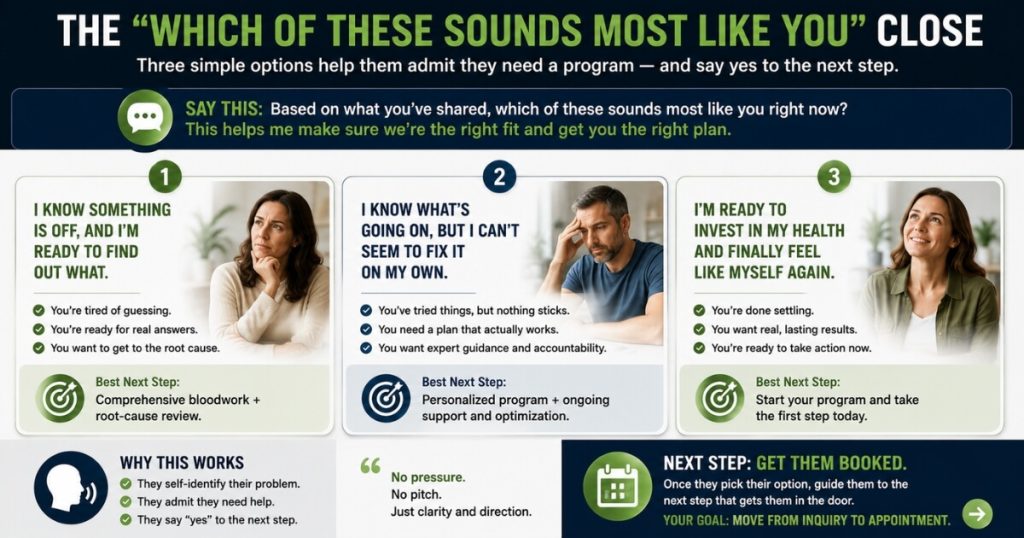
Offer three common situations and let the patient identify which one fits.
That self-selection becomes the turning point of the conversation.
One effective prompt is:
“Typically folks hop on a call with us for a few reasons:
• You’ve tried everything you know and you’re stuck.
• You just want to get there faster.
• You want a personalized plan instead of wasting time and money figuring it out yourself.
Which sounds most like you?”
After they answer, simply ask:
“What makes you say that?”
Almost every patient will explain why they selected that option.
In doing so, they often admit they:
- Feel stuck.
- Need guidance.
- Want a structured plan.
That admission changes everything.
Once patients explain—in their own words—that they need help, your program naturally becomes the answer.
You’re no longer convincing them.
You’re responding to a need they already identified.
That is why self-selection consistently converts better than telling patients they need your help.
How do I present the offer so the price feels justified?
Present the value first.
Then present the price.
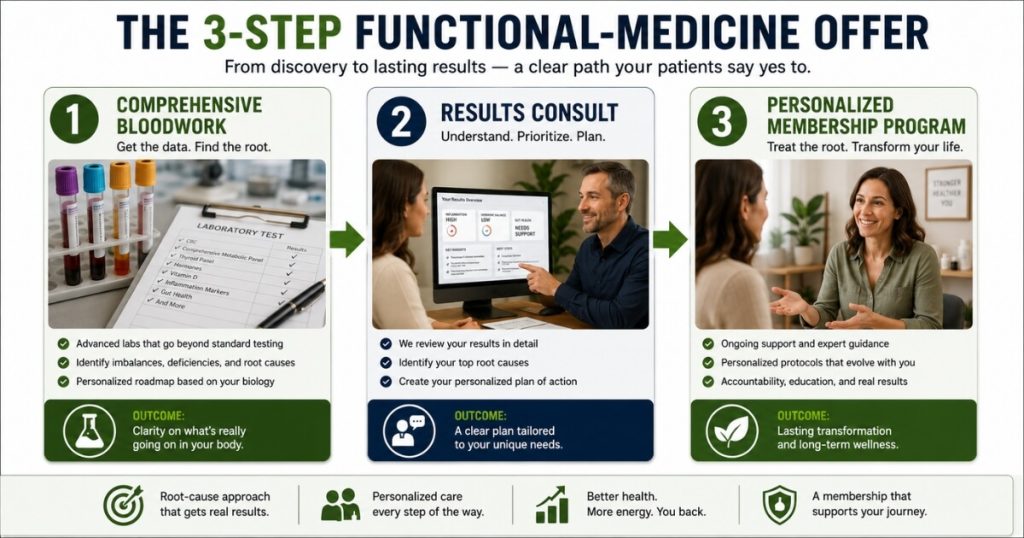
One effective structure is a simple three-step process.
Step 1
Complete comprehensive bloodwork.
Explain that the testing establishes a complete baseline by measuring items such as:
- Hormones
- Inflammation markers
- Organ function
- Metabolism
- Immune markers
- Insulin
Patients typically receive more than 20 panels and approximately 9–10 pages of results.
Step 2
Meet with the provider or program specialist.
Review the bloodwork together.
Explain what the results mean.
Step 3
Receive a personalized membership program.
The provider and patient work together to determine the best path forward.
This structure makes the process feel:
- Thorough.
- Personalized.
- Medical.
- Evidence-based.
Notice that price has not been discussed yet.
Instead, patients first understand exactly what they receive.
By the time pricing comes up, they recognize they are investing in:
- Comprehensive diagnostics.
- Professional interpretation.
- A personalized treatment plan.
Value first.
Price second.
That order makes the investment feel logical instead of surprising.
What should my hormone membership actually cost given my real margins?
Charge transparently.
Separate the diagnostic investment from the ongoing membership.
One clinic presents pricing like this:
- Bloodwork: $550
- Consultation: $300
- Total initial investment: $850
- Membership: Approximately $300–$1,000 per month, depending on laboratory results.
The clinic also highlights the convenience of using a mobile phlebotomist, allowing patients to complete bloodwork without sitting in a traditional lab.
Your own pricing should reflect your:
- Market.
- Costs.
- Business model.
The important principle is staged, transparent pricing—not these exact numbers.
Present the investment confidently.
Confidence communicates certainty.
Hesitation creates doubt.
Once patients understand the value, pricing simply becomes another piece of information.
State it clearly.
Then continue moving naturally toward scheduling.
How do I handle it when the patient asks, “How much does it cost?”
Answer the question—but only after you’ve established the value.
The script is intentionally designed so pricing comes after the three-step process has been explained.
When patients understand what they’re receiving, the investment feels much more reasonable.
When it’s time to answer, present the numbers clearly.
For example:
- Bloodwork investment.
- Consultation investment.
- Mobile phlebotomy option.
- Typical monthly membership range.
Then immediately move the conversation forward.
For example:
“Do you have any questions, or are you ready to schedule your bloodwork?”
That transition is intentional.
Answer the pricing question.
Then continue toward booking instead of leaving space for uncertainty.
Once the patient agrees, collect everything needed to secure the appointment, including:
- Full name
- Email address
- Phone number
- State
- Date of birth
- Referral source
- Mobile carrier for reminders
- Credit card information
Collecting payment information while commitment is highest turns interest into a real appointment.
If a patient asks about price too early, acknowledge the question while redirecting gently.
For example:
“Great question, and I’ll absolutely cover that. First, let me make sure this is the right fit for you.”
Then continue the discovery process.
The sequence matters:
- Build value.
- Present pricing.
- Schedule immediately.
FAQ’s About the Functional-Medicine Discovery Script
What’s the difference between an inbound and an outbound version of the script?
The only real difference is the opening.
Everything after the introduction follows the same discovery process and offer presentation.
For an outbound call, confirm that the patient requested an appointment.
For example:
“I understand you requested an appointment on our website. Is that right?”
If they don’t remember, remind them of the concern they submitted.
For an inbound call, simply greet the caller and ask how you can help.
Then collect their basic contact information.
From the discovery questions onward, both conversations follow the exact same structure.
That consistency helps make conversion predictable.
Should my whole team use the same script?
Yes.
A standardized script makes your results consistent instead of depending on who happens to answer the phone.
Everyone who handles new-patient inquiries should follow the same framework:
- Discovery questions.
- Three-option self-selection.
- Three-step offer.
- Scheduling process.
The script is not meant to sound robotic.
It is simply a reliable structure.
Once your team practices it through:
- Role-playing.
- Recorded-call reviews.
- Coaching.
they’ll naturally make it sound like their own conversation.
Consistency creates predictable conversion.
Why collect payment and the credit card at the time of scheduling?
Because commitment is highest immediately after the patient says yes.
A booked appointment with a credit card on file is much more likely to show up than one without.
Collecting payment information at scheduling turns interest into commitment.
At that moment, gather:
- Diagnostic payment.
- Credit card details.
- Scheduling information.
Waiting until later creates unnecessary opportunities for hesitation.
The discovery script is designed to build momentum.
Collecting payment immediately helps preserve that momentum.
What if the patient only wants one service instead of the full program?
Meet the patient where they are.
However, use the discovery conversation to explain why a comprehensive approach usually produces better results.
The bloodwork-first process exists for a reason.
Without a proper baseline, individual treatments often deliver less predictable outcomes.
Walk patients through the logic of:
- Comprehensive testing.
- Personalized interpretation.
- Customized treatment planning.
If they still prefer a single service, serve them well.
Deliver an outstanding experience.
Then leave the door open for a future conversation.
Many patients who begin with one service eventually choose the complete program after experiencing the quality of care.
What’s the next step?
If your functional-medicine inquiries are not converting into paying patients, the problem is usually not the quality of your leads.
It is usually the phone conversation.
A structured discovery script helps patients:
- Describe their own problem.
- Recognize they need help.
- Understand the value of your process.
- Commit before price becomes the focus.
The sequence matters:
- Discovery.
- Value.
- Price.
- Immediate booking.
That simple structure consistently converts far better than leading with pricing or trying to sell too early.
During a strategy call, we’ll review how your team currently handles new-patient inquiries.
Then we’ll build a customized discovery-and-offer script specifically for your practice.
We’ll also help your team install it through:
- Role-playing.
- Recorded-call reviews.
- Ongoing coaching.
It’s the same conversion process behind clinics like a longevity and functional medicine clinic where we increased website leads by 900% and inbound calls by more than 100 per month.