
What Should My Front Desk Say When a Referred Functional-Medicine Patient Calls? (The Call-Handling Triage Script That Stops Referrals From Leaking)
The warmest lead a functional-medicine clinic will ever get is a referral — someone who calls already pre-sold by a friend or a doctor they trust. And it is the lead that leaks the most, because most front desks treat that call as a scheduling task instead of a triage conversation. They answer a couple of questions, quote a price cold, and the patient says “let me think about it” and calls the next clinic. This is the inbound-referral call-handling triage script we install for cash-pay functional-medicine clinics — the exact order of Trust, Problem, Timing, Quick Blast, and Finances that keeps a warm referral warm all the way to a booked lab draw or consultation. Every line below is the real script, not a theory.
Why do so many referred functional-medicine patients call and never book?
Because most front desks treat an inbound referral call as a scheduling task instead of a triage conversation.
They answer questions, quote a price, and hang up.
As a result, the warmest lead you will ever get leaks out the bottom of the funnel.
A referred functional-medicine patient is calling already pre-sold.
A friend got results, or a physician they trust said, “Go see them.”
That borrowed trust is the single most valuable asset on the call.
However, it is fragile.
It evaporates the moment the conversation turns into an interrogation about insurance, a flat price quote with no context, or a receptionist who clearly just wants to get the caller off the line.
The patient came in warm and left cold.
Then they call the next clinic that picks up.
The fix is not a better receptionist.
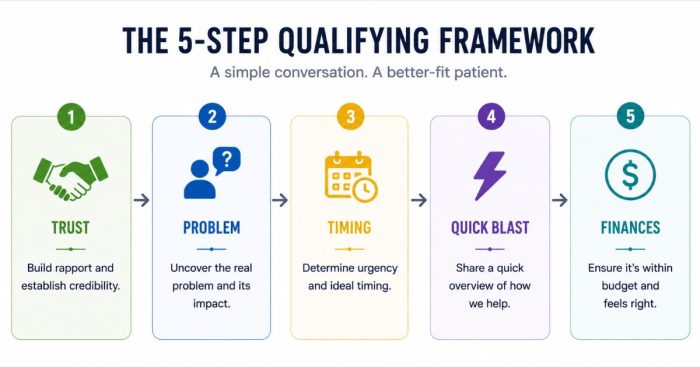
It is a structured triage script that every person who answers the phone runs the same way:
- Re-establish the referral trust.
- Surface the real problem.
- Confirm the timing.
- Frame the path to becoming a patient.
- Handle finances last.
When the front desk follows that order, the referral stays warm all the way to a scheduled appointment.
The same systematized intake discipline is what powered VYVE Wellness, a longevity and functional-medicine clinic we grew to 100+ inbound calls per month and a 900% increase in website leads in four months.
The leads only convert if the phone is answered with a system behind it.
What is the first thing my front desk should ask on an inbound functional-medicine call?
Ask how they heard about you.
For example:
“How did you hear about us? Were you referred by a friend or did you look us up online?”
Ask that before anything else.
This single question does three jobs at once.
It confirms whether the caller is a warm referral or a cold online searcher.
That changes how the rest of the call should run.
It lets the front desk anchor on the referral source.
Naming the friend or the doctor who sent them rebuilds the trust that got them to dial in the first place.
It also opens the door to the real reason they are calling without making them feel processed.
From there, the conversation branches naturally.
For a referral, ask:
“What’s going on that your friend referred you to us?”
For an online lead, ask:
“So tell me, what’s going on that has you looking for functional medicine doctors online?”
Notice what the front desk is not doing yet.
They are not collecting a name.
They are not asking for a date of birth.
They are not quoting a price.
The first job of the call is to establish trust and uncover the problem.
The booking comes later.
Because of this order, it also comes easier.
How does my front desk uncover the real problem without sounding like an interrogation?
Use a short, conversational problem-discovery sequence that lets the patient tell their story.
Ask about:
- What’s going on.
- What they’re doing about it now.
- What they’ve tried in the past.
- Whether anything has given them relief.
Functional-medicine patients have usually been failed by several providers before they call you.
They are frustrated.
They have spent money.
Most importantly, they want to be heard.
The script gives the front desk four questions in a row:
- “What are you doing right now to try and solve this problem?”
- “What have you tried in the past?”
- “Has there been anything that has given you any relief, anything that’s worked?”
- “Have any family members or partners recommended other solutions?” (where relevant)
Each question signals that this clinic is different from the ones that rushed them.
This stage is also where real triage happens.
Certain presentations should be routed straight to the functional-medicine physician rather than the standard intake path.
In this clinic’s script, Lyme, cancer, autism, mold, long COVID, and EBOO all go directly to the doctor.
Triage is not only about whether someone books.
It is also about routing them to the right service and the right provider so the consultation actually fits.
For weight-loss callers, the script adds one more timing question:
“Is there anything going on in your life right now that has you wanting to lose this weight now?”
Urgency uncovered on the call is urgency that carries into the booking.
When should the front desk talk about price on a functional-medicine call?
Only after trust, problem, and timing are established.
Always wrap pricing in the value of what the patient is actually buying, never as a naked number.
The script calls this moment the “Quick Blast.”
It opens with a permission-based bridge:
“Gotcha, thank you for explaining all of that to me — I think we can help. Do you want me to explain what it looks like to become a patient here?”
That question gets the patient’s permission to hear the path.
As a result, the pricing feels like an answer to their request instead of a sales pitch they did not ask for.
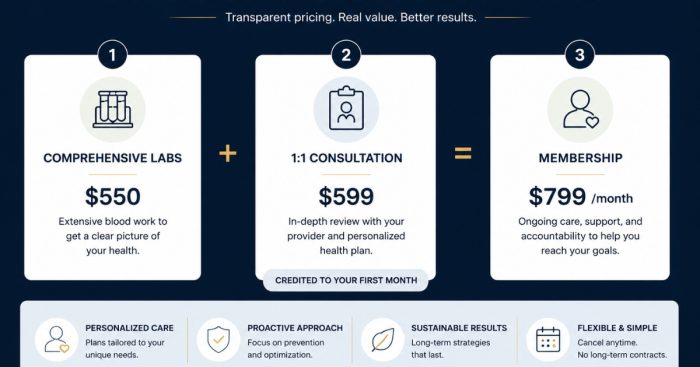
For a new functional-medicine patient, the front desk explains:
- A 60-minute one-on-one initial consultation with the physician.
- The physician reviews the patient’s medical-history intake forms ahead of time.
- At the end of the consultation, the physician will likely recommend more comprehensive testing to confirm what they are experiencing.
- The initial consultation is $599.
- If appropriate, and the physician accepts the patient as a member, that $599 is credited toward the first month of membership.
- Membership is $799 per month.
The numbers never land cold.
They land inside a story about how this patient specifically gets better.
That is the difference between a price objection and a booked appointment.
A documented service ladder like this — consult priced as a credit toward membership — is one of the highest-leverage pieces of functional medicine & longevity clinic marketing.
It lives or dies at the front desk.
How should my front desk handle the insurance and finances question?
Get ahead of it with a confident, prepared answer that reframes cash-pay as the standard for functional medicine and immediately offers the payment paths that exist.
The line in the script that works is:
“Functional medicine is generally not covered by any insurance. However, we’d be happy to help you by providing a superbill at the end of your treatment that you could submit to your insurance company for potential reimbursement. We do accept HSAs, FSAs, and offer CareCredit as a financing option.”
Said this way, the insurance objection rarely becomes a dealbreaker.
The front desk has acknowledged it, normalized it, and handed the patient three real ways to pay before they had to ask.
The mistake clinics make is letting the front desk improvise the finances answer.
Improvisation produces hesitation.
The patient reads hesitation as a red flag.
If the clinic is not sure how this works, why should they be?
A scripted, confident finances answer is the last thing standing between a warm referral and a booked appointment.
Therefore, it has to be rehearsed until it sounds effortless.
The same applies to the lab-scheduling logic.
The script gives the patient a clear choice:
- Come into the clinic to do labs for $375 with no waiting in line.
- Take a requisition to LabCorp or Quest with the caveat that they should verify insurance coverage to avoid a surprise bill.
Clarity at this step is what closes.
How do I make sure my whole team runs the triage script the same way?
Document the script as a fixed call-handling sequence.
Role-play it until it sounds natural.
Then hold the team accountable with call reviews and tracked booking rates.
A script only stops referral leaks if every person who answers the phone runs the same play in the same order:
- Trust
- Problem
- Timing
- Quick Blast
- Finances
They also need to capture the information required to close at the right moment, not before.
The clinics that win are not the ones with the single best receptionist.
They are the ones whose entire front desk converts referrals at the same high rate.
That happens because the script, the routing rules, and the follow-up are systematized rather than left to whoever happens to pick up the phone.
The triage call should also chain into the rest of the patient journey rather than ending at the booking.
The intake forms, the lab requisition, the consultation reminder, and the membership conversation all flow off the triage call when the front desk is operating inside a real system.
That is how a clinic turns a warm referral into a long-term member instead of a one-off consultation.
It is also how you stop measuring success by leads generated and start measuring it by referrals retained.
FAQ’s About a Functional-Medicine Call-Handling Triage Script
Why do so many referred functional-medicine patients call and never book?
Because most front desks treat an inbound referral call as a scheduling task instead of a triage conversation.
They answer questions, quote a price, and hang up.
As a result, the warmest lead you will ever get leaks out the bottom of the funnel.
A referred functional-medicine patient is calling pre-sold by a friend or a doctor they trust.
That trust is the single most valuable asset on the call.
However, it evaporates the moment the conversation turns into an interrogation about insurance or a cold price quote with no context.
The fix is a structured triage script.
It re-establishes referral trust, surfaces the real problem, confirms the timing, frames the path to becoming a patient, and only then handles finances.
When the front desk follows that order — Trust, Problem, Timing, Quick Blast, Finances — the referral stays warm all the way to a scheduled lab draw or consultation instead of leaking to the next clinic that answers the phone.
What is the first thing my front desk should ask on an inbound functional-medicine call?
Ask how they heard about you before anything else.
For example:
“Were you referred by a friend or did you look us up online?”
This single question confirms whether the caller is a warm referral or a cold online searcher.
It also lets the front desk anchor on the referral source and rebuild the trust that brought the patient to the clinic.
From there, ask:
“What’s going on that your friend referred you to us?”
Or, for an online lead:
“What’s going on that has you looking for functional medicine doctors online?”
Do not begin by collecting a name or date of birth.
First establish trust and uncover the problem.
The booking comes later, and it comes easier.
How does my front desk uncover the real problem without sounding like an interrogation?
Use a conversational sequence that allows the patient to tell their story.
Ask what is going on, what they are doing now, what they have tried, and whether anything has helped.
Those questions help patients feel heard after often being failed by multiple providers.
They also help the front desk route the patient correctly.
Certain conditions such as Lyme, cancer, autism, mold, long COVID, and EBOO should go directly to the physician instead of the standard intake path.
Triage is not just about booking.
It is also about matching the patient with the right provider and service.
When should the front desk talk about price on a functional-medicine call?
Discuss pricing only after trust, problem, and timing have been established.
Begin with the script’s permission-based bridge:
“Thank you for explaining all of that to me — I think we can help. Do you want me to explain what it looks like to become a patient here?”
Then explain the 60-minute physician consultation, the comprehensive testing, the $599 consultation fee credited toward the first month of membership if accepted, and the $799 monthly membership.
The numbers never land cold.
Instead, they are presented inside the patient’s treatment path.
That is what makes the investment feel justified.
How should my front desk handle the insurance and finances question?
Prepare a confident answer before the patient asks.
Explain that functional medicine is generally not covered by insurance.
Then explain that the clinic provides a superbill for potential reimbursement and accepts HSAs, FSAs, and CareCredit.
Presenting the payment options immediately makes the objection far less intimidating.
The script also gives patients a clear choice between completing labs in the clinic for $375 or using LabCorp or Quest with the reminder to verify insurance coverage beforehand.
How do I make sure my whole team runs the triage script the same way?
Document the script.
Role-play it regularly.
Review calls.
Track booking rates.
Every team member should follow the same sequence:
- Trust
- Problem
- Timing
- Quick Blast
- Finances
The triage call should naturally lead into intake forms, lab requisitions, appointment reminders, and the membership conversation.
The clinics that convert the most referrals are not the ones with one exceptional receptionist.
They are the ones with an entire front desk that follows the same proven process every time.
What’s the next step?
If your functional-medicine clinic is generating referrals and inbound calls but you suspect the front desk is leaking them, the fix is rarely more marketing.
It is a documented call-handling triage script that every person on the phone runs the same way, every time.
Trust.
Problem.
Timing.
Quick Blast.
Finances.
Install it.
Role-play it.
Review the calls.
Track the booking rate.
That is how a warm referral becomes a long-term member instead of a “let me think about it.”
If you want help building the triage script, the routing rules, and the patient-journey automation that chains off it for your specific clinic, that is the conversation to book.
We have built these systems for cash-pay functional-medicine clinics like VYVE Wellness, where we drove a 900% lead increase and 100+ inbound calls per month.
The script is what converts them.