
The Front Desk Phone Inquiry Script a $4M Cash-Pay Clinic Runs on Every Call (Capture, Connect, Close — Verbatim)
Most cash-pay clinics spend thousands generating phone calls and then improvise what happens when the phone rings. The practice behind this script didn’t. Their front desk runs a written phone inquiry script — Capture, Connect, Close — on every inbound and outbound call, and it’s one of the systems that carried them from $1M a year to $4M a year. Here it is, word for word, with the reasoning behind each line.
What should my front desk actually say when a new patient calls my cash-pay clinic?
A scripted greeting, a permission question, and a structured discovery sequence — in that order, on every call, with no improvising.
The script opens with tone before words.
“Always smile when you answer the phone” is written into the document itself because callers hear posture.
The verbatim opening is: “Hi, thank you for calling [clinic], this is Lauren, how can I help you?”
Then, whatever the caller asks for: “Great! We can absolutely help you with that!” It’s an immediate yes that keeps the caller moving forward.
The most important line comes next, and almost no clinic uses it:
“Is it ok if I ask you a few questions to get a deeper understanding of how we can best help you?”
That permission question flips the dynamic.
The caller stops interviewing your front desk about prices and starts answering questions like a patient.
The framework the whole script hangs on is three words long — Capture, Connect, Close.
Capture the inquiry, connect to the caller’s actual problem, and close the next step.
A front desk that only answers questions does none of those three.
The opportunity gets bigger as inbound demand grows. At one regenerative practice, that included first-time patient calls that rose from 50 to 173 a month.
What discovery questions should the front desk ask before quoting any price?
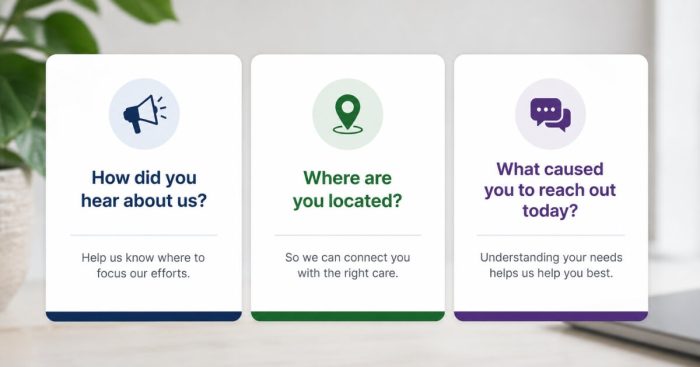
Three, verbatim: “How did you hear about us?”, “Where are you located?”, and “Can you tell me a little bit about what caused you to reach out today?”
Each question has a job.
“How did you hear about us?” gives you marketing attribution on every call for free.
When the answer is a referral, the script has a warmth line ready: “Oh great! We love [name]! I’ll make sure to thank her for recommending us!”
“Where are you located?” qualifies logistics early, before anyone falls in love with a treatment they can’t come in for.
The third question is where revenue lives.
“What kind of symptoms, concerns, goals are you wanting to achieve?”
The script instructs the coordinator to take notes because callers typically reveal two or three major pain points they want solved.
Those notes get used later, verbatim:
“It sounds like [repeat their challenges back] are the things you’d really like to focus on improving, is that right? Is there anything else?”
Then come two deepening questions:
“How long have you been struggling with this?”
“What steps have you taken so far to resolve this, or are we your first step?”
By the time price comes up, the conversation is about their sleep, energy, and weight — not about dollars.
This is the discovery structure we install as part of a predictable patient acquisition system at every clinic we work with.
How should the front desk present pricing on a phone inquiry without scaring the caller off?
Anchor the value first, then state the number plainly, then ask a yes-question — never apologize for the price.
Watch how the script sells a $550 lab panel.
First comes the transition:
“Thank you for sharing all of that with me — I have a clear picture of where we need to go to get you on track, and I feel really confident we can help you. Most of our patients come here for the exact same reasons.”
Then ask permission again:
“Would you like me to share what your next steps would be?”
Next comes the value frame before the number:
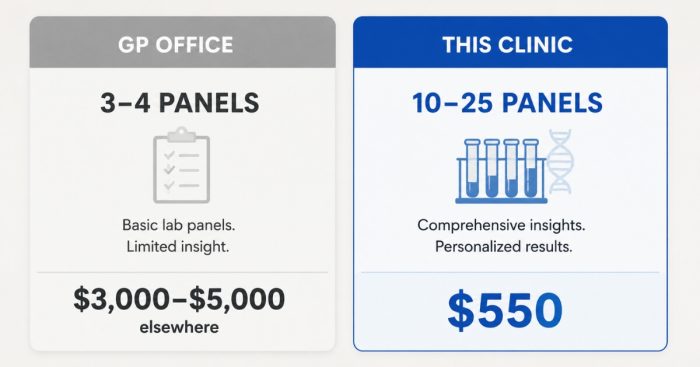
“The blood work we do here is a very comprehensive lab panel. We run 10 to 25 panels where your general practitioner’s office typically runs 3 to 4.”
Only then comes the price:
“When you do your blood work with us, it will only be $550.”
Follow it immediately with:
“Does that sound good to you?”
When a caller pushes back — “Wow, I wasn’t expecting $550, why is it so expensive?” — the script already has the answer written.
Elsewhere, these labs range from $3,000 to $5,000 for fewer panels.
Because the practice is cash-pay with thousands of patients, it has negotiated lab and medication costs down and passes those savings on.
The objection becomes a proof point.
Price resistance at the front desk almost always means the value framing was skipped, not that the price is wrong.
Should my front desk collect payment over the phone?
Yes — the script collects payment before the appointment is ever scheduled, and that sequencing is deliberate.
After the caller agrees to move forward, the script follows a fixed order: collect the demographic details (name as spelled on the driver’s license, date of birth, email, phone, and address), then billing, then scheduling.
Verbatim:
“The total for the blood work and the initial consultation will be $850. Are you ready to take care of that now? Great! I’m ready for the number when you are.”
Card number, expiration, and CVC — all collected on the call.
Most clinics do this backwards.
They book the appointment, plan to collect at the visit, and then wonder why no-show rates are brutal.
A caller who has paid $850 shows up.
The script also softens the entire sequence with two service lines worth stealing:
“Do you have any questions at this time?”
“I know this is a lot of information, but we will be with you every step of the way.”
Payment-first isn’t cold when the discovery work was warm.
How should the front desk answer “Do you take insurance?” at a cash-pay practice?
With a calm, complete, non-apologetic answer that ends in what the clinic can do — and the script has it word for word.
“We do not take medical insurance as our preferred physician is not a Medicare provider. We do not file insurance paperwork on your behalf. However, we are able to provide you with a detailed receipt and billing summary that you can submit to your insurance carrier at your will.”
Three sentences: the fact, the boundary, and the bridge.
No discount offered, no defensiveness, and no five-minute justification of the cash-pay model.
The reason this matters is simple.
The insurance question is usually the first hard objection in the call, and an unscripted front desk either fumbles it or over-explains.
A scripted answer lets the coordinator return directly to the caller’s pain points, which the discovery questions already uncovered.
The clinic this script comes from, an HRT and age-management practice we grew from $1M to $4M a year with 60 new-patient inbound calls a month fields this exact question every day.
The answer never changes, so it never derails the conversation.
Does the same phone script work for outbound follow-up calls?
Yes — the outbound version changes only the opener, then joins the identical Capture–Connect–Close track.
The verbatim outbound opener is:
“Good morning [name], this is Lauren calling from [clinic], and I have an email that you requested information about our program — is that right?”
That single line does three things.
It names the reason for the call — their request, not your pitch.
It earns an immediate small yes.
Then it places the coordinator on the same script the inbound calls use: the same permission question, the same three discovery questions, and the same value-first pricing framework.
This is why one written script beats a drawer full of one-off talk tracks.
The clinic runs separate inquiry branches for programs, hair testing, IV therapy, and NAD+.
However, every branch shares the same spine.
Train the spine once, and every service you add inherits a working phone process.
When we take on a clinic through our medical practice marketing engagements, the phone script is one of the first assets we audit because ad spend only compounds when the phone process converts what the ads produce.
Orthobiologics Associates converted 79.4% of leads into booked appointments with this kind of disciplined inside-sales process — without a dollar of paid ads behind it.
FAQ’s About Front Desk Phone Inquiry Scripts for Cash-Pay Clinics
What is the Capture–Connect–Close framework for medical practice phone calls?
It’s the three-job structure of a front desk phone inquiry script: capture the inquiry and its source, connect to the caller’s symptoms and goals through scripted discovery questions, and close the concrete next step — payment and a scheduled appointment — on the same call.
If a call ends without all three, the script wasn’t followed.
Should the front desk quote prices over the phone at a cash-pay clinic?
Yes, but only after discovery and value framing.
The script quotes $550 for labs only after establishing that the panel runs 10–25 markers versus a GP’s typical 3–4.
It answers the “why so expensive?” objection with a comparison to the $3,000–$5,000 those labs cost elsewhere.
Refusing to quote prices frustrates callers.
Quoting them cold loses them.
How does a front desk script reduce no-shows?
By collecting payment before scheduling.
The script takes card details for the $850 blood work and consultation total first, then books the appointment.
A caller with money committed keeps the appointment.
A caller with a free slot on the calendar often doesn’t.
What conversion rate can a cash-pay clinic expect from phone inquiries?
Clinics running a disciplined scripted process can convert a large majority of qualified inquiries.
Orthobiologics Associates booked 79.4% of leads into appointments with a structured inside-sales process.
By comparison, untrained front desks that answer questions and say “call back when you’re ready” typically convert only a small fraction of that.
Do I need different scripts for every service I offer?
No — one shared spine with short service branches.
The clinic behind this script uses the same greeting, permission question, discovery questions, and payment sequence for every call.
Brief branch scripts for its programs, hair testing, IV therapy, and NAD+ inquiries are simply layered on top.
What’s the next step?
If your ads and SEO are producing calls but your front desk is improvising — answering price questions cold, booking without collecting payment, and letting “do you take insurance?” end conversations — the leak is fixable in a week with a written script and a role-play session.
Book a strategy call.
In 60 minutes we’ll map your current call flow against the Capture–Connect–Close framework, identify where callers are falling out, and give you the exact script structure to fix it.