
Your Front Desk Is Your Most Profitable Provider: Why the Best Cash-Pay Clinics Treat Reception as a Sales Role
Some clinics believe their product is peptides, hormones, or GLP-1.
Wrong.
Your real product is how people feel every time they interact with your clinic — and that experience is controlled more by your front desk than by you.
Your most valuable employee doesn’t have an MD.
Here’s the FAQ on turning the front desk from an admin cost center into the most profitable “provider” in the practice.
Why is the front desk the most profitable “provider” at a cash-pay clinic?
Because the front desk controls the product patients actually buy: how it feels to deal with your clinic.
And they make or break that first impression in about ten seconds.
Think about who actually touches the moments where revenue is won or lost.
Who answers when a new lead calls, scared about their symptoms?
Who fields “do you take insurance?” and “how much is it?” — the two questions where cash-pay patients decide whether to keep listening?
Who determines whether a nervous first caller books or hangs up?
Not the physician. The front desk.
In the best clinics we work with, that position is treated like a sales and hospitality role, not “admin.”
Same desk, same phone, completely different job description.
And the revenue difference between the two versions of that role is bigger than most owners’ entire marketing budget.
How do I train a receptionist to sell without feeling salesy?
Give them the truth/fact/reality frame.
This person contacted us (truth), there’s a real reason behind that (fact), and they’re in pain and need help (reality).
Once they believe that, “sales” becomes responsibility.
Most receptionists resist anything that sounds like selling.
They didn’t sign up to close deals, and pushing feels wrong in a medical setting.
The frame fixes the psychology instead of the script.
Nobody fills out a hormone quiz or calls a weight loss clinic for fun.
The inquiry itself is evidence of a problem.
Seen that way, helping the caller take the next step isn’t pressure — it’s care.
And failing to guide them isn’t neutrality. It’s leaving someone in pain without help.
That mental shift outperforms any word-track because it changes what the front desk wants to happen on every call.
Scripts tell people what to say; the frame tells them why it matters.
What sales rules should a clinic front desk follow?
Three, and none of them are “close the deal”:
- Help the person make the best decision for them.
- Don’t force and don’t withhold.
- Find the problem, suggest the next step, and make it easy to say yes.
Sometimes the right next step is booking the consult.
Sometimes it’s honestly referring the caller somewhere else.
Either way, the patient leaves the interaction thinking, “they actually cared.”
That converts the bookable callers today and sends the non-fits away as future referrers instead of detractors.
Note what’s absent: pressure tactics, overcoming objections, and quota energy.
Cash-pay medicine doesn’t need them.
High-intent callers arrive wanting a solution.
The front desk’s job is diagnosis and ease — surface the real problem, name the appropriate next step, and remove the friction between the two.
That’s the intake half of a real patient acquisition system.
It’s also why clinics with disciplined intake processes convert at rates that look impossible from the outside.
Orthobiologics Associates booked 79.4% of its leads into appointments with exactly this kind of trained, accountable intake role.
What metrics should I measure my front desk on?
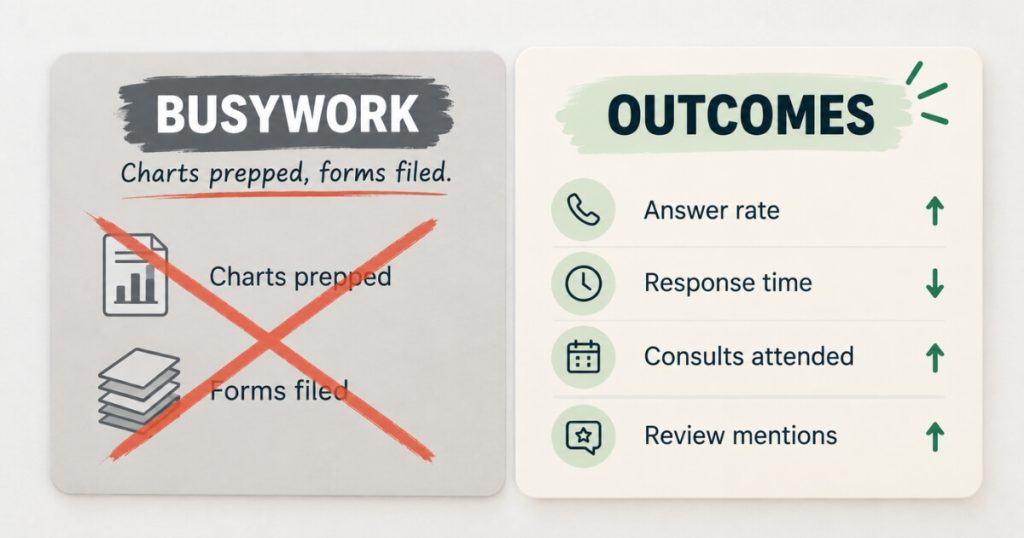
Outcomes, not busywork: answer rate, response time, new consults attended, and mentions in five-star reviews.
Bad clinics judge the front desk on charts prepped, filing speed, and forms pushed.
That’s activity that keeps people busy and grows nothing.
Good clinics measure four numbers:
- Answer rate: What percentage of calls get answered?
- Response time: How fast do inquiries get a response?
- New consults attended: How many new consultations actually happen?
- Five-star review mentions: How often do patients name the front desk in reviews?
Busy front desks don’t grow businesses. Effective front desks do.
The metrics also change the hiring profile.
If the job is measured on hospitality and conversion outcomes, you stop hiring for filing accuracy.
Instead, you start hiring for warmth, reliability, and phone presence.
And you pay accordingly because this seat is a revenue role.
A front desk that lifts answer rate and consult attendance by even a few points each month out-earns its salary many times over.
How do I know if my front desk is a growth lever or a leak?
Run the ten-review test: pull your last ten Google reviews and count how many mention the front desk by name.
Zero mentions means you’ve found a growth lever.
Patients rave about what they notice, and they notice how they were treated before they ever saw the provider.
When reviews name the person at the desk — “Maria made everything so easy” — the experience is landing.
And it’s compounding into referrals and reputation.
When ten straight reviews mention only the doctor, the front-of-house experience is invisible at best.
Invisible is a leak.
It means the first ten seconds of every patient relationship are being handled forgettably.
Pair the review test with the numbers.
Run an answer rate audit by calling your own clinic at busy hours and seeing what happens.
Then check the response time on your last twenty leads.
Those three checks take an afternoon and routinely surface more recoverable revenue than a quarter of new ad spend.
It’s the same experience-first lens we apply across medical practice marketing.
After all, marketing can only sell an experience the clinic actually delivers.
What changes when a clinic rewires its front desk this way?
Conversion rises without a dollar of new marketing, reviews improve, and the team stabilizes.
That’s because the role finally has meaning, measurement, and stakes.
The sequence we run starts with reframing the role: sales and hospitality, not admin.
Next, install the truth/fact/reality mindset and the three rules.
Then set the four outcome metrics with a weekly review.
Finally, tie a piece of compensation to results.
Within weeks, the same phone, the same lead flow, and the same staff produce more booked consults.
That’s why front-desk rewiring is usually the highest-ROI project in the practice.
It’s also cultural.
People treated as revenue-critical professionals act like it, and that shows up in retention on both sides of the desk.
The operational and the human results move together.
FAQ’s About the Front Desk as Your Most Profitable Provider
Why does the front desk matter more than clinical quality for growth?
It doesn’t matter more — it’s encountered first.
Patients can’t evaluate your clinical excellence until they get through the phone call, the pricing question, and the first visit.
And the front desk controls all three.
Great care behind a bad first impression never gets discovered.
What is the truth/fact/reality frame for receptionists?
Truth: this person filled out a form or called you.
Fact: there’s a real reason behind that.
Reality: they’re in pain and they need help.
It converts “selling” into responsibility.
The receptionist stops feeling pushy and starts feeling accountable for guiding the caller to help.
Should the front desk ever turn patients away?
Yes — when the clinic isn’t the right fit.
The rule is “don’t force, don’t withhold”: refer them somewhere that can help.
That caller becomes a source of goodwill and referrals.
Meanwhile, the front desk’s credibility with bookable patients rises because the recommendations are honest.
What’s a good answer rate for a clinic front desk?
As close to every call during business hours as staffing allows — and a fast, automated text-back for anything missed.
The bigger point is to measure it at all.
Most owners have never audited their answer rate and are shocked by what happens when they call their own clinic at 9 a.m.
How do I start improving my front desk this week?
Run the ten-review test and count front-desk name mentions.
Then audit your answer rate and response time.
Next, hold one training conversation introducing the truth/fact/reality frame and the three rules.
Measurement plus meaning — that combination alone usually moves bookings within a month.
What’s the next step?
If your reviews never mention your front desk, your answer rate is a mystery, and your intake still gets judged on charts prepped — there’s revenue sitting in your reception area that no ad budget can reach.
Book a strategy call.
In 60 minutes, we’ll audit your intake experience end to end — answer rate, response time, scripts, and metrics.
Then we’ll map the front-desk rewiring that turns your first ten seconds into your most profitable provider.