
The Founder Content Machine: How to Produce a Month of Clinic Videos Ahead of Schedule (What We Do for Our Own Brand)
Most clinic owners record video the way they exercise in January: a burst of enthusiasm, then silence.
This article opens up a real production strategy call for our own founder-led content — the same machine we tell cash-pay practice owners to build.
We’ll cover batch recording, the chessboard calendar, cheap studio lighting, client interviews, and the one rule that ties every video to actual revenue.
How much content should a clinic owner record at one time?
More than your team can edit — deliberately.
Surplus footage lets you schedule a full month ahead without constantly chasing new content.
On the production call behind this article, every campaign was already scheduled a month in advance.
Meanwhile, edits for the following month were already underway.
The standing instruction to the team was simple: always be editing the next campaign before it’s needed.
As we explained on the call:
“It’s very rare that we are going to be behind; we’re always going to be ahead.”
But that only works when each recording session produces more content than the current month requires.
The math is straightforward.
One focused recording session built around a deeper-dive topic can produce multiple usable segments.
Your editor can turn those segments into reels, short clips, and teasers.
Together, that footage can support six or more weeks of content.
The goal is to record a surplus.
Then, let your editor work from a full library of footage instead of waiting for you to record something new.
Because the moment your content calendar depends on what you filmed this week, you don’t have a machine.
You have a hobby.
How do you keep clinic video content from feeling repetitive?
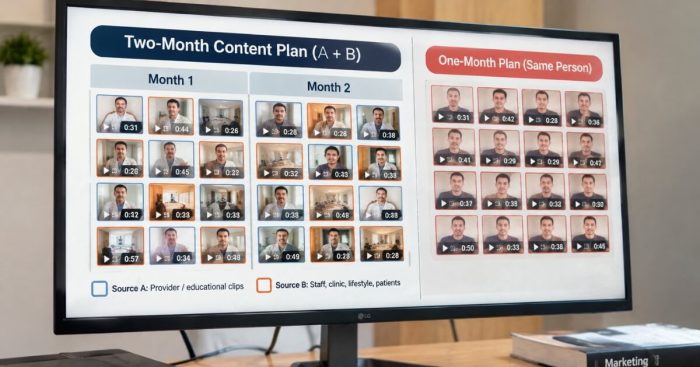
Shuffle it like a chessboard.
Instead of publishing every clip from one recording in the same month, spread those clips across multiple months.
This was one of the most important lessons from the production call.
We had already seen what happens when too many clips from one featured doctor appear close together.
Even when the information is valuable, viewers start feeling like they’ve already seen it.
The solution is to treat each recording source like a different colored chess piece.
Then, distribute those pieces throughout the content calendar.
For example, one week might feature a clip from this month’s interview.
The next could include a segment from last month’s solo recording.
Then, you might publish a teaser for a longer video scheduled to release in December.
As we explained:
“Record more than you can publish and reshuffle based on how much content you have, editing speed, and your message priorities.”
This approach creates two advantages.
First, your audience experiences more variety.
Second, your team gets more value from every recording session.
Nobody needs to see 16 videos featuring the same guest in one month.
Instead, distribute those clips alongside other content sources.
That consistency and variety help build channel authority over time.
The goal isn’t simply to publish more videos.
It’s to build a recognizable presence that keeps delivering value without becoming repetitive.
What equipment does a clinic actually need to produce good video?
Less than you probably think.
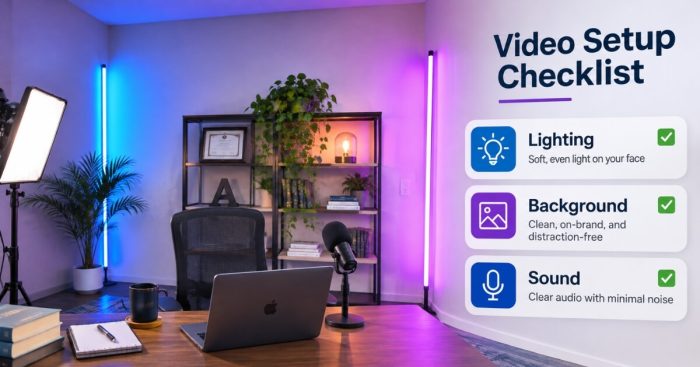
Start with decent sound, a clean background, and a couple of RGB light bars.
Only upgrade the camera when your content production schedule justifies the investment.
The quality checklist from our production call had three priorities:
- Lighting.
- Background.
- Sound.
One client’s early videos only met the sound requirement.
So we focused on improving the production environment.
Because that client recorded a podcast every week, investing about $3,000 in a proper camera made sense.
We also recommended better lighting.
However, our own founder studio needed a much simpler solution.
The plan was to place a low-profile RGB light bar on the floor in a corner.
That light would wash color up the wall behind the desk, creating depth without an expensive studio setup.
The instruction was straightforward:
“Buy one, test the corner placement, add a second if you like it.”
The total lighting investment was under $100 before considering the camera.
And that’s the important distinction.
You don’t need expensive equipment to start producing consistent video content.
The order of improvements matters more than the price of the equipment.
Start by fixing the audio because poor sound makes even a good-looking video difficult to watch.
Then, clean up the background.
Next, improve the lighting.
Finally, upgrade the camera when your recording frequency justifies it.
Clinics that begin by shopping for a cinema camera often never get around to publishing their second video.
Focus on consistency first.
Then, improve production quality as the content machine grows.
Should a clinic owner record solo videos or interviews?
Both.
Solo videos communicate your instructions, opinions, and expertise.
Meanwhile, interviews with patients, providers, and business partners validate those ideas through someone else’s voice.
Our production plan used two parallel tracks.
The first focused on solo, deeper-dive recordings.
These sessions gave the editing team longer conversations they could break into multiple short clips.
The second track focused on interviews.
That included conversations with business partners and exemplary clients.
These interviews allowed the relationships themselves to come through on camera.
But the real opportunity comes from combining both formats.
That’s where intercutting becomes valuable.
For example, your editor can take a direct-to-camera explanation from the founder and insert supporting soundbites from an actual conversation.
As we described it:
“Alternating voices to support what you’re saying — a huge validator.”
For a medical practice, imagine recording a video explaining your approach to hormone optimization.
Then, you intercut that explanation with a patient describing their personal experience and what changed for them.
Instead of relying entirely on the provider’s perspective, the video includes another voice.
That makes the content more engaging and gives viewers additional context.
However, there are two important housekeeping rules.
First, get a signed agreement covering the footage before featuring anyone.
For patients, that also means obtaining appropriate authorization and following applicable healthcare privacy and advertising requirements.
Second, feature people whose relationship with your practice is stable.
You don’t want to build an entire video series around someone who’s about to leave.
When done correctly, these collaborations benefit both sides.
Your practice gains credible supporting content.
Meanwhile, the featured patient, provider, or partner receives additional exposure when appropriate.
How do you make video editing fast and cheap?
Give your editor timestamped soundbites instead of hours of unorganized footage.
Then, schedule recording sessions immediately after the working days that give you the most ideas.
Two workflow habits from our production call make this process significantly easier.
The first is timestamping.
Whenever you share a recorded call or interview, identify the exact moments you want to use.
Include the timestamps and attach the transcript.
That way, your editor knows which soundbites matter and where to find them.
As we explained:
“If I can just solve when, and get them the transcript, and they know what I’m looking for, it’ll be way easier.”
Without that preparation, an editor might spend hours reviewing footage just to find a few usable clips.
With timestamps, they can move directly into production.
The second habit is recording when your ideas are freshest.
Our founder scheduled a recording session for the afternoon after two full days of back-to-back client calls.
Why?
Because those conversations would give him plenty of real examples, frustrations, and wins to discuss.
As he put it:
“I’ll have all kinds of stuff to pull from.”
One of the best-performing recordings came from a day when the founder was, in his own words, pissed off.
That frustration translated into conviction on camera.
And viewers could feel it.
For clinic owners, the same principle applies.
Record after a busy clinic day, a series of consultations, or a week filled with important patient conversations.
That’s when the questions, objections, and insights are fresh in your mind.
You don’t need to manufacture enthusiasm.
You already have something meaningful to say.
Batch your recording sessions when you’re full of ideas.
Then, timestamp the strongest moments and hand them to your editor.
With the right workflow, the content machine can run on just a few hours of your time each month.
That’s exactly the kind of leverage a medical practice marketing system should create.
How do you connect content to actual revenue instead of just views?
Aim every video at the specific patient or client tier you want more of.
Then, use your messaging to steer people away from offers that don’t make sense for your business.
Throughout our production strategy call, we kept returning to one idea.
Play chess, not checkers.
Content marketing isn’t just about publishing consistently.
It’s about sequencing your messages around specific business objectives.
First, identify your most profitable customer tier.
For the business discussed on this call, that meant top-tier engagements.
Next, identify the problems those buyers are actually trying to solve.
For example, they might be struggling to scale across multiple locations.
Or they might be wondering whether their team and systems can handle more growth.
Those are the problems your videos should address.
Instead of publishing generic content, speak directly to the people you want to attract.
Meanwhile, use your pricing and messaging to discourage offers that create more frustration than value.
As we explained on the call:
“Either make it more expensive or just tell them it doesn’t make sense.”
Every cash-pay clinic has an equivalent.
Maybe it’s a one-off service that fills the schedule but generates little long-term value.
Meanwhile, higher-value membership patients are waiting for appointments.
Your content should help attract the patients you actually want.
At the same time, it should naturally filter out patients who aren’t a good fit for your business model.
That’s how content becomes a growth strategy rather than a collection of views.
And when you consistently publish educational content for the right audience, the results can compound.
The goal isn’t simply to become more visible.
It’s to become more visible to the patients who support sustainable growth.
FAQ’s About Founder-Led Content for a Cash-Pay Clinic
How far ahead should a clinic’s content calendar be scheduled?
At least one full month.
Ideally, your team should already be editing the following month’s content while the current month’s posts are scheduled.
However, that buffer only works when you record more footage than you publish.
Surplus content gives your team flexibility.
It also prevents last-minute recording sessions from becoming a weekly emergency.
The goal is to stay ahead rather than constantly catching up.
How do I stop followers from feeling like they’ve seen my videos before?
Avoid publishing every clip from the same recording in one month.
Instead, organize your content calendar like a chessboard.
Mix clips from different recording sessions, interviews, and topics.
For example, alternate between this month’s interview, last month’s solo recording, and a teaser for an upcoming video.
That keeps the feed varied even when some footage was recorded weeks earlier.
Your audience gets a more interesting mix of content.
Meanwhile, your team gets more value from every recording.
What’s the minimum equipment for clinic video content?
Start with good sound, a clean background, and basic lighting.
One or two RGB light bars can add depth to your recording space for under $100.
You don’t need a professional studio to begin.
Instead, prioritize clear audio and a distraction-free environment.
If you eventually develop a recurring format, such as a weekly podcast, a more expensive camera may become worthwhile.
On our production call, a camera investment of approximately $3,000 made sense because the client recorded every week.
But for most clinics, consistency matters more than expensive equipment.
Do I need permission to publish videos featuring patients or staff?
Yes.
Get a signed agreement covering the footage before publishing videos featuring patients, employees, or partners.
For patients, make sure the authorization meets applicable healthcare privacy requirements.
You should also consider the stability of the relationship.
If someone is about to leave your organization, featuring them heavily could create unnecessary problems later.
The goal is to build a sustainable content library.
You don’t want to spend months producing videos only to question whether you should keep using them.
When is the best time to record founder content?
Immediately after your most intense working days.
That might mean recording after a busy clinic schedule, several consultations, or a week filled with important conversations.
Those experiences give you fresh stories and useful insights.
And they help you speak with genuine conviction.
Our founder deliberately scheduled recording sessions after back-to-back client calls for this reason.
The best ideas often come from the problems you’re actively solving.
Capture them while they’re fresh.
Your audience can usually tell when you’re speaking from real experience.
What’s the next step?
If you want a content machine for your practice instead of another January burst of enthusiasm, book a strategy call.
We’ll map your recording cadence and build a chessboard content calendar that keeps your videos varied.
We’ll also identify the simple studio setup you need, even if that means starting with just one light bar in the corner.
Most importantly, we’ll identify the patient tier your content should attract.
Every video should have a purpose beyond generating views.
We run this system for our own brand.
And we’ll show you how to build the same kind of content machine for your clinic.