
The First Milestone in Scaling a Healthcare Business: Why $20–30K a Month Is the Hurdle That Changes Everything
Every cash-pay practice owner asks some version of “when does this get easier?”
There’s an actual number.
The first milestone in scaling a healthcare business is $20,000 to $30,000 a month in revenue.
And what you should be doing before that hurdle is almost the opposite of what you should be doing after it.
Here’s the FAQ, including the uncomfortable advice about keeping your other income until you’re there.
What’s the first revenue milestone when scaling a healthcare business?
$20K to $30K a month.
That’s the first hurdle — the point where the practice can begin to sustain itself and fund its own growth.
Below that line, a cash-pay practice isn’t yet a self-supporting business.
It’s a project that needs outside fuel.
Above it, there’s enough recurring revenue to cover core overhead, keep a basic marketing engine running, and start compounding.
The number matters because owners who don’t know it tend to make stage-inappropriate decisions.
They go full-time too early, hire too early, or conclude the model “doesn’t work” when the practice is simply pre-milestone.
Getting to the first hurdle isn’t about doing everything.
It’s about doing the few things that produce paying patients: a clear offer, one working acquisition channel, and follow-up that doesn’t leak.
Should I keep my day job while launching a cash-pay practice?
If the practice isn’t doing $20–30K a month yet — yes.
You should have something full-time supporting you until it is.
That’s the advice we give owners directly: if your business is not currently doing $20 to $30 grand a month, you should probably have something full-time to support that.
That’s because you’re going to need supplemental income coming in.
The early practice needs investment in other resources, and it can’t yet fund both those resources and your life.
Owners hate hearing this because it feels like a lack of commitment.
It’s the opposite.
The clinic that fails isn’t usually the one that grew slowly.
It’s the one where the owner needed to pull a full salary out of a pre-milestone practice.
As a result, there was never money left for the website, the CRM, or the marketing that would have gotten it past the hurdle.
Keeping outside income is what protects the growth budget.
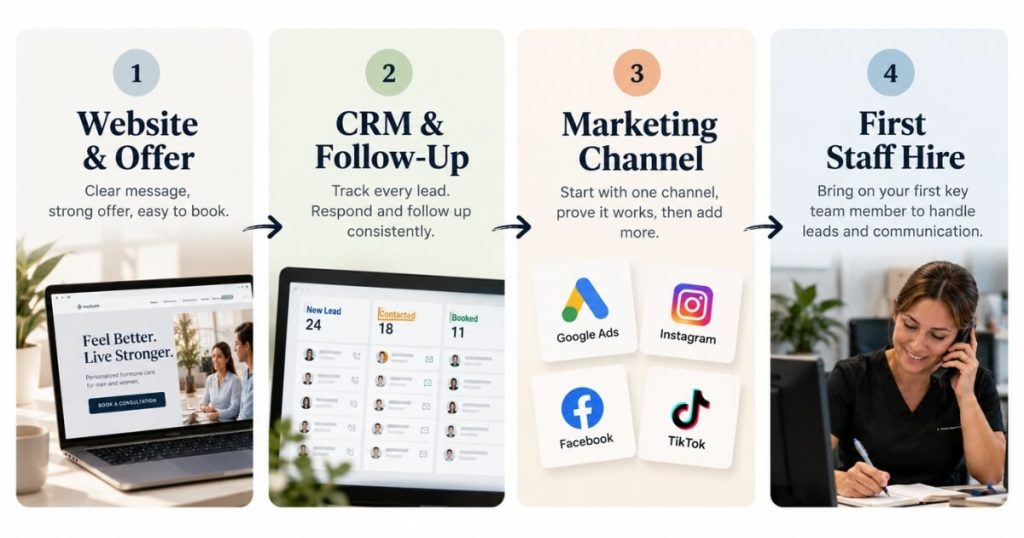
What does a new cash-pay clinic need to invest in before it’s profitable?
Four things, in order: a clear offer, a website that converts, a CRM with automated follow-up, and one acquisition channel done properly.
The offer comes first because everything downstream converts or dies based on it.
It defines what the patient gets, what it costs, and why it’s worth paying cash for.
Next, the website serves as the storefront every prospective patient checks before calling.
The CRM stops early leads from leaking through spreadsheet tracking and forgotten callbacks.
Those leads are scarce and precious at this stage.
Finally, one channel done properly beats three channels done half-heartedly.
For most new clinics, that’s local SEO plus a Google Business Profile.
That’s because high-intent searchers convert at a fraction of the acquisition cost of cold traffic.
This is exactly why pre-milestone owners need supplemental income.
These investments come before the revenue that justifies them.
A practice trying to pay the owner’s mortgage and fund this stack at the same time usually funds neither well.
How do I get a new practice to $20–30K a month?
Pick the highest-intent channel available, build a real patient acquisition system behind it, and let one proof loop compound.
High intent comes first.
People already searching for your treatment convert faster and cheaper than people who need convincing.
Averaged out, that’s a practice clearing the first hurdle every single month on organic demand and disciplined follow-up.
The second half of that sentence matters as much as the first.
A predictable patient acquisition system is what turns the channel’s output into revenue.
That means speed-to-lead response, scheduled follow-up, and a booking process that doesn’t leak.
Early-stage clinics don’t have enough lead volume to survive sloppy conversion.
Every inquiry has to count.
What changes after crossing the first milestone?
The job flips from “generate any revenue” to “build the machine.”
Reinvestment, first hires, and systems become the priority.
Past $20–30K a month, the practice can fund its own growth.
That means more content, more channels, and a first administrative hire to get scheduling and follow-up off the owner’s plate.
This is where the owner’s role starts shifting from doing everything to building the operation.
It’s also the stage where working with a team that does medical practice marketing full-time starts paying for itself.
That’s because there’s now revenue for the marketing to compound.
The milestones keep coming after that.
Around $100K a month is when a practice can typically support another provider.
But the first hurdle is the one that changes the owner’s decisions the most.
Before it: protect your income, invest in the foundation, and obsess over one channel.
After it: reinvest, hire, and systematize.
FAQ’s About the First Milestone in Scaling a Healthcare Business
Why is $20–30K a month the first milestone for a cash-pay practice?
Because that’s roughly where a practice covers its core overhead and can fund its own growth.
Below it, the practice depends on outside money — the owner’s savings or supplemental income.
Above it, revenue can be reinvested into marketing, staff, and systems without starving the owner.
Is it a red flag if my practice is under $20K a month after launch?
Not by itself.
Every practice starts pre-milestone.
The red flag is being under the hurdle with no working acquisition channel and no follow-up system.
That’s because there’s no mechanism to get you across.
Fix the offer, one channel, and the CRM before judging the model.
How long should it take to reach $20–30K a month?
It varies by specialty and market.
However, clinics with a clear cash-pay offer, a converting website, and one properly run high-intent channel typically get there inside the first year.
Clinics spreading their budget across many channels with leaky follow-up often never do.
Should I take a salary from a pre-milestone practice?
Keep it minimal — ideally covered by outside income instead.
Every dollar the owner pulls from a pre-milestone practice is a dollar not invested in the website, CRM, or marketing that gets the practice over the hurdle.
The earlier the stage, the more expensive that dollar is.
What’s the next milestone after $20–30K a month?
Around $100K a month.
That’s the point where a cash-pay practice can usually support hiring another provider.
The owner also starts building real leverage through team and systems.
Between the two milestones, the job is reinvesting and systematizing.
What’s the next step?
If your practice is under the first hurdle and you’re not sure whether the problem is the offer, the website, the channel, or the follow-up — book a strategy call.
In 60 minutes, we’ll pinpoint which piece is actually holding you under $20–30K a month.
Then we’ll map the shortest path across, drawing on what’s worked for clinics like a longevity practice whose website leads we grew 900% in four months while inbound calls climbed past 100 a month.