
What Should a New Cash-Pay Patient Get on Day 0? (The Welcome Kit That Fills the Dead Weeks Between Paying and Results)
The most dangerous window in any cash-pay program isn’t the sales call — it’s the one to two weeks after the patient pays.
The labs are at the lab, the consult is on the calendar, and the patient receives absolutely nothing.
That silence is where buyer’s remorse lives.
A physician-led longevity clinic we work with closes that window with something almost embarrassingly simple: three printed cards, three stapled product samples, and three habits that start tonight.
Here’s exactly how their Day-0 kit works, and how to build one for your practice.
What happens between a patient paying and getting their first results — and why is it dangerous?
In most cash-pay practices: nothing.
The patient pays hundreds or thousands of dollars, then waits one to two weeks in total silence.
Think about the sequence from the patient’s side.
They made a big, often emotional purchase from a practice they may have never visited before.
Then the momentum stops: schedule the draw, wait for results, wait for the consult.
Every day of that dead air, the confident version of them that said yes fades a little.
Meanwhile, the skeptical version — the one whose spouse is asking what exactly they paid for — gets louder.
Refund requests, no-shows at the results consult, and lukewarm program enrollment all incubate in this window.
The fix isn’t faster lab turnaround.
It’s making sure the program visibly starts the moment the money moves.
That way, the patient is in the program in hour one, not week two.
What is a Day-0 kit?
A small physical package handed to the patient at signup or the blood draw: printed cards, real product samples stapled to them, and instructions that start tonight.
The kit our client hands out contains three 4×6 cards, each with a sample attached.
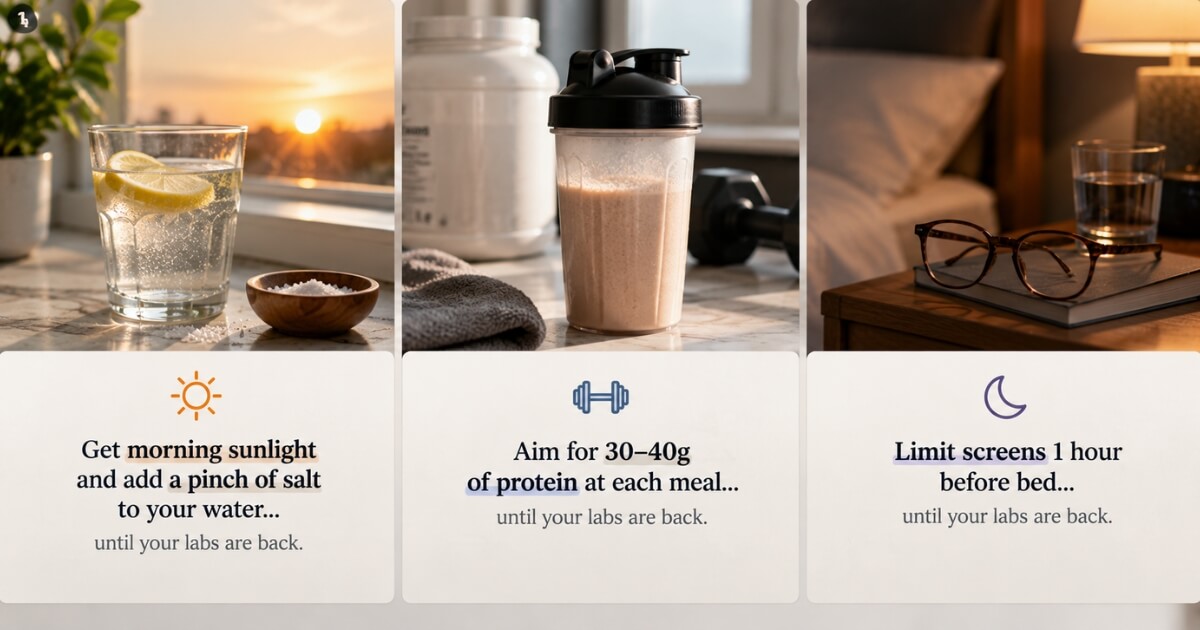
Card one: A sugar-free electrolyte packet. Mix it into water on waking, before coffee, every morning “until your labs are back.”
Card two: A single serving of third-party-tested whey. Get 30 grams of protein in the hour after training, “until we build your personalized plan.”
Card three: A pair of blue-light-blocking glasses. Put them on 90 minutes before bed, starting tonight.
Notice the design choices.
Each card explains why the clinic chose that specific product.
It gives the actual mechanism in plain language, with the clinic’s clinical standards visible: “third-party tested, no artificial sweeteners… the kind of label a precision-diagnostics clinic can staple its name to.”
Each habit is safe and universal, so nothing depends on results that aren’t back yet.
The instructions also tie each habit to the program itself — “until your labs are back.”
That quietly converts a waiting period into a preparation period.
The patient isn’t waiting for the program to start anymore.
They’re on Day 3 of it when the consult arrives.
Why does a physical kit beat a welcome email?
Because the patient paid for a promise, and a physical object is the first proof the promise is real.
A welcome email gets skimmed and buried by lunchtime.
A card with a sample stapled to it sits on the kitchen counter, and the patient actually uses the sample.
That means the first “win” of the program happens in the patient’s own body within 24 hours, not in a portal.
Clearer mornings from hydration.
A night of better sleep from the glasses.
Small, feelable, fast.
The patient starts attributing improvements to the program before a single result is back.
Then they walk into the results consult already convinced the clinic changed something.
There’s also a positioning effect.
Every element of the kit repeats the clinic’s identity — physician-led, precision, no junk — in a format the patient physically handles.
That’s brand-building at the exact moment trust is most fragile.
It’s also a page straight out of what makes functional medicine & longevity clinic marketing different from selling commodity treatments.
High-consideration patients don’t just buy the protocol.
They buy the standard of care the protocol signals.
How does a Day-0 kit pay for itself?
Through restock links — disclosed plainly — and through the retention math of a patient who starts winning immediately.
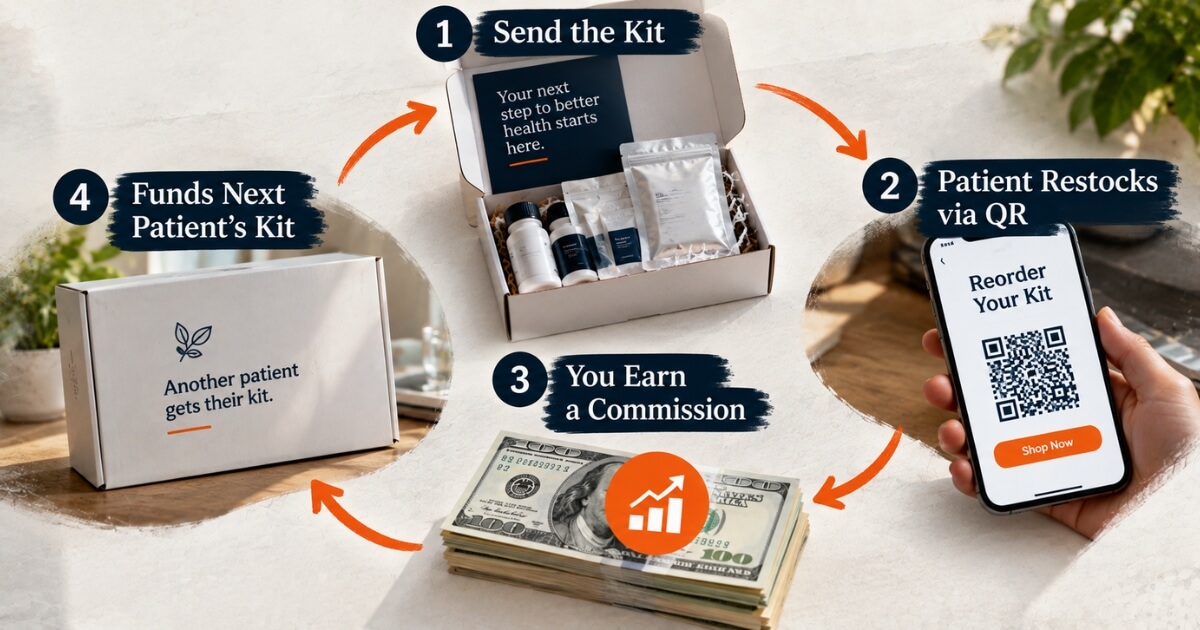
Each card in our client’s kit carries a QR code to restock the product through the clinic’s affiliate link.
A transparency note appears right on the card: restocking through it never costs the patient extra, and the small commission “funds welcome kits for future patients.”
That disclosure does double duty.
It’s honest, and it turns the affiliate link into a community gesture instead of a money grab.
But the affiliate revenue is the small win.
The real return is downstream.
A patient who felt something improve in week one shows up to the consult primed to enroll.
And a patient who enrolls already holding three kept promises churns less.
That’s the economics that built a hormone clinic with 250 active members paying $1,000 a month.
Recurring-revenue medicine lives or dies on whether the patient keeps feeling the program working.
The Day-0 kit is the first, cheapest link in that chain.
What should go in your clinic’s Day-0 kit?
Three actions your provider genuinely believes in, that are safe for everyone, feelable fast, and executable tonight — plus a sample that removes the first excuse.
The selection rules matter more than the specific products.
Choose something universal and safe because nothing can depend on labs that aren’t back.
It should also feel different within days — hydration, sleep, or a protein target — because the point is early proof, not marginal optimization.
Your provider should personally endorse it: “whatever your physician believes in most.”
The kit either speaks with the clinic’s clinical voice or it’s just a gift bag.
Finally, physically sample the product.
The packet stapled to the card is what converts advice into action on day one.
A hormone practice, a GLP-1 program, a regenerative clinic, and a concierge practice would each pick a different three — but every vertical has three.
The card copy formula stays identical: why we chose this exact product, what it does for your specific journey, how long to do it (“until your labs are back”), and where to restock.
One page per habit, written once, printed forever.
Where does the Day-0 kit fit in the bigger patient journey?
It’s mile one of the 12–18 month journey — the moment retention actually starts.
Most practices treat onboarding as paperwork and retention as something to worry about at renewal time.
Clinics that build durable recurring revenue design the journey the other way around.
They schedule value touches from day zero — kit, first-signals check-in while results process, results consult, protocol milestones, and scheduled reviews.
As a result, there is never a stretch where the patient wonders whether anything is happening.
The Day-0 kit is simply the first touch, and the cheapest one on the whole map.
It also compounds with acquisition.
A patient who gets this treatment tells the story — to a spouse, a friend, or in a Google review.
Word-of-mouth from an over-delivered first week is the least expensive medical practice marketing channel there is.
The same clinic ecosystem this kit comes from grew inbound demand dramatically once the experience matched the promise.
We took a longevity clinic we took to 900% more website leads and 100+ inbound calls a month in four months — and the kit is part of why that demand converts and stays.
FAQ’s About Day-0 Patient Welcome Kits
What goes in a Day-0 welcome kit?
Three printed cards, each with a physical product sample attached and one habit that starts tonight.
The clinic version this article is based on uses a sugar-free electrolyte packet for morning hydration.
It also includes a single serving of third-party-tested whey protein for the post-training “golden hour” and blue-light-blocking glasses for the 90 minutes before bed.
Each habit is time-boxed “until your labs are back.”
When should the kit be handed to the patient?
The moment the program becomes real — at payment or at the blood draw.
The kit’s entire job is to fill the dead window between paying and first results.
So delivering it with the welcome email a week later defeats the point.
Handing it over in person, with the samples stapled to the cards, is part of the effect.
Is it okay to put affiliate links in a patient kit?
Yes, if you disclose plainly and the products meet your clinical standard.
The kit this article describes prints the disclosure on every card.
Restocking through the QR code never costs the patient extra, and the commission funds welcome kits for future patients.
Choose products you’d recommend anyway.
Then disclose the relationship in plain sentences, and the link reads as a service, not a sales pitch.
What makes a good Day-0 habit?
Four tests: safe for every patient regardless of what the labs eventually show; feelable within days, not months; genuinely believed in by your provider; and startable tonight with the sample in the kit.
Hydration, protein targets, and sleep-environment changes pass all four for almost every cash-pay vertical.
Does a Day-0 kit work outside longevity and functional medicine?
Yes — the mechanism is universal.
Any practice where money changes hands before results arrive has the same remorse window.
That includes hormone programs waiting on baseline labs, GLP-1 programs waiting on first titration, and regenerative patients waiting on a procedure date.
Each vertical picks its own three safe actions.
The card formula and the timing stay the same.
What’s the next step?
Walk your own patient journey from the moment of payment and count the days until the patient receives anything at all.
If the answer is more than 24 hours, you have a remorse window — and it’s costing you refunds, consult no-shows, and soft enrollments you never see coming.
Book a free strategy call and we’ll map your pay-to-results window, design your version of the Day-0 kit, and show you where the other silent gaps in your patient journey are leaking revenue.