
Why Does My CRM Show No Patients From My Ads? (A Live Attribution Audit of a Cash-Pay Weight Loss Practice)
The owner of a cash-pay medical weight loss practice in Florida believed Facebook was doing almost nothing for him.
On one consulting call we rebuilt his October numbers live: $861 in spend he didn’t know he’d made (“Wait, where did you get that Facebook spend?”), roughly 45 leads at about $20 apiece, 5 findable bookings, and 2 paying patients worth $1,088.96.
The ads were fine.
The tracking was destroying the evidence.
Here’s the FAQ on how that happens — and how to audit your own funnel before you kill a working campaign.
How do I know if my Facebook ads are actually getting me patients?
Trace one month end-to-end — spend, leads, cost per lead, bookings, cost per booking, new patients — and refuse to accept any gap in the chain.
Most owners judge ads by feel: the schedule looks the same, so the ads must not be working.
The audit on this call told a different story.
October spend was $861.
Reconstructing the lead lists gave ~45 Facebook leads — roughly $20 per lead, a healthy number for medical weight loss.
Then the funnel went dark.
Only 5 Facebook-sourced booked appointments were findable in the pipeline. And only 2 conversions were traceable, worth $1,088.96 combined.
Of 26 new members that month, 24 showed “referred by patient” or no source at all.
That’s not a performance report.
That’s a tracking failure wearing a performance report’s clothes.
Why does my CRM show no patients from my ads?
In this practice’s case, every time a booked lead no-showed, the CRM moved them back to the first pipeline stage — overwriting the booking and the source.
We found the mechanism live.
A lead books from a Facebook ad, no-shows once, and the automation recycles them to “Prospects” as if they’d never booked.
The history is gone: “that’s just going to give you inaccurate data.”
Multiply that by every no-show and reschedule, and a month of real ad-driven bookings evaporates from your reports.
Meanwhile, the patients who eventually show up get logged as walk-ins or referrals.
The fix costs nothing.
An automation adds a persistent “booked appointment” tag and a source tag the moment the booking happens. Those tags survive every stage move.
Use dedicated reschedule and no-show stages instead of recycling people to the top of the funnel.
And keep attribution in ONE system — this practice’s EHR was quietly overwriting sources the CRM had captured correctly.

What marketing metrics should a cash-pay practice track every month?
Seven, per platform: spend, leads, cost per lead, appointments booked, cost per booking, new patients, and recurring patients.
Keep them in one shared tracking sheet reviewed monthly.
The per-platform split is what makes the sheet useful — blended numbers hide the winner and protect the loser.
When the chain is intact, you can make real decisions.
A ~$20 CPL with weak bookings points at follow-up or offer, not creative.
A high CPL with strong conversion points at targeting or budget.
A practice owner we work with added $2 million in revenue from Facebook ads alone — and the reason that number is knowable is that every stage of the funnel was tracked by source.
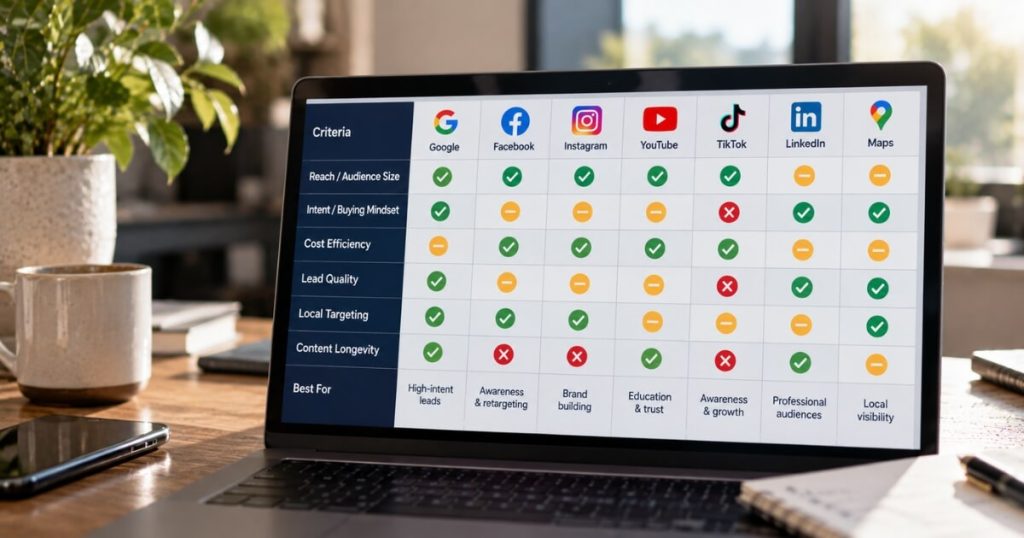
Why are my Facebook leads so low quality?
Usually targeting, not creative — and usually because an automated audience setting is choosing your patients for you.
This practice was running Meta’s hands-off AI targeting with no audience control, pulling clicks from browsers of Medicare age for a cash-pay weight-loss offer.
The rebuild on the call was a defined audience of women 25–64, capped under 65 “because 65 and up is Medicare.”
We layered that with proven shopper interests. The audience landed around 300,000 people, plus the practice’s own buyer list uploaded as a seed.
Same ads, same budget, dramatically different intent.
Before you rewrite creative, audit who the machine is actually showing it to.
Dialing this in is core GLP-1 & weight loss clinic marketing — the offer and the audience have to match before spend scales.
How long does SEO take for a medical practice to rank?
About two years of consistent publishing — and the early wins show up in impressions before they show up in clicks.
The owner wanted to know when SEO would “work.”
The honest benchmark from our portfolio: the weight-loss medspa we helped add $6.7M in revenue in a single year took roughly two years of consistent blogging to dominate its search market.
The leading indicator is impressions rising month over month — clicks follow impressions.
Check Search Console yourself monthly: impressions, clicks, GMB calls, and indexed pages.
And stop tinkering.
This practice had experimented its way into a mess that nearly required re-uploading 350 pages.
Set the structure, publish consistently, and leave the site alone.
Should I kill a campaign my CRM says isn’t converting?
Not until you’ve verified the CRM is telling the truth — audit the tracking before you audit the ads.
The sequence matters.
First, confirm bookings and sources survive no-shows and reschedules with persistent tags.
Then confirm one system owns attribution — CRM, not the EHR.
Next, pull one month of spend and walk it stage by stage.
Only after the chain holds do performance judgments mean anything.
This owner was a week away from concluding Facebook “did little” — on numbers that undercounted his own funnel by more than half.
FAQ’s About Ad Attribution for Cash-Pay Practices
What is a good cost per lead for a cash-pay weight loss practice?
Around $20 per lead from Facebook is solid for medical weight loss.
This practice hit roughly that — $861 spend and ~45 leads — in the audited month.
Cost per booking and cost per new patient matter more, which is why the tracking chain has to survive past the lead stage.
Why do most of my new patients show up as “referred by patient” in the CRM?
Because source fields get overwritten or never set.
In this audit, 24 of 26 new members had no usable source.
That came from a mix of no-show recycling erasing history and the EHR overwriting the CRM’s source data.
Should my EHR or my CRM be the source of truth for marketing data?
The CRM.
The EHR is built for clinical records, not attribution.
Pick one system for pipeline and source tracking and make the other read-only for marketing purposes.
What’s a persistent tag and why does it fix attribution?
A persistent tag — like “booked-appointment” or “source: Facebook” — gets applied by automation the moment an event happens.
Unlike pipeline stages, tags don’t get wiped when a contact moves.
That means a no-show can go back for rebooking without erasing the fact that the ad produced a booking.
Is targeting or creative usually the problem with bad Facebook leads?
Targeting, most of the time.
Unbounded automated audiences chase cheap clicks wherever they live, including demographics that can’t buy a cash-pay offer.
Define the audience — age caps, interests, and seed lists — before spending a dollar on new creative.
What’s the next step?
If your gut says the ads aren’t working but you can’t trace a single month of spend from click to collected cash, you don’t have an ads problem — you have an evidence problem.
Book a strategy call.
In 60 minutes we’ll walk one month of your spend through the funnel live, find where the data chain breaks, and set up the persistent-tag structure so next month’s decision is made on real numbers.