
How to Design a Concierge Medicine Pricing Table That Sells the Membership (Real Numbers From a DPC Clinic)
Most concierge and DPC clinics lose the membership sale before a word is spoken — in the pricing layout itself.
Below is the actual pricing grid we designed with a concierge medicine clinic we consult with: four columns, one anchor, and math the patient does in their own head.
Real numbers included, because the layout only makes sense when you see what it does to them.
How should a concierge or DPC clinic present its pricing?
One table, four columns: A La Carte first, then each membership tier — so every “Included” reads against a real dollar figure.
The grid we built for this clinic runs: A La Carte | Family DPC ($350/month) | Individual DPC ($275/month) | Hormone Membership.
Down the left side, list every service a patient actually buys: labs, a 60-minute initial consult, follow-up labs, follow-up consults, hormones, GLP-1, peptides, supplements, sick visits, and kids’ sick visits.
The design principle: never show a membership price in a vacuum.
A membership number floating alone on a page invites one question — “is that expensive?”
The same number sitting beside the a-la-carte cost of everything it replaces answers the question before it’s asked.
Why does the a-la-carte column come first?
Because it’s the anchor — and the anchor does the selling.
In this clinic’s grid, the a-la-carte column adds up to $9,600 a year.
That includes $400 labs, a $300 initial consult, $300 follow-up labs, $300 follow-up consults, $100/month hormones, $200/month supplements, and $100 sick visits.
Against that anchor, the Family DPC at $4,200 a year and the Individual DPC at $3,300 a year stop looking like costs.
Instead, they start looking like the obvious move.
The Hormone Membership at $4,800 a year reads the same way.
Nobody at the clinic ever has to say “it’s a great deal.”
The patient runs the comparison themselves, left to right.
And a conclusion a patient reaches on their own beats any claim a clinic makes.
That’s the entire psychology of the layout.
It’s the same anchoring logic that powers functional medicine & longevity clinic marketing across every high-consideration membership offer.
What belongs in the rows of a concierge pricing table?
Every service a patient would otherwise buy separately — priced honestly in the a-la-carte column and marked “Included” wherever the membership absorbs it.
The repetition is the point.
When a patient scans the Family DPC column, they read Included, Included, Included, Included down the page.
That applies to labs, the initial consult, follow-up labs, follow-up consults, sick visits, and kids’ sick visits. It also includes concierge access for medication questions, priority scheduling, and shipping support.
The membership stops being an abstract subscription.
Instead, it becomes a bundle of things they can already picture using.
Two row types matter, and they behave differently.
Fixed-cost services — consults, labs, and sick visits — get marked Included. Their marginal cost to the clinic is low, while their perceived value is high.
Consumables with real unit costs work differently.
GLP-1 at $400, peptides averaging $300/month, and supplements at $200/month get a 15% discount instead.
That distinction is what makes the table generous and profitable at the same time.
How do you keep membership pricing profitable while including so much?
Never include what scales with usage — discount it.
The rule visible in this grid is simple: “Included” is reserved for services whose cost the clinic controls, such as provider time and in-house labs.
Anything with a hard per-unit cost that grows with patient usage appears as 15% off in every membership column.
That includes GLP-1 medications, peptides, and supplements.
A member taking advantage of everything saves about $60 a month on GLP-1, $45 on peptides, and $30 on supplements.
Those are real, visible savings that reward the membership without putting the clinic in the position of losing money on its heaviest users.
Get this wrong — include the consumables — and your best customers become your worst margins.
Get it right, and recurring membership revenue compounds.
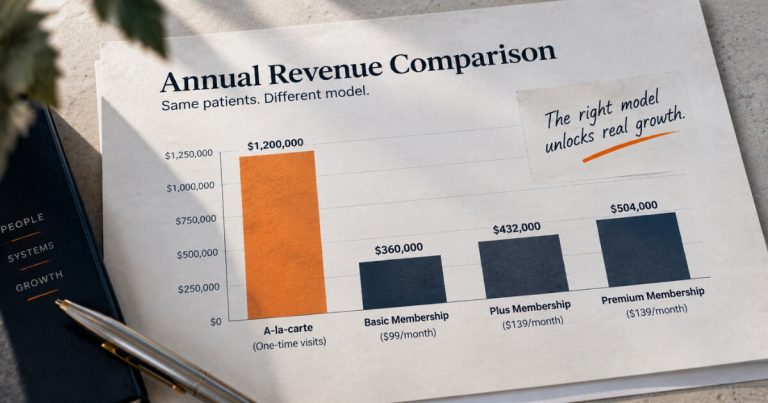
Should the pricing table show the savings math explicitly?
Yes — print the annual totals and the monthly savings lines directly on the page.
This clinic’s grid ends with the annual comparison in plain sight: $9,600 a-la-carte versus $4,200 for Family DPC, $3,300 for Individual DPC, and $4,800 for the Hormone Membership.
That’s followed by the per-line savings for members.
Don’t make the patient do arithmetic to discover the value.
Patients who have to calculate savings usually don’t. Patients who see them printed treat them as fact.
This also arms the front desk.
When a caller asks “how much is it?”, the team doesn’t defend a number — they walk the caller through a comparison.
The table turns a price objection into a value conversation.
That’s precisely the skill gap that keeps most practices dependent on the owner to close.
What mistakes do clinics make when presenting concierge membership pricing?
Three show up constantly: hiding pricing entirely, offering too many tiers, and including usage-based consumables.
Hiding pricing feels safe, but it filters out nobody and frustrates everybody.
Motivated cash-pay patients research price before they call. A clinic with no visible pricing logic loses them to one with a clear grid.
Too many tiers — five, six, or seven options — create analysis paralysis.
This clinic runs three memberships against one anchor, and that’s plenty.
Finally, including consumables like GLP-1 or peptides to make the membership look richer quietly destroys the economics that make membership medicine work.
The same discipline that decides what gets “Included” is the discipline that turned a specialist practice’s insurance dependence into a growing cash-pay practice with $40K+ more in monthly revenue.
FAQ’s About Concierge and DPC Pricing Table Design
What is price anchoring on a concierge medicine pricing page?
It’s placing the full a-la-carte cost of services — $9,600 a year in this clinic’s real grid — in the first column.
That way, the membership prices of $3,300 to $4,800 a year are read against it.
The patient concludes the membership is the smart buy on their own.
That’s far more persuasive than the clinic claiming it.
What did this real DPC clinic charge for its memberships?
Family DPC at $350/month, Individual DPC at $275/month, and a Hormone Membership.
Those sit against a-la-carte prices of $400 for labs, $300 for a 60-minute initial consult, $300 for follow-up consults, $100 for sick visits, and $50 for kids’ sick visits.
Use the structure, not necessarily the numbers.
Your market and cost basis set the exact figures.
Should labs and consults be included in a DPC membership?
Generally yes — they’re fixed-cost services whose marginal cost the clinic controls.
Rows of “Included” are also what make the membership feel complete.
The repetition of Included down the column is a deliberate design choice, not decoration.
Should GLP-1s, peptides, and supplements be included in membership pricing?
No — discount them instead.
This clinic gives members 15% off GLP-1, peptides, and supplements.
That’s worth roughly $60, $45, and $30 a month respectively.
Members see real savings, but the clinic never loses money on heavy users the way it would if usage-based consumables were flat-out included.
Should a cash-pay clinic publish its pricing on the website?
Show the structure — the tiers, what’s included, and the anchor comparison — even if you reserve exact quotes for the consult.
Cash-pay patients research pricing before calling.
A clear pricing layout wins trust from the patients most ready to buy.
What’s the next step?
If your concierge or DPC clinic’s pricing lives in a text list, a PDF nobody opens, or the owner’s head, you’re losing memberships in the layout.
Book a strategy call.
In 60 minutes, we’ll rebuild your pricing into an anchored grid like this one — what to include, what to discount, and how to present it so patients sell themselves.