
What Should a Concierge Medicine Clinic Charge À La Carte? (The One-Page Service Cost Layout That Anchors Your Membership)
Most concierge and cash-pay clinic owners agonize over the membership price and never write down what each service costs on its own. That’s backwards. The à-la-carte service cost layout — one page, seven lines — is the document that makes every other pricing decision easy. Here’s the exact layout a concierge medicine practice we work with uses, line by line, and the logic for building yours.
Why does my concierge clinic need an à-la-carte price for every service?
Because a membership is only compelling next to a visible alternative.
The à-la-carte sheet is that alternative.
Patients don’t evaluate a membership price in a vacuum.
Instead, they evaluate it against what the same care would cost piece by piece.
If the individual prices don’t exist anywhere, the membership number floats.
Unfortunately, a floating number always feels expensive.
The à-la-carte layout gives every service a published, defensible price.
As a result, the membership can be presented as the obvious better deal rather than a leap of faith.
It also protects you operationally.
For example, non-members who want one lab panel or one sick visit can be served profitably at list price instead of receiving ad-hoc discounts.
Meanwhile, your front desk stops improvising quotes on the phone.
What does a real concierge clinic’s à-la-carte service cost layout look like?
Seven lines.
Here is the actual layout from a concierge medicine practice we work with:
- Labs — $300
- Initial Consult (60 minutes) — $300
- Follow-up Labs — $300
- Follow-up Consult (60 minutes) — $300
- Hormones — $100 per month
- GLP-1 — $400
- Sick Visit (20 minutes) — $100
That’s the whole document.
There is no 40-line CPT-style menu.
There are no asterisks.
Instead, every core touchpoint a patient will experience during the first year has one clean number attached to it.
Those touchpoints include:
- Testing
- The long initial visit
- Re-testing
- The follow-up review
- Ongoing medications
- The occasional acute visit
How do I set the à-la-carte price for each service?
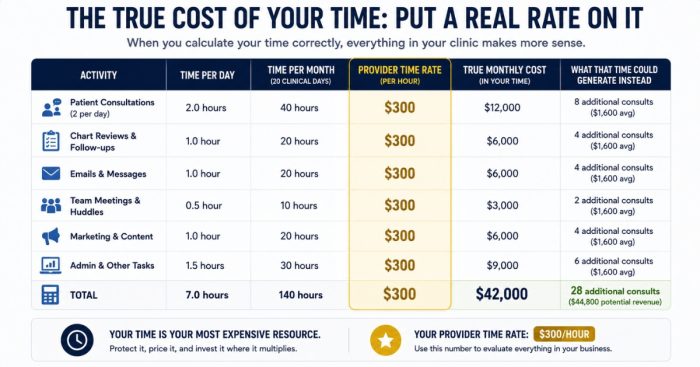
Anchor everything to one internal rate for provider time.
Then price recurring items monthly.
Look closer at the table, and the logic reveals itself.
A 60-minute consult costs $300.
Meanwhile, a 20-minute sick visit costs $100.
Both use the same $300-per-provider-hour rate.
That consistency matters.
When every time-based service maps back to one hourly rate:
- Your pricing becomes defensible.
- Your margins become predictable.
- Adding a new service takes five minutes instead of a pricing committee.
Recurring items follow a different rule.
For example, hormones cost $100 per month.
That subscription-style number matches how the patient consumes them.
By contrast, GLP-1 costs $400 because of its higher medication expense.
Diagnostics follow another simple rule.
Labs and follow-up labs cost $300 each as flat panels.
Therefore, three basic pricing rules cover almost everything a concierge, functional medicine, or hormone practice sells:
- Time at a fixed hourly rate
- Medications as monthly recurring charges
- Diagnostics as flat panels
How does the à-la-carte sheet anchor my membership pricing?
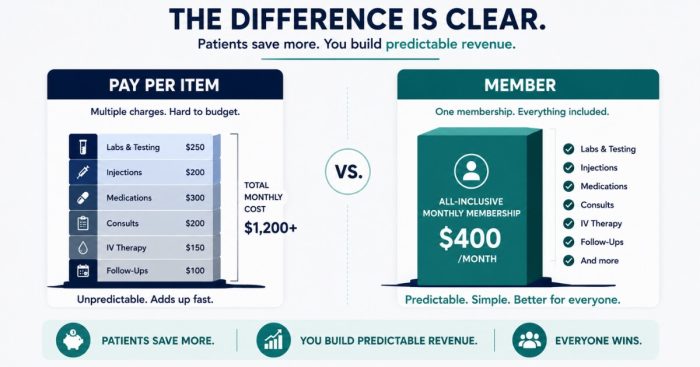
Stack the first-year à-la-carte total.
Then price the membership visibly below it.
Walk a typical first year through the sheet above:
- Labs — $300
- Initial consult — $300
- Follow-up labs — $300
- Follow-up consult — $300
Together, those services total $1,200 before a single month of medication.
Then add hormones at $100 per month.
At that point, the à-la-carte patient spends more than $2,400 during the first year.
When your membership bundles those touchpoints into one monthly price, the value calculation is visible on paper.
The patient can clearly see:
- What they would pay piecemeal
- What they save by committing
This is the anchoring pattern behind every strong recurring-revenue practice we work with.
Memberships like that get sold against a visible à-la-carte alternative.
They aren’t sold against thin air.
Structuring the offer this way is also a core part of functional medicine & longevity clinic marketing.
The sheet does the selling before the consultation starts.
Should hormones and GLP-1 be inside the membership or priced as add-ons?
Price medications as recurring add-ons layered on top of the membership.
That is exactly how this layout handles them.
Notice that the clinic keeps hormones at $100 per month and GLP-1 at $400 as separate lines.
It does not bury them inside one all-inclusive price.
This approach does three things.
First, it keeps the base membership price lower and easier to accept.
Second, it protects your margin.
Medication costs vary by patient and market.
Therefore, a flat all-inclusive price may force you to absorb that difference.
Third, it creates natural expansion revenue.
For example, a hormone patient who adds GLP-1 increases their monthly value without requiring a renegotiation.
If you operate a weight-loss program, this add-on structure also supports strong GLP-1 & weight loss clinic marketing economics.
The advertisement sells the entry offer.
Then the layered pricing sheet grows the patient relationship from there.
What mistakes do clinics make when they build a service pricing sheet?
Clinics usually make three mistakes:
- Inconsistent time pricing
- Hiding the pricing sheet
- Allowing the sheet to become too long
Inconsistent time pricing is the most common problem.
For example, a clinic may charge $250 for one consultation.
Meanwhile, it may charge $150 for a “quick visit” that actually takes 45 minutes.
The moment your hourly rate changes between services, patients sense that the pricing is arbitrary.
In addition, your team cannot clearly explain the logic over the phone.
Instead, choose one provider-hour rate and apply it consistently.
This layout maintains a $300-per-hour rate across both:
- A 60-minute consultation at $300
- A 20-minute sick visit at $100
Hiding the sheet is the second mistake.
The à-la-carte layout can only anchor your membership when patients actually see it.
Therefore, use it:
- During pricing conversations
- Inside the consultation
- On the services page
A pricing sheet hidden in a drawer anchors nothing.
Sprawl is the third mistake.
Seven lines fit on one page.
They also fit inside one phone conversation.
By comparison, 40 lines encourage patients to compare every individual item.
Keep the sheet focused on the core touchpoints.
Then fold smaller items into those main services.
FAQ’s About a Concierge Clinic’s À-La-Carte Service Pricing
What should a concierge clinic charge for an initial consultation?
One concierge medicine practice we work with charges $300 for a 60-minute initial consultation.
That equals a $300-per-provider-hour rate.
The practice applies the same rate to every time-based service, including a $100 20-minute sick visit.
The exact amount depends on your market and specialty.
However, the principle stays the same.
Set one internal hourly rate.
Then calculate every appointment length from it.
How many lines should an à-la-carte price sheet have?
Around seven.
Include one line for each core patient touchpoint:
- Labs
- Initial consultation
- Follow-up labs
- Follow-up consultation
- Recurring medications, such as monthly hormones
- Higher-cost programs, such as GLP-1
- An acute sick visit
Keep everything on one page.
If your pricing sheet needs a table of contents, it is encouraging item-by-item comparison shopping instead of anchoring the membership.
Should medications like hormones and GLP-1 be included in the membership price?
Price them as recurring add-ons above the base membership.
For example, the layout above charges:
- $100 per month for hormones
- $400 for GLP-1
This structure keeps the base membership easier to accept.
It also protects your margin from changing medication costs.
Finally, it creates expansion revenue when a patient adds another program.
How does à-la-carte pricing help sell memberships?
It creates a visible price anchor.
A first year purchased piece by piece from the sheet above includes $1,200 in consultations and laboratory testing alone.
With monthly hormones, the total exceeds $2,400.
When the membership bundles those touchpoints for visibly less, patients can see the savings on paper.
As a result, the membership no longer feels like an unexplained number.
It becomes the obvious better value.
Should a cash-pay clinic publish its à-la-carte prices?
Yes.
The sheet only works when patients can see it.
Use it:
- During the pricing conversation
- Inside the consultation
- On your services page
Publishing clear per-service prices signals confidence.
It also prevents your front desk from improvising quotes.
Most importantly, it gives patients a visible alternative to compare with your membership.
That is exactly the comparison you want them to make.
What’s the next step?
If your membership price was chosen by instinct and your services have never been priced individually, start with the one-page layout.
Use:
- Seven core lines
- One provider-hour rate
- Medications as monthly add-ons
Then price your membership against the total stack.
If you’d rather not build it alone, book a strategy call.
In 60 minutes, we’ll:
- Lay out your à-la-carte pricing sheet
- Pressure-test your membership price
- Determine which services should be bundled
- Identify which services should remain add-ons
It is the same pricing architecture we’ve installed in concierge, hormone, and functional medicine practices across the country.