
How Do You Combine Google Ads With a Local Event to Fill a Women’s Hormone Clinic? (The Quiz Funnel + Friendsgiving Playbook)
A women’s hormone clinic does not grow on one channel. The woman who searches “hormone doctor near me” at 11pm and the woman who walks into a partner’s Friendsgiving and scans a QR code are two different buyers — and the clinics that fill their schedule capture both. This is the field report from a cash-pay women’s HRT clinic in Scarsdale that turned on a Google Ads quiz-to-discovery-call funnel and ran a 40-to-50-person community event in the same week, both feeding one CRM. Here is exactly how the funnel, the nurture, the event check-in, and the partner engine were built.
Should a women’s hormone clinic run Google Ads and local events at the same time, or focus on one?
Run both at once, because they capture two different kinds of demand a women’s hormone clinic needs — Google Ads catch the woman actively searching for hormone help right now, and local events catch the warm community that will never type a search but will walk into a Friendsgiving and scan a QR code.
Hormone is a high-LTV, recurring business.
Hormone patients stay longer than weight-loss patients, so the lifetime value justifies acquiring them across multiple channels.
Google Ads give you a measurable, optimizable acquisition channel you can read every 48 hours.
A local partner event gives you a room of 40 to 50 people, many already warm to the brand, who you can tag and follow up with for months.
The mistake is treating either as a one-off campaign.
You run the ads to build a permanent patient acquisition channel.
You run events as a repeatable referral and partner engine.
Both feed the same CRM so you can market to everyone in one place.
That dual-channel discipline is exactly the recurring, high-LTV model that defines smart functional medicine & longevity clinic marketing.
What should a women’s hormone clinic offer in a Google Ad if you can’t discount the treatment?
Offer a free hormone discovery call — that is the real offer when you cannot legally or economically discount the treatment itself at the top of the funnel.
For a women’s hormone clinic, the only things you can incentivize that early in acquisition are labs or the consult.
Therefore, a free consult or a dollar amount off the consult is effectively the strongest offer available, and “free discovery call” is the cleanest version of it.
The funnel that works is straightforward:
- A Google Ad sends searchers to a women’s hormone quiz.
- They check off their symptoms.
- The symptom check doubles as a light spam filter.
- They book a free discovery call on a scheduling page.
- They land on a thank-you page.
It does not need to be a BuzzFeed-style quiz to convert.
A simple symptom-capture form has worked across multiple markets without buyers being confused by it.
Keep the landing page tightly relevant to the ad and keyword instead of padding it with brand description like “family-owned, Scarsdale-based.”
The tighter the match between the ad, keyword, and page, the stronger your ad rank.
How do you nurture a hormone lead the moment they opt in?
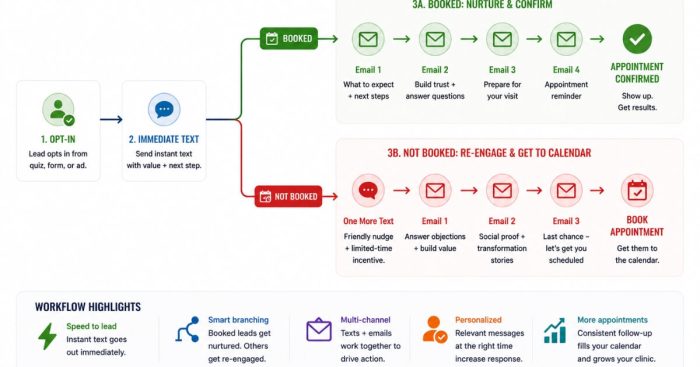
Trigger an automated text the instant they opt in, then split the follow-up based on whether they booked — because the first few minutes are when a hormone lead is hottest and most likely to schedule.
The sequence that works begins the moment someone opts in.
They get a text that acknowledges the clinic by name and location (“Protocol Health in Scarsdale, received your inquiry — if you have not yet booked your discovery call, please do so here”).
The text pushes them straight to the booking page if they have not booked yet.
If they have already scheduled, they drop into the nurture emails.
These are the same women’s hormone replacement therapy education emails the website already sends.
If they have not scheduled, they get one more text plus a couple of emails to pull them back to the calendar.
The whole thing runs inside one CRM workflow.
As a result, a lead from a Google Ad and a lead from the website get the same proven nurture, just tagged by source.
Keep the list clean, too.
Download the SMS error list (invalid mobile numbers) and the do-not-disturb list.
Then scrub them from future sends, because repeatedly texting bad numbers is how you get your sending flagged.
How long should you run Google Ads before judging them, and how do you optimize?
Never set an end date.
Run ads to build a permanent acquisition channel, and optimize the keywords every 48 hours rather than waiting out a fixed window.
You should not run ads with the intention of running them for a set period.
Instead, you run them with the intention of figuring out how to use this as a new patient-acquisition channel.
Google’s own learning period is roughly 21 days.
However, you do not sit idle for three weeks.
You check it the same day you turn it on to confirm it is actually spending.
If it is spending, you can get feedback from it.
Then every 48 hours you go in and cut waste:
- Turn off the low-intent, just-curious keywords.
- Turn off the irrelevant terms that cost money without converting.
- Concentrate budget on the high-intent terms.
Once leads are flowing, the optimization moves down the funnel.
If leads are not booking discovery calls, you fix the booking step.
Then comes the normal work of presenting pricing and closing.
One timing note that saves money: do not launch into Black Friday and Cyber Monday weekend, when some advertisers spend 75 percent of their budget and auction costs spike.
Instead, wait until the Tuesday or Wednesday after.
(Context that matters here: this clinic’s prior agency had burned about $3,000 on semaglutide ads at a very high cost per lead, which is exactly why a tightly optimized, channel-building approach matters for a hormone clinic where the patient LTV is the whole point.)
How do you turn a local clinic event into trackable leads instead of just a party?
Put a QR-code check-in form at the event and tag every attendee in your CRM, so a 40-to-50-person Friendsgiving becomes a segmented list you can market to for months instead of a one-night party.
The check-in is simple.
A QR code opens a short form.
Everyone who scans gets a single event tag — a “Friendsgiving” tag, in this case.
From there, you filter contacts by that tag and email the whole room.
Thank them for coming and offer them something.
The tag does the segmentation work.
As a result, you do not need a separate pipeline.
Existing patients, new prospects, and partners all land under one filterable label.
Any genuinely new attendee still enters the system as a fresh contact.
Then make the event itself convert.
Instead of giving away your own services in a raffle, sell discounted packages on the spot:
- A 5-pack of IV drips.
- A percentage off PRP.
- A percentage off a consult.
Attendees actually spend money.
Meanwhile, reserve free raffle entries for partner-business prizes as a no-cost door-entry draw.
Just sign your name on a ticket and drop it in a jar.
That keeps the energy of a giveaway while turning the night into revenue and a tagged follow-up list.
This is the same event-plus-digital stacking that Eternity Health Partners used to grow from $1M to $4M a year and build 250 active members at $1,000/month.
How do you build a referral and partner engine around a women’s hormone clinic?
Place branded offer boards and referral cards with local partners, give each partner a trackable referral code, and back it all with a membership that rewards multi-service patients — that combination turns one event into an ongoing local-referral machine.
The pieces fit together.
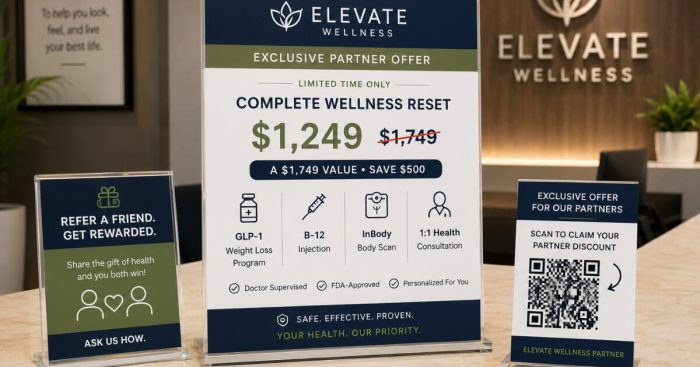
A well-designed partner offer board sits on a partner’s front desk — a boxing studio, for example.
It shows a slashed price and everything the patient gets.
Use one board per partner.
Patients leave with referral cards.
Each partner also gets its own form and QR code so referrals are attributed correctly.
The referral codes have to live on separate forms, so plan for that.
Bulk-build the partner QR codes up front.
Then train the clinic to add new partners themselves so the program scales without a phone call every time.
Underneath it all is the membership.
It is a no-brainer for anyone doing any recurring treatment.
It also unlocks real value once a patient stacks multiple services — hormones plus a peptide, for example.
The membership is what converts the foot traffic from events and partners into recurring, high-LTV revenue.
It is the mechanism that took an HRT clinic from $1M to $4M in 4 years on $1.7M/year in memberships from SEO alone.
FAQ’s About Combining Google Ads and Local Events for a Women’s Hormone Clinic
Should a women’s hormone clinic run Google Ads and local events at the same time, or focus on one?
Run both at once, because they capture two different kinds of demand a women’s hormone clinic needs.
Google Ads catch the woman actively searching for hormone help right now.
Local events catch the warm community that will never type a search but will walk into a Friendsgiving and scan a QR code.
Hormone is a high-LTV, recurring business, so the lifetime value justifies acquiring patients across multiple channels.
Google Ads provide a measurable acquisition channel you can optimize every 48 hours.
Meanwhile, a local partner event gives you a room of 40 to 50 people you can tag and follow up with for months.
The mistake is treating either as a one-off campaign.
Instead, build a permanent patient-acquisition channel with ads and a repeatable referral engine with events, both feeding the same CRM.
What should a women’s hormone clinic offer in a Google Ad if you can’t discount the treatment?
Offer a free hormone discovery call because that is the real offer when you cannot legally or economically discount treatment at the top of the funnel.
For a women’s hormone clinic, the only things you can incentivize early are labs or the consult.
Therefore, a free consult or a dollar amount off the consult is effectively the strongest offer available.
The funnel is simple.
A Google Ad sends searchers to a women’s hormone quiz.
They complete a symptom check, book a free discovery call, and land on a thank-you page.
The quiz does not have to be elaborate.
A simple symptom-capture form has worked across multiple markets.
Keep the landing page tightly aligned with the ad and keyword so the ad rank stays strong.
How do you nurture a hormone lead the moment they opt in?
Trigger an automated text immediately after the opt-in.
Then split the follow-up based on whether the lead booked.
The first few minutes are when a hormone lead is hottest and most likely to schedule.
The initial text acknowledges the clinic and directs anyone who has not booked to the scheduling page.
Leads who already booked move into the women’s hormone replacement therapy email nurture.
Those who have not booked receive one additional text and a couple of reminder emails.
Everything runs inside one CRM workflow.
Leads from Google Ads and the website receive the same nurture while remaining tagged by source.
Keep the list clean by removing invalid mobile numbers and do-not-disturb contacts from future SMS sends.
How long should you run Google Ads before judging them, and how do you optimize?
Never set an end date.
Run ads as a permanent acquisition channel and optimize the keywords every 48 hours.
Google’s learning period is roughly 21 days.
However, do not wait three weeks before making improvements.
Confirm the campaign is spending on day one.
Then remove low-intent and irrelevant keywords every 48 hours while shifting budget toward high-intent searches.
Once leads begin arriving, optimize the booking process before focusing on pricing and closing.
Also, avoid launching campaigns during Black Friday and Cyber Monday weekend, when advertising costs often spike.
How do you turn a local clinic event into trackable leads instead of just a party?
Put a QR-code check-in form at the event and tag every attendee in your CRM.
That turns a 40-to-50-person Friendsgiving into a segmented marketing list instead of a one-night event.
Everyone who checks in receives the same event tag.
From there, email attendees after the event and keep marketing to them over time.
Instead of giving away clinic services, sell discounted packages on the spot and reserve raffle prizes for partner businesses.
That approach generates revenue while also creating a valuable follow-up list.
How do you build a referral and partner engine around a women’s hormone clinic?
Place branded offer boards and referral cards with local partners.
Give every partner a trackable referral code and QR code.
Support the entire system with a membership that rewards patients using multiple services.
Partner offer boards, referral cards, and dedicated forms make attribution simple.
Bulk-build partner QR codes at the beginning, then train the clinic to create additional partners without outside help.
The membership converts event traffic and partner referrals into recurring, high-LTV revenue.
What’s the next step?
If you run a cash-pay women’s hormone clinic and you are leaning on one channel — just ads or just word of mouth — you are leaving the other half of your demand on the table.
The growth move is to run a tightly optimized Google Ads quiz-to-discovery-call funnel and a repeatable local event engine at the same time.
Both should pour into one CRM where every lead receives the same nurture and every attendee is tagged and followed up.
That is how a women’s hormone clinic turns a single Friendsgiving into months of segmented follow-up.
It is also how the clinic builds the membership base that makes the entire model recurring.
It is the same approach behind Eternity Health Partners, an HRT clinic we grew from $1M to $4M with $1.7M/year in memberships from SEO alone.
If you want someone to build the funnel, the nurture, and the event-to-CRM tagging for your clinic, that is the conversation to book.