
Why Aren’t My Clinic’s Leads Booking? What a Monthly Lost-Lead Audit Actually Finds (We Read All 55)
Every month, one of our multi-location cash-pay clients — weight loss, TRT, and peptides across seven Minnesota locations — produces a lead audit.
It includes every opportunity created that month, with a written comment on what actually happened to it.
July’s board had 55 opportunities, 36 already marked lost.
We read every single comment.
The lessons aren’t abstract “follow up faster” advice. They’re specific, repeatable failure patterns that almost certainly exist in your CRM right now.
Here’s the FAQ, with the receipts.
Why aren’t my clinic’s leads booking even though the leads keep coming?
You don’t actually know — and neither did this clinic — until someone reads every lost lead, one comment at a time.
Aggregate dashboards hide the story.
“36 lost” tells you nothing; the comments tell you everything.
In July’s audit, the losses sorted into five patterns.
First were pure non-responders who never engaged at all — ten leads, a normal cost of doing business.
Then came slow responses to live buying questions and leads who asked for a scheduling link before vanishing.
We also found operational mix-ups that burned actively interested patients.
Finally, there were status-hygiene errors — including leads marked “lost” whose own comments say they attended their appointment.
Only the first category is unavoidable.
The other four are fixable process, and they’re invisible until you do the read.
This is the unglamorous core of a patient acquisition system that actually converts: not more leads — an honest autopsy of the ones you already paid for.
What is a monthly lost-lead audit and how do I run one?
Export every opportunity created in the month — name, stage, status, tags, and a one-line comment on what happened.
Then have a human read it end to end.
It takes about an hour.
The format matters: one row per lead, and the comment must say what actually occurred, not a code.
“Patient texted asking to speak with an actual person; our reply went out 40 minutes later; no further communication” is auditable.
“Unresponsive” is not.
Two rules make the audit compound.
First, every comment on a revivable lead ends with a recommended next action: “send a personal check-in text, not another automated link.”
Second, name every process failure without blame.
The goal is to fix the system, not the staffer.
Clinics that run this loop monthly get a compounding effect.
August’s process fixes come directly from July’s autopsy.
It’s the same discipline that let a pain practice we work with add $2,095,039 in revenue in just 10 months — conversion problems die when they get named specifically.
How fast do I need to respond when a lead asks a live question?
Minutes, not hours.
One July lead texted, “can I speak with an actual person?”
She got a reply 40 minutes later and was never heard from again.
That lead was actively engaged, mid-decision, phone in hand.
Forty minutes later, the moment was gone.
The pattern repeated in softer forms across the month.
One Spanish-speaking lead was responsive and engaged over text but needed a phone call — ideally in Spanish — and never got one.
Another mother called in ready to schedule her daughter’s appointment.
Instead of booking her live on the call, the clinic redirected her to “complete it online.”
She didn’t complete it online.
The audit produced a simple rule.
When a lead does something human — asks a question, requests a person, or calls in — a human closes the loop in that moment, in their language, on their channel.
Automation is the safety net between human touches, never a substitute for the touch itself.
Why is “I’ll send you the scheduling link” where bookings go to die?
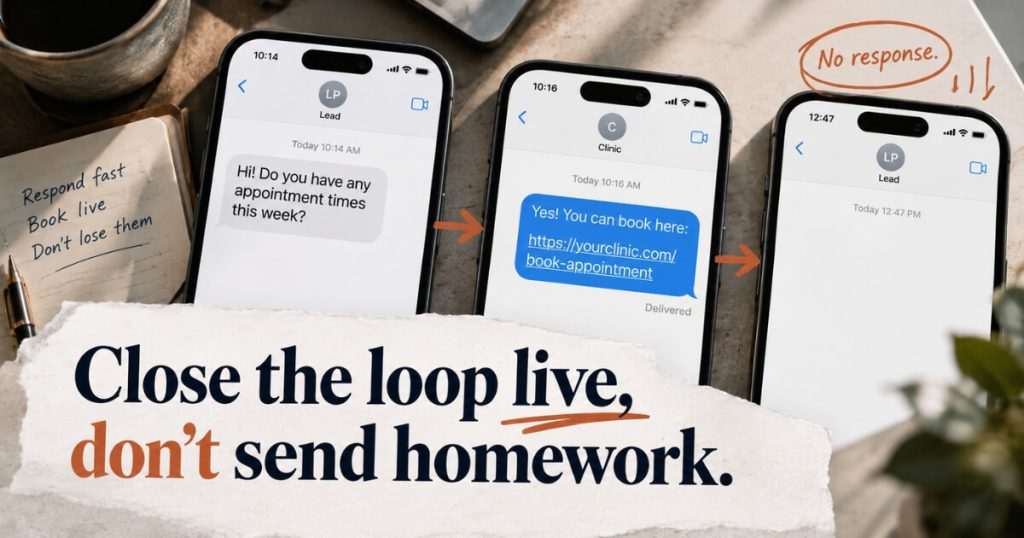
Because a link is homework.
At least six of July’s lost leads asked for the link or available times, received them, and went silent.
The comments read almost identically: “patient requested the scheduling link, indicating initial interest, but did not proceed or respond to subsequent communication.”
Interest was real — they asked.
The clinic answered with a task instead of an appointment.
The fix is to treat a link request as a buying signal and close on the spot:
“I can grab that time for you right now — does Thursday 2:15 or Friday 10:30 work?”
Book it live, send the confirmation, done.
The link goes out only as a fallback after a time is already held.
One clinic behavior change could potentially mean a half-dozen extra consults a month.
At weight-loss and TRT patient lifetime values, that’s the difference between a flat month and a growth month.
That’s exactly the arithmetic that drives GLP-1 & weight loss clinic marketing economics.
What operational mistakes show up in a lost-lead audit?
The expensive kind.
July’s board included a patient who drove to a closed clinic because her reminder text fired a day early — and leads marked “lost” whose comments say they attended.
The early-reminder patient had a real appointment for the next day.
Then she got a “your appointment is today at 10:40 AM” text.
She drove in, found locked doors, and never responded again.
A misconfigured automation cost the clinic a booked, motivated patient.
The clinic also missed the chance to clarify what happened when she reached out.
Meanwhile, the audit caught status hygiene rotting the data itself.
At least three “lost” leads had comments saying, “patient confirmed the appointment — please re-check the status.”
Attended appointments were also still sitting in stale stages.
Bad statuses aren’t cosmetic.
Next month’s re-engagement campaigns, revenue attribution, and this very audit all run on those fields.
Every audit should therefore end with a data-correction pass before anyone draws a single strategy conclusion.
Which lost leads are actually worth reviving?
The ones who did something before going quiet — asked a question, requested times, or confirmed interest.
July’s audit flagged more than a dozen of them, each with the same prescription: one personal text, zero automation.
The comments are explicit: “rather than sending another automated message or scheduling link, send a simple, personalized text checking in on how they’re doing and whether they’re still interested.”
A month of silence after real engagement calls for a human sentence, not sequence re-enrollment.
These leads already graduated past the robot.
Equally important is knowing who not to chase.
That includes the ten pure non-responders and the lead who enabled Do-Not-Disturb after one automated follow-up too many.
There were also fit mismatches — a patient who wanted a product the clinic doesn’t offer and another who expected insurance and cancelled on learning it’s cash-pay.
Those last two aren’t follow-up failures.
They’re targeting and expectation-setting notes for the marketing side.
A good audit sorts the revivable from the finished, so the team’s energy lands where it can still convert.
FAQ’s About Monthly Lost-Lead Audits at a Cash-Pay Clinic
How often should a clinic audit its lost leads?
Monthly.
Export every opportunity created that month with stage, status, tags, and a one-line comment on what happened.
One person reads all of it in about an hour.
The output is a short list of process fixes plus a revival list for one personal follow-up text each.
What percentage of clinic leads never respond at all?
In this real July audit, 10 of 55 opportunities — roughly one in five — never engaged with any outreach.
That’s a normal floor.
The concern isn’t the silent fifth.
It’s the engaged leads lost to slow replies, link-sending, and process errors, which are fixable.
What’s the biggest fixable reason clinic leads don’t book?
Answering a buying signal with homework.
Leads who ask for a scheduling link or available times are closing themselves.
Book them live on the phone or in the text thread instead of sending a link and hoping.
In this audit, at least six engaged leads received a link and vanished.
How do I revive a lead that went cold a month ago?
One personal, non-automated text: check in on how they’re doing and ask if they’re still interested.
Don’t re-enroll them in a nurture sequence — they’ve already ignored it.
Reserve revival for leads who showed real engagement before going quiet.
And respect every DND immediately.
What should the comment field on a lost lead contain?
What actually happened, in plain language, plus a recommended next action.
“Asked about pricing, our reply took 40 minutes, no response since — send personal check-in” is auditable and actionable.
“Unresponsive” or “not interested” hides the process failure the audit exists to find.
What’s the next step?
If your clinic generates leads but bookings feel like a leaky bucket — and nobody has read your lost-lead comments in months, or nobody writes any — book a strategy call.
In 60 minutes we’ll walk through your last 30 days of opportunities the way we walked through this clinic’s July.
We’ll name the patterns costing you consults and hand you the audit template and follow-up rules to run it monthly yourself.