
Why Did Revenue Drop When My Clinic’s Leads Went Up? (Untracked Calls, Mislabeled Lead Statuses, and the Taxonomy That Fixes Both)
A cash-pay functional medicine practice in Texas had its best lead month ever: website leads jumped from 17 in August to 48 in September, and inbound calls went from 63 to 103.
Same month, revenue came in at $46,232 — “still significantly lower than last month, almost half.”
The audit on our call found the machinery underneath: outbound calls made from personal cell phones the CRM never saw, and lead statuses set from memory instead of evidence.
Here’s the FAQ on diagnosing — and fixing — a pipeline that’s lying to you.
Why did my clinic’s revenue drop when leads went up?
Because lead volume and lead conversion are different machines — and this clinic’s conversion machine was invisible.
Of 48 website leads, only 9 booked.
The clinic’s $150 strategy sessions told the trend story: 17 in May, 18 in June, 23 in July — then 7 in August and 3 in September, exactly as lead volume peaked.
Nobody could say where the leads died because the follow-up calls happened on personal phones, off the record.
The pipeline showed statuses like “called 3x” with no call logged anywhere.
More leads flowing into an unmeasured process doesn’t produce more revenue.
It produces more untraceable loss.
Should staff call leads from their personal cell phones?
No.
Route every lead call through the CRM’s mobile app, so it’s logged, recorded, and attributable.
The rule we gave this owner became the operating standard:
“There’s no note here that says that we called him, and there’s no call here… I don’t have evidence to prove that something else happened, so I assume it didn’t.”
No evidence, it didn’t happen.
On the call, we installed the CRM’s phone app on the front desk’s phone live.
Lead calls now go through the tracked line, while the legacy phone system stays for existing-patient calls during transition.
The side benefit compounds: recorded lead calls become the training library for your next hire.
“You will have recorded calls in there that we can train the new person off of.”
This is the foundation layer of a patient acquisition system that can actually be audited — every later fix depends on the calls being visible.
What should my lead statuses actually mean?
Three buckets with hard definitions: “in contact” (any live conversation or text-back), “lost” (three calls, zero response), and booked.
Delete the vague ones.
This clinic’s pipeline had a status called “abandoned” — and sitting inside it was a lead who had held a real phone conversation with the clinic.
A warm lead, mislabeled into a graveyard.
The instruction from the call:
“If you’ve talked to somebody, put them in in contact… completely unresponsive and called three times, mark as lost.”
A status only means something if there’s an evidence-based rule for entering it.
If your team sets statuses from memory, your pipeline is a mood board.

What percentage of website leads should a cash-pay clinic convert?
Close to 50%.
This clinic was at 9 of 48 — under 20% — when the audit started.
Website leads are high-intent: someone found you, read about your services, and handed over their contact info.
Our benchmark from the call: “we should definitely be converting close to 50% from the website.”
When actuals run under 20%, the gap is almost never the leads.
It’s response speed, follow-up structure, and what gets said.
The HRT practice we helped grow from $1M to $4M a year runs on that math: roughly 40 website leads a month, converted at rates that build a 250-member recurring base.
Not thousands of leads — just leads that get worked.
How should my front desk record the outcome of every lead call?
With a fixed outcome menu, not free-text notes.
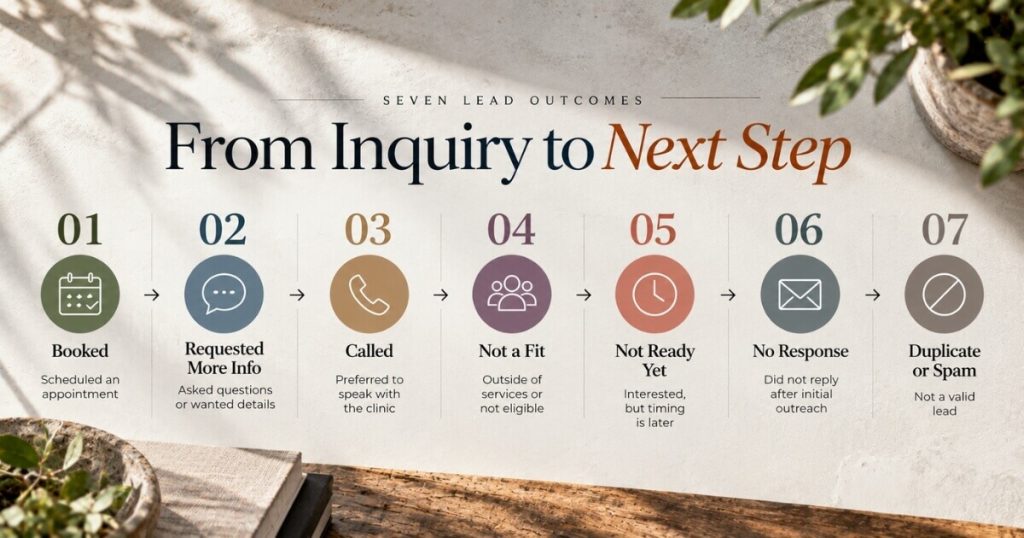
Seven outcomes cover nearly every call:
- scheduled
- sending labs
- talk to partner
- thinking about it
- shopping around
- call me back
- can’t help
Every outcome maps to a next action and a date.
“Talk to partner” triggers a 48-hour callback task. “Sending labs” starts a document-chase sequence. “Can’t help” exits cleanly.
The seven outcomes also expose your real objection mix.
If half your calls end in “shopping around,” you have a positioning problem, not a staffing problem.
One more script note from the same call: never lead with price.
Opening with “It’s going to be $300 to get your labs done” kills conversations that were about symptoms, sleep, and energy.
The front desk’s best line on this team was pure value framing:
“You get 35 to 45 minutes with a provider… You can’t get your toes done for that.”
Is my chat widget generating real leads?
Count chat separately before celebrating lead volume — half of this clinic’s “record month” was chat, and some of it wasn’t leads at all.
Of the 48 September leads, 24 were chat-widget conversations — including existing patients asking service questions like, “How do I reconstitute my peptide?”
Chat inquiries are real work and sometimes real leads.
However, blending them into the website-lead count inflates the denominator and makes conversion look worse than it is — or makes a weak month look strong.
Segment the sources, then judge each on its own conversion math.
FAQ’s About Clinic Lead Statuses and Call Tracking
What does “no evidence, it didn’t happen” mean in practice?
If a call isn’t logged in the CRM — no recording, no note, no timestamp — it’s treated as never made, and the lead gets called again.
The rule sounds harsh, but it’s the only standard that makes a pipeline audit-proof.
How many call attempts before marking a lead lost?
Three logged calls with zero response.
Fewer, and you’re abandoning warm leads.
More without structure, and your team burns hours on ghosts while fresh leads wait.
Should existing-patient calls run through the same tracked line as leads?
Eventually, but leads come first.
This clinic moved lead calls to the CRM app immediately and kept the legacy system for existing patients during the transition.
Sequencing beats a big-bang cutover.
What’s the fastest signal that statuses are being set from memory?
A status the data contradicts — like “called 3x” with no logged calls, or a lead marked “abandoned” who had a real conversation.
One contradiction usually means the whole board is unreliable.
How do recorded lead calls help me hire a salesperson?
They’re the onboarding curriculum.
A new hire hears exactly how your best calls open, how price questions get handled, and what a booked call sounds like.
These are real examples from your own patients, not a generic script.
What’s the next step?
If your lead count is climbing while bookings and revenue slide, don’t buy more leads — audit the machine.
Book a strategy call.
In 60 minutes we’ll pull your last 30 days of leads, check every status against the evidence, and rebuild your status taxonomy and call-outcome menu so next month’s numbers mean what they say.