
Why Are My Cash-Pay Telehealth Leads Disappearing Between My EHR and My Booking System? (The Single-Source-of-Truth Fix)
One of the most expensive problems in cash-pay telehealth is invisible: leads that come in, never get contacted, and disappear—not because the marketing failed, but because the leads are being managed in two different systems that never talk to each other. The provider books in the EHR. The leads self-schedule in the CRM. Nobody can see the gap.
This is the FAQ on closing it, drawn from a telehealth practice that discovered 20 paying-intent leads sitting uncontacted in a single week, all because they were being booked in the wrong place.
Why are my cash-pay telehealth leads disappearing between my EHR and my booking system?
They’re disappearing because booking is split across two systems.
As a result, no one can see the complete picture in one place.
When providers schedule cash-pay consultations inside the EHR while leads book themselves through a separate CRM, the two systems never reconcile.
Consequently, leads arrive through the marketing platform and quietly sit there while providers focus on the clinical schedule.
A lead that nobody sees quickly becomes a lead that nobody contacts.
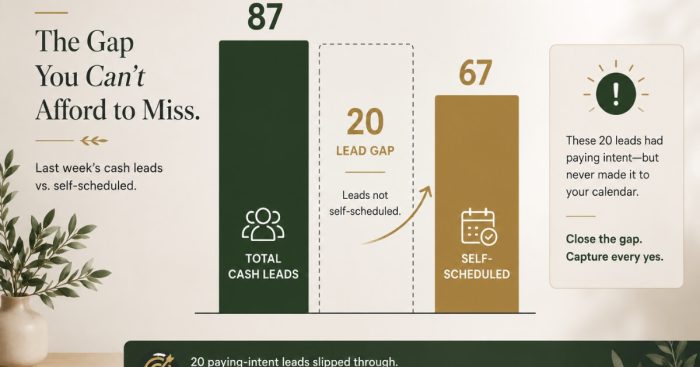
For example, one telehealth practice generated 29 leads in a single week.
Of those, 26 were cash-pay leads.
However, only six people actually self-scheduled.
That left 20 high-intent leads sitting untouched simply because they were booked in the wrong system.
The solution is straightforward.
Choose one platform as your single source of truth and book every cash-pay consultation there.
Once everything lives in one place, the gap between leads generated and appointments booked becomes immediately visible.
This is one of the highest-return improvements in patient acquisition because it recovers leads you’ve already paid to generate.
No additional advertising is required.
Should I use my EHR or a CRM like GoHighLevel to book cash-pay consults?
Use your CRM for cash-pay booking, communication, and lead management.
Keep your EHR focused on clinical documentation.
Each system serves a different purpose.
For example, the CRM—such as GoHighLevel—is where new leads arrive, conversations happen, and opportunities move through the sales pipeline.
Meanwhile, the EHR stores clinical documentation, SOAP notes, and patient records.
Problems begin when clinics schedule cash-pay consultations inside the EHR.
Doing so removes those patients from the marketing workflow, making follow-up much more difficult.
Instead, route every cash-pay and wellness consultation through the CRM calendar.
Insurance and traditional in-office appointments can remain in the EHR if that’s already your established workflow.
In other words, don’t turn your CRM into an EHR.
Likewise, don’t expect your EHR to function as a lead-management system.
When each platform stays in its proper role, the entire cash-pay pipeline becomes visible and manageable.
How do I find the cash-pay leads that never booked an appointment?
Start with your CRM dashboard.
Then compare the number of cash-pay leads with the number of appointments that actually booked.
The difference becomes your call list.
For example, one clinic reviewed a single week of activity and found:
- 29 total leads
- 26 cash-pay leads
- 6 self-scheduled appointments
Immediately, that revealed 20 leads that still needed follow-up.
Without comparing those numbers side by side, those opportunities would have remained hidden.
That’s exactly why split systems become so expensive.
The leads aren’t gone.
They’re simply invisible.
To prevent that from happening again, build a weekly review process.
For example:
- Filter the dashboard to the previous seven days.
- Count total cash-pay leads.
- Compare that number with completed bookings.
- Open every unbooked contact.
- Review the pipeline stage.
- Call anyone who hasn’t booked.
Just as importantly, maintain discipline inside the pipeline itself.
Every lead should move into a clear stage such as:
- Booked
- Contacted
- Lost
That organization allows everyone on the team to understand lead status immediately.
Meanwhile, assign one person to work new leads every day.
Then conduct a weekly review to catch anything that slipped through the cracks.
Most of the time, the leads are already sitting inside your CRM.
They simply need to be surfaced and contacted.
How do I get my provider to use the CRM instead of texting patients from his personal phone?
Require every patient call and text to go through the CRM.
The simplest way is to have providers click the contact’s phone button directly inside the platform.
When providers text patients from personal phones, no one else can see the conversation.
As a result, important follow-up opportunities disappear, and managers have no way to coach or improve the process.
By comparison, CRM-based communication records every call, logs every outcome, and creates a complete communication history.
It also allows managers to review conversations and provide specific coaching.
For providers who aren’t naturally comfortable with sales, that feedback can make a significant difference.
In fact, someone closing around 70% of consultations may improve to 80–90% simply by reviewing recorded calls and refining their conversations.
This process isn’t about surveillance.
Instead, it’s about making the cash-pay sales process visible enough to improve.
Keep clinical documentation inside the EHR.
However, route every communication related to converting or retaining a cash-pay patient through the CRM.
Ultimately, you can’t improve what you can’t see.
What should I say when a telehealth lead just asks for the price?
Treat price-shopping as a normal request for information.
Then begin the conversation with one simple question before discussing cost.
Ask:
“Have you tried this before, or would this be your first time?”
That single question encourages the prospect to open up before you attempt to schedule anything.
Instead of feeling transactional, the conversation immediately becomes personal.
Next, explain that every patient starts with a free 15-minute consultation with a provider.
Position that consultation as a valuable clinical step rather than a sales hurdle.
When the discussion turns to pricing, provide a range instead of an exact number.
For example, explain the typical investment for a starting dose and then describe what higher-dose patients usually invest.
Because treatment varies from person to person, an exact figure is often impossible to quote before the consultation.
A realistic range keeps the conversation moving while setting appropriate expectations.
Finally, avoid robotic text messages such as, “We have a 3 p.m. appointment. Do you want it?”
Instead, send warm, conversational messages that begin with the “Have you tried this before?” question.
That small change in tone often determines whether a lead replies or disappears.
Should I require a credit card on file for free telehealth consults?
Yes.
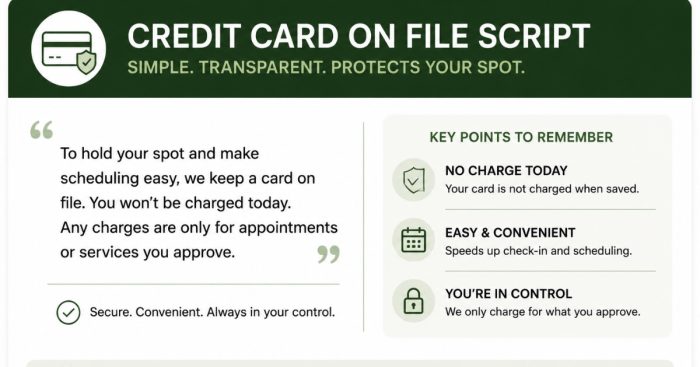
Require a credit card on file for every free consultation while clearly explaining your no-show policy.
Doing so dramatically improves show rates without creating a financial barrier to booking.
A simple script works well:
“All of our consults are free. There’s absolutely no charge to you. We simply request a credit card on file to reserve your appointment. Your card will never be charged unless you no-show or cancel within 24 hours of your appointment.”
Many clinics pair that policy with a $100 no-show fee and a 24-hour cancellation window.
As a result, patients remain free to book while providers gain meaningful protection against empty appointment slots.
The policy also filters for serious patients without discouraging legitimate prospects.
For even better results, include the same language on your Book-a-Consult page.
That way, patients understand the policy before they ever schedule.
Although it’s a small operational change, it often produces a noticeable improvement in show rates.
Higher show rates, in turn, improve every conversion metric that follows.
FAQ’s About Cash-Pay Telehealth Lead Management
Is a 70% close rate on cash-pay consults good?
Yes.
A 70% close rate is genuinely strong, particularly for providers who haven’t received formal sales training.
To improve that number even further, record consultations through your CRM and review them regularly.
Specific coaching often helps providers increase close rates into the 80–90% range.
When you combine call reviews with a structured conversation and a credit-card-on-file policy, consistently high conversion rates become much more realistic.
How many cash-pay appointments per day can a single provider handle once leads stop leaking?
The answer depends on the practice.
However, fixing the lead leak alone can significantly increase daily patient volume.
For example, one provider went from seeing one or two cash-pay patients each day to four or five.
Importantly, demand never changed.
Instead, improving visibility allowed the clinic to recover opportunities that were already there.
What’s the right cadence for working telehealth leads?
Work new leads every day.
Then review older leads every week.
Assign one team member to contact every new lead as it arrives.
In addition, schedule a weekly dashboard review to identify any lead from the previous week that still hasn’t been dispositioned.
That weekly review acts as a safety net, ensuring qualified prospects don’t quietly disappear through operational gaps.
How does this help me convert insurance inquiries into cash-pay patients?
A single, visible CRM pipeline allows you to manage every inquiry consistently.
Instead of losing insurance or primary-care callers, you can guide them into an appropriate cash-pay consultation.
Begin with the simple question, “Have you tried this before?”
Then offer the free provider consultation as the next logical step.
That structured conversation creates an opportunity to turn price-shopping and insurance inquiries into direct-pay relationships.
Over time, this process helps clinics reduce their dependence on insurance while continuing to grow cash-pay revenue.
What’s the next step?
If your telehealth leads seem to disappear, the problem usually isn’t your advertising or your offer.
More often, the issue is that your leads live in two different systems and nobody can see the gap between them.
Instead, choose one platform as your single source of truth.
Book every cash-pay consultation there.
Run every patient conversation through the same CRM.
Disposition every lead.
Finally, protect your providers’ schedules with a credit-card-on-file policy.
Most of the leads you’ve been losing are already inside your system.
They simply need to become visible.
During a strategy call, we’ll map your current lead flow across both your EHR and CRM.
Then we’ll show you exactly where patients are slipping through the cracks—and how to close those gaps this week.
It’s the same operational approach behind a specialist practice where we cut insurance dependence in half and added over $40K a month in cash-pay revenue.