
Why Is My Cash-Pay Practice Stuck at $80,000 a Month?
Everest Regenerative Medicine kept landing on the same number. Roughly $80,000 collected, month after month, regardless of what changed inside the building. The practice was busy — the phones rang constantly — but nobody could tell you how many times they rang, how many callers had never been seen before, or what happened to a lead after it arrived. Over the following nine months, the same physician in the same treatment rooms collected $1.44 million and averaged about $148,000 a month. Here’s why cash-pay practices plateau, and what actually breaks the ceiling.
Why is my cash-pay practice stuck at $80,000 a month?
A revenue plateau in a cash-pay practice is almost never a demand problem. It is usually a capture problem hiding behind activity nobody is counting.
Here is what a plateau feels like from the inside. You are working hard. The schedule looks full some weeks and thin others, yet deposits keep landing in the same narrow band.
So you conclude the market is tapped out, the town is too small, or people in your area will not pay cash for this.
That conclusion feels obvious because it is the only explanation available. However, it is also the one explanation you have no data to test.
Everest was already generating real interest before anything changed.
In the months before the engagement, the practice averaged 263 total inbound calls a month. About 50 came from first-time patients.
Nobody in the building could have quoted those figures at the time. We reconstructed them during the onboarding audit from phone records.
That is not a demand shortage.
That is fifty strangers a month, in West Fargo, North Dakota, raising their hand. Yet no system recorded who they were, what they wanted, or whether anyone called them back.
The ceiling was not the size of the market. It was how much of that market the practice could hold onto.
Hence the line we keep coming back to from that engagement: you can’t scale a practice you can’t measure.
Measurement matters because everything you would do to break a plateau requires knowing which part is leaking. Whether you spend more, hire, add a service line, or change the offer, you need that information.
Without it, you are guessing with money.
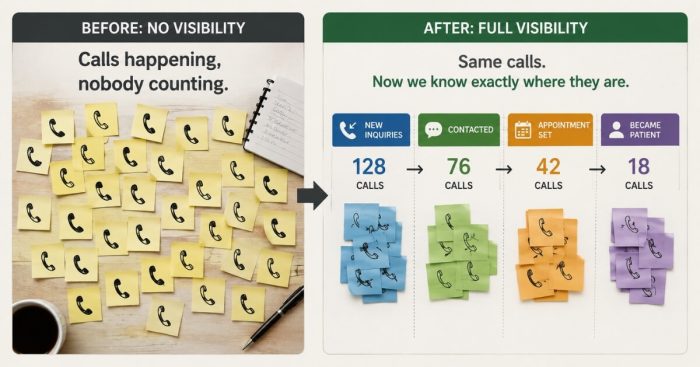
How do I tell whether my plateau is a demand problem or a capture problem?
Count your inbound calls for thirty days and separate first-time callers from existing patients. If first-time volume is healthy while revenue stays flat, you have a capture problem.
Most practice owners genuinely cannot do this today. That is not a criticism. It is the normal state of a clinic that grew off reputation and referrals.
The front desk answers the phone. Some calls become appointments, while others do not.
Nobody logs the difference. Therefore, the only number that reaches the owner is the deposit at the end of the month.
That single number is a terrible diagnostic. It moves for a dozen reasons at once and never tells you which one.
The moment you split the phone log, the picture resolves fast.
Across nine months, Everest tracked 3,490 total inbound calls. Of those, 1,310 came from first-time patients.
First-time call volume moved from roughly 50 a month to an average of 173. Meanwhile, total call volume rose 44% to an average of 379.
Those signals do two different jobs. One tells you the market is responding. The other tells you the practice is getting busier.
When you only see revenue, you see neither. As a result, you cannot distinguish a marketing problem from a front-desk problem or a pricing problem.
A plateau can genuinely come from weak demand. That can happen in a very small market or with a brand-new service line nobody is searching for yet.
However, that is far rarer than owners assume.
If strangers contact your practice every week while revenue stays flat, demand is not your constraint.
This is the least glamorous work in marketing for cash-pay regenerative medicine clinics. Yet it determines whether anything after it means anything.
If you cannot say how many new people contacted your practice last month, you cannot confidently interpret any campaign result shown afterward — including ours.
What are the three ceilings that actually cap a cash-pay practice?
Almost every stalled cash-pay practice faces one of three ceilings: lead leakage, no recurring revenue, or an owner who is the only person able to sell.
The first ceiling is leakage.
A form fill comes in. Someone calls at 4:50pm. A message arrives without an assigned owner.
Then the opportunity evaporates.
That failure stays invisible because an opportunity you never recorded cannot appear as a loss. It simply never becomes revenue.
Practices with this ceiling usually believe they need more leads. Often, they need to stop losing the ones they already have.
The published figure for one practice we work with is a 79.4% lead-to-booked rate at Orthobiologics Associates.
The case study reports the rate, not the reason behind it. From the practices we see, our view is that a number in that range depends heavily on what happens in the hours after a lead arrives.
The second ceiling is structural.
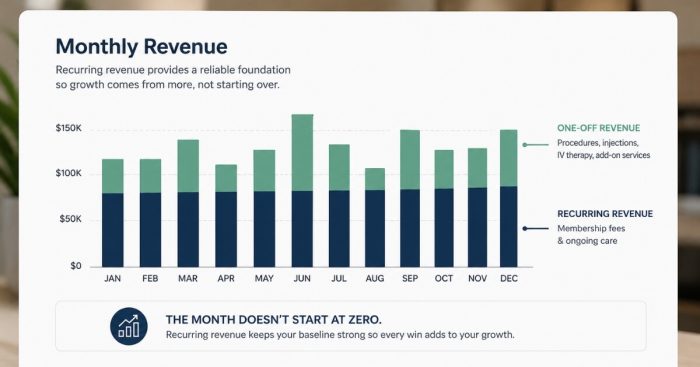
If every dollar comes from a one-time procedure, every month begins at zero. You can have a spectacular March and still enter April with an empty ledger and the same anxiety.
Weak marketing did not create that plateau. The revenue model did.
Ad spend cannot solve the underlying problem. Spend buys transactions, while the model consumes transactions faster than you can buy them.
The third ceiling is the owner.
In most cash-pay practices, the physician is the only person who can explain why a treatment is worth several thousand dollars and ask for the decision.
That works beautifully until it becomes the constraint.
If closing lives entirely in your head, revenue is capped by the number of consultations you can personally run. Hiring more staff may make the phones busier without making the practice bigger.
How does tracking turn invisible activity into a manageable pipeline?
Tracking turns loose activity into a countable list of named people at known stages. Only then can someone manage it.
Over nine months, Everest tracked 631 opportunities in the CRM.
That number is not impressive by itself. It is neither revenue nor patients.
Instead, it represents 631 people who expressed interest and existed as records rather than memories.
Each person had a stage. The team could assign the opportunity, follow up, and eventually mark it won or lost.
Some version of that activity had already been happening. What was missing was a way to see it, sort it, and act on whatever was stalling.
Once that happens, management becomes possible.
You can see why people sit at “consult scheduled” without moving. One service line may convert at half the rate of another. A slow month can also be traced to fewer inquiries or weaker handling of the same inquiries.
A practice measuring itself only by deposits cannot answer those questions.
The 631 opportunities and 3,490 calls tracked at Everest Regenerative Medicine did not create demand.
They made existing demand legible — and legible demand is the only kind you can improve.
A shared spreadsheet is dramatically better than nothing. However, it remains dramatically worse than a system that timestamps calls, assigns owners, and shows stages.
Spreadsheets depend on someone remembering to update them while the practice is busiest. Unfortunately, those are precisely the moments when leads go missing.
Everest’s 631 tracked opportunities existed because logging became part of the workflow rather than another task layered on top.
Be clear about what this does and does not do: tracking closes nothing.
The practice’s own physician and team closed those consultations. Therefore, the results reflect their clinical quality and sales execution as much as the marketing work.
What the instruments did was end the guessing. They exposed the ceiling and showed which part to push on.
Weekly accountability meetings then turned visible sales-process gaps into changed behavior.
The dashboard tells you where the leak is. Somebody in the building still has to fix it.
How long does it take to see movement once tracking is in place?
Tracking changes nothing on day one. It simply tells you the truth about what is already happening.
As a result, the first weeks often produce uncomfortable clarity rather than revenue.
In this case, the engagement ran nine months of tracked results after two onboarding months.
Across that window, the practice collected $1.44 million and averaged about $148,000 a month. Before that, its baseline sat near $80,000 a month.
That is the shape to expect: a window measured in quarters, not weeks.
The sequence runs visibility first, then changed behavior, then money.
Early movement appears in the phone log rather than the deposit.
Everest’s first-time call volume went from roughly 50 a month to an average of 173. Meanwhile, total inbound calls rose 44% to an average of 379 a month.
Those shifts appeared before they had finished working their way through to collections.
Practices that judge the first month by revenue alone tend to quit right before the useful part. Leading indicators and lagging indicators simply move on different clocks.
How does a membership program break a revenue ceiling?
A membership layer puts a floor under the month, so the practice stops restarting from zero every thirty days.
Everest enrolled 102 new members across three programs — Men’s HRT, Women’s HRT, and Concierge Primary Care — during the nine-month period.
Structurally, that revenue differs from a liposuction package. It recurs and is forecastable.
A slow procedure month on top of a committed base creates a much smaller problem than a slow month on top of nothing.
Members also have an ongoing reason to stay connected with your practice. That makes future service lines easier to introduce.
There is another effect that is easy to miss: recurring programs make marketing math survivable.
When a new patient is worth one transaction, you judge every acquisition cost against a single sale. Consequently, many channels look expensive.
When patients enter a program they stay in, that same acquisition cost gets judged against a longer relationship. Campaigns that looked marginal can become obviously worth running.
This is one reason men’s hormone clinic marketing tends to compound rather than plateau — the offer underneath it is built to repeat.
This approach also works in a mostly procedure-based practice, provided the membership solves something ongoing.
Hormone therapy, concierge primary care, and longevity programs work because patients have a continuing clinical reason to stay enrolled.
By contrast, a discount club attached to procedures people need once does not create the same floor.
The order matters too.
Adding a membership program to a practice that cannot track its leads mostly creates a more complicated version of the same plateau.
Measurement comes first. Capture comes second. Recurring structure comes third.
Everest restructured its membership programs after tracking and CRM were already in place. Consequently, the enrollments showed up as a floor rather than scattered anecdotes nobody could count.
How much of a result like this comes from marketing versus the practice itself?
Both, and it is not close to all marketing. The result reflects the practice’s clinical quality and sales execution as much as anything done on the marketing side.
Marketing exposed the ceiling, brought more first-time callers to the phone, and gave the team instruments to manage what arrived.
The practice’s own physician and staff converted those conversations into $1.44 million.
Nobody from an agency sat in a consultation room and explained why a treatment was worth several thousand dollars. Likewise, no dashboard has ever closed a case.
Any agency that claims full credit for a number like that is describing a case study you should not trust.
This matters when you read the figures above or any other case study.
The honest division of labor is straightforward. Measurement made 3,490 calls and 631 opportunities visible. Weekly accountability then turned that visibility into different behavior at the front desk and in the consult room.
The practice supplied that behavior.
If your clinical outcomes are weak or nobody in the building can hold a high-ticket conversation, better tracking will expose the problem faster. It will not fix it.
Ready to find out what your practice’s real ceiling is?
If your practice has been landing in the same revenue band for a year, your market is probably not exhausted.
More likely, a meaningful share of people already raising their hand never enter a system that can hold them. Your revenue model may also force you to rebuild the month from scratch every thirty days.
Measure first. Capture second. Put a recurring floor underneath it third.
On a 60-minute strategy call with Real ADvice, we go through your actual numbers rather than a template.
We look at inbound call volume and how many callers are first-time patients. Then we review what happens to a lead in the first hour after it arrives.
Next, we look at whether recurring revenue exists underneath the procedure work. We also identify who, other than you, can close a high-ticket consultation.
You leave with a clear read on which of the three ceilings is holding you down — whether or not you ever work with us.