
How Do I Build a Marketing Plan for a Cash-Pay Hormone Clinic? (Pricing, CAC Math, Scripts, and Hiring — From 40 Clinics and $87M)
We work with 40 hormone and cash-pay clinics that did $87 million in combined revenue in 2025.
All in the US. Same medications, same protocols available to everyone — and wildly different results.
One clinic added 33 members in 30 days with zero ad spend; another spent $11,000 on Google Ads and got nothing.
The difference is never the testosterone.
It’s the order of operations: pricing first, sales process second, leads third, retention fourth, hiring fifth.
Here’s the FAQ version of the whole plan.
How should I price my cash-pay hormone clinic membership?
$350 labs, $350 initial consult, $350 a month — with the consult fee credited toward month one only if they commit the same day.
That structure is running today in California, Arizona, Texas, North Dakota, Florida, Minnesota, and North Carolina.
In higher-end markets, pricing ranges from $400–$450.
The credit mechanic is the engine: “month one feels like $50, not $350.”
Never run a free consult.
“Consult fee credited toward first month” is the same math with none of the devaluation.
And kill the pre-paid package instinct.
“It’s $5,000 for the six-month program plus the $300 consult. Nobody wants to buy that.”
Car dealers figured this out decades ago.
Nobody advertises the $79,000 truck; they advertise “as low as $499 a month.”
What’s inside the $350/month membership?
All medications (the pharmacy ships and bills the clinic), quarterly labs, and all follow-up consults.
Quarterly labs have high perceived value, although most patients use two a year.
The membership also includes 10–15% off other services and DPC-style access perks.
What are the unit economics of a hormone patient?
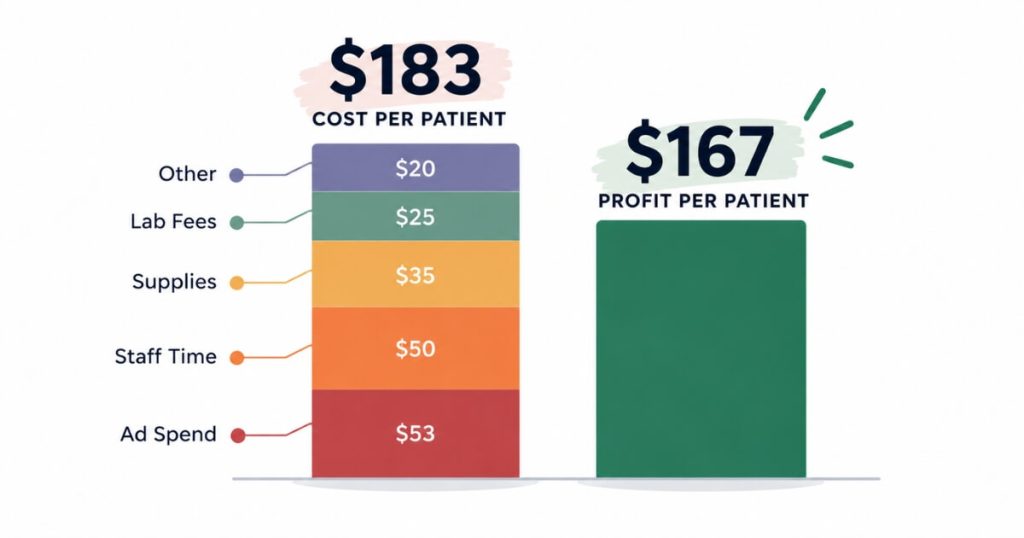
About $167 gross profit per patient per month — and roughly $4,200 a year in revenue, with patients staying around 36 months when cared for.
The cost stack on a $350 membership looks like this:
- ~$100 for medications
- ~$50 for labs ($600/year ÷ 12)
- ~$33 for provider time (four consults a year at $100/hour, spread monthly)
That’s $183 in costs, leaving $167 in margin per member per month.
Factor in referrals, and “one new hormone member is worth $5,000 over a year.”
This math is why hormone memberships are the best recurring model in cash-pay medicine.
It’s also why the HRT practice we helped grow from $1M to $4M a year built its entire business on 250 members at recurring rates.
What does it cost to acquire a TRT patient with ads?
$150–$300.
Under $150, you’re crushing it; under $300 is okay and scalable.
Run the math backwards from there.
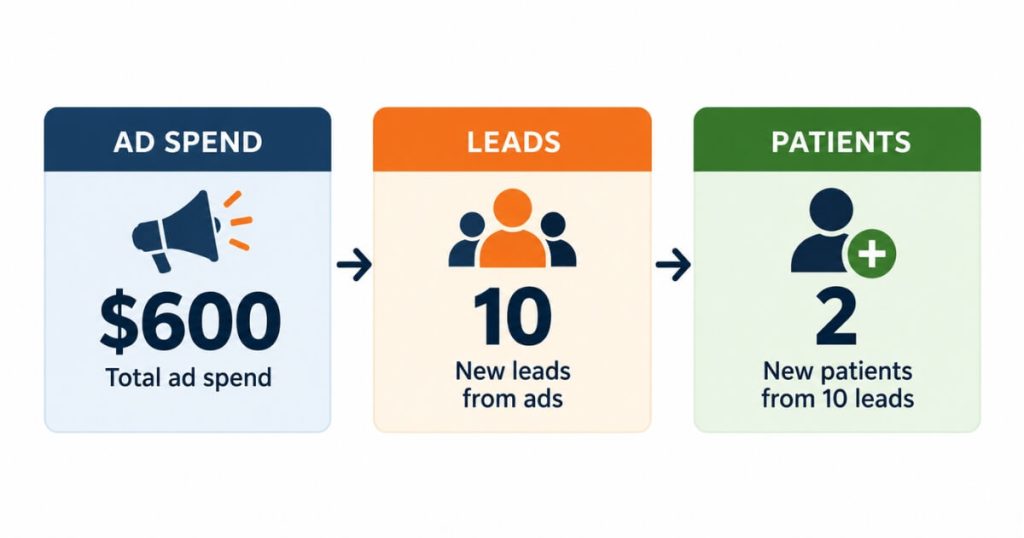
At a $300 CAC target and a booking rate of 2 in 10 leads, your ceiling is $60 per lead.
$600 of spend buys 10 leads, which buys 2 patients.
That $60 number is the tripwire for every channel decision.
A Google Ads quiz funnel starts at $75/day.
If cost per lead stabilizes at or under $60, you scale.
If it can’t get there, you fix the funnel before adding budget.
Against a patient worth $4,200 a year, a $300 CAC is a 14:1 first-year revenue-to-acquisition-cost ratio.
That’s exactly why underpriced clinics can’t run ads.
The same CAC against a $99 consult offer is a losing trade.
What should my front desk say when a lead asks “what’s the price?”
Only the first step: labs plus consult.
“They don’t need to know how much the cheesecake is before they’ve eaten their salad.”
The four-step consult script separates the 33-members-in-30-days clinic from the $11,000-wasted clinic.
First, hear the problem in the patient’s own words. Let them describe the fatigue, the sleep, and the drive — salt the wound.
Next, validate it: “We’ve helped patients exactly like you.”
Then present testing as the obvious next step.
Finally, present $350/$350/$350 without squirming.
Collect the lab payment on the phone.
The insurance question gets its own rebuttal.
Hormone optimization is rarely deemed “medically necessary,” so the clinic provides a letter of medical necessity and a superbill for possible reimbursement.
Say it plainly, without apology.
One functional medicine clinic changed nothing but this phone pitch.
As a result, bookings increased from 16 in September to 25 in October on the same lead volume.
The full follow-up cadence around these calls is its own discipline: instant text, fast manual call, and 24/48/72-hour touches.
That’s the core of men’s hormone clinic marketing done right.
Where do hormone clinic leads actually come from?
Two engines: SEO and Google Ads.
SEO includes location pages, blogs, reviews, schema, and Google Business Profile.
Meanwhile, Google Ads sends traffic into a 60-second symptom quiz funnel.
The quiz outperforms a generic contact form because it validates and qualifies at once.
The lead finishes it thinking, “I do qualify for a consultation.”
Offer design differs by audience.
Free testosterone testing pulls men who suspect they’re low.
The symptom quiz works better for women, who tend to research first.
Both feed a booking flow with a human setter on the other end.
Start ads at $75/day and hold until CPL stabilizes at or under the $60 ceiling.
Then scale.
Let SEO compound underneath as the channel that eventually makes every patient cheaper.
Who should a hormone clinic hire first — and when do memberships stall?
New patient coordinator first, then client service coordinator, then promote one to office manager.
That trio carries you to about 250 high-touch members.
The pay structure from clinics that retain includes:
- Front desk/new patient coordinator: around $25/hour plus a per-appointment-attended bonus ($10–$50). “$50 cash if you book 3 today” works.
- Team bonus: $50 per net new member.
- NP/PA: $100+/hour.
- Client service coordinator: $60,000–$75,000 annually plus bonuses.
Past 250 members, add an NP/PA, billing support, an RN for refills, and a second new patient coordinator.
On retention, churn spikes at months 3, 6, and 9.
The reasons differ: no results yet, results with no next step, or feeling like a number.
The countermeasures are structural.
Start with a 13-month journey map and a warm handoff to THEIR person — never the doctor as account manager.
Add pre-consult mini forms asking questions like “what was your main goal…”
Finally, use a mobile phlebotomist for follow-up labs so the quarterly draw never requires a parking spot.
FAQ’s About Marketing a Cash-Pay Hormone Clinic
Should a hormone clinic ever offer a free consultation?
No.
Credit the $350 consult toward the first month on a same-day commitment instead.
The patient gets the same $350 of value, and the clinic never prices the doctor’s time at zero.
What’s a realistic monthly revenue per hormone member?
$350/month is the working standard across the clinics where we run this model.
In premium markets, that increases to $400–$450.
The membership includes all medications, quarterly labs, and follow-ups.
That’s roughly $4,200 a year per member before referrals.
How long do hormone patients stay?
Around 36 months when the retention structure exists.
Watch months 3, 6, and 9.
That’s where cancellations cluster, and each has a different cause and fix.
What lead cost should I walk away from?
If a channel can’t produce leads at or under roughly $60 with a working funnel, fix the offer or the funnel before scaling spend.
At a 2-in-10 booking rate, $60 leads are what a $300 CAC allows.
Does this model only work in big cities?
No — it’s live in markets from Southern California to North Dakota.
Pricing shifts modestly, with a $350 baseline and $400–$450 in higher-end markets.
However, the structure, scripts, and hiring order are the same.
What’s the next step?
If your hormone clinic has the medications, the providers, and the leads but not the results, the gap is almost always sequencing.
Pricing and sales process before spend. Retention before scale.
Book a strategy call.
In 60 minutes, we’ll pressure-test your pricing against the $350/$350/$350 model, run your CAC math backwards, and map which hire your member count actually calls for.