
Should I Run Lab Testing Before the First Consultation at My Cash-Pay Clinic? (The Test-First Consult That Lets Patients Sell Themselves)
Most cash-pay clinics sell the program first and test afterward. The clinics with the most consistent close rates do the opposite: they run the labs first and hold the consult once the results are back. The difference sounds small, but it changes the entire dynamic of the visit because a patient looking at their own data co-diagnoses with you instead of being sold to.
This is the FAQ on the test-first consult, pulled from a functional-medicine practice that rolled a $650 test-first consult out to every new patient and watched its sales conversation transform.
Should I run lab testing before the first consultation or after it?
Run the testing first.
Then hold the consultation once the results are back.
When patients arrive with objective lab and functional-testing data already in hand, the conversation becomes one of co-diagnosing rather than persuading.
As a result, patients often sell themselves into the program that best fits their needs.
The sequence is straightforward:
- The patient pays for a test-first consultation.
- Blood work and functional testing happen immediately.
- The clinic schedules the results review after the laboratory results return, usually about two and a half weeks later.
Compare that with the traditional process.
In the standard model, clinics sell the program first and complete testing afterward.
That approach asks patients to commit before seeing any objective evidence.
Consequently, the provider’s ability to persuade becomes the deciding factor.
Testing first completely changes that dynamic.
Instead of relying on persuasion, the data does the convincing.
More importantly, this is a structural improvement to your patient acquisition process rather than a clever sales script.
Because the structure stays the same, it works consistently across providers and across months.
Why does a test-first consult improve close rates at a cash-pay clinic?
Objective data transforms the consultation from a sales conversation into a clinical conversation.
Patients review their own numbers and reach conclusions alongside the provider.
Most people resist being sold.
However, they trust evidence they can actually see.
When laboratory results clearly show what’s happening with gut health, hormones, detox pathways, stress response, and muscle health, the recommended program no longer feels like an upsell.
Instead, it becomes the logical next step.
The provider isn’t arguing patients into treatment.
Rather, the provider is interpreting evidence the patients already paid to generate.
Just as importantly, that process is highly repeatable.
Every consultation follows the same framework:
- Empathize
- Test to be absolutely sure
- Present the program that matches the findings
Because the structure never changes, clinics can train multiple providers to deliver the same experience.
That consistency allows growth without depending on one exceptionally charismatic closer.
It’s also the type of conversion discipline that produces results like a cash-pay clinic that converted 79.4% of its leads into booked appointments.
Strong close rates come from process, not luck.

Should I charge for the test-first consultation?
Yes.
Charging a meaningful fee for the test-first consultation qualifies patients, positions the visit as clinical rather than sales-focused, and improves everything that happens afterward.
For example, one functional medicine clinic charges $650 for its test-first consultation, including laboratory testing.
Every new patient follows that same process.
First, the fee filters out people who aren’t serious about finding answers.
Someone willing to invest in testing has already demonstrated meaningful intent.
Second, paying for testing changes the patient’s mindset.
Instead of arriving skeptical, patients arrive engaged because they’ve already invested in understanding what’s wrong.
There’s also a practical business benefit.
Offering a free consultation often means giving away an hour of provider time along with an extensive diagnostic evaluation to people who never planned to move forward.
By comparison, a paid test-first consultation ensures that the patients sitting in your office have already shown commitment.
The fee isn’t a barrier for the right patient.
Instead, it filters out the wrong one while creating the right expectations for everything that follows.
How does a paid test-first consult help me close anxious or hesitant patients?
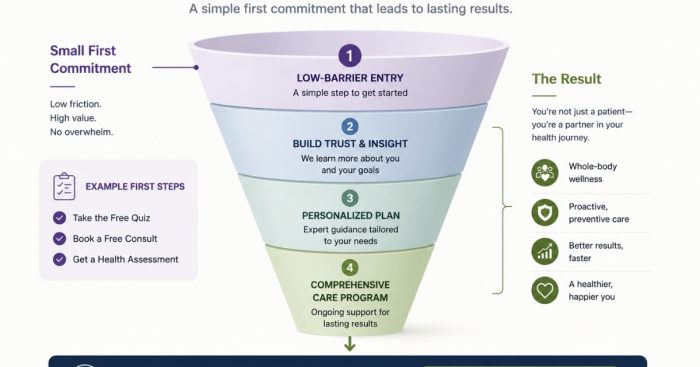
A paid test-first consultation gives anxious patients a smaller, lower-risk first commitment.
Instead of asking them to purchase a large program immediately, it allows trust to develop first.
Many anxiety-prone patients struggle with high-ticket decisions.
For example, someone may commit to an $8,000 functional medicine program only to cancel before testing—or even before meeting the provider.
In those situations, the clinic technically made the sale but still lost the patient.
The test-first model changes that pattern.
Rather than asking patients to make their biggest commitment on day one, the clinic gradually moves them toward the larger program after trust and objective data have been established.
The pattern becomes even more revealing over time.
When an anxious patient pays $650 for testing and later needs to delay treatment, she typically doesn’t request a refund the way she might after purchasing an $8,000 program.
Instead, she simply asks for a little more time.
That smaller first commitment keeps her inside the funnel while allowing both the relationship and the data to build confidence.
Who is the test-first consult best suited for at a cash-pay clinic?
The test-first consult works especially well for three types of patients:
- Optimization seekers who don’t have one obvious symptom
- Patients with complex or unclear cases
- Anxious patients who need a low-risk first step
First, optimization seekers can be difficult to move forward because nothing appears obviously wrong.
However, objective data gives them a concrete reason to act.
In many cases, laboratory findings accomplish what conversation alone cannot.
Next, ambiguous cases benefit from front-loaded testing because the underlying cause isn’t immediately clear.
Rather than guessing during the consultation, providers can review the data and confidently recommend the right program.
Finally, anxious patients often need a smaller first commitment before they’re comfortable making a larger investment.
The test-first model gives them that opportunity.
Across all three patient types, the laboratory results do the work the conversation can’t.
That’s the strength of the model.
It performs best in situations where a sell-first approach is weakest.
For that reason, it fits naturally into a functional medicine & longevity clinic marketing strategy, where patients expect evidence and tend to resist pressure.
How do I keep my consult close rate stable from month to month?
Standardize the consultation process.
Don’t rely on the provider being “on” every single day.
Instead, follow the same repeatable framework every time:
- Empathize
- Test to be sure
- Present the program that matches the findings
Close rates become inconsistent when every consultation is handled differently.
For example, one clinic saw its close rate drop from 66% one month to 53% the next despite having the same lead volume.
That kind of variation points to an inconsistent process rather than a lead-quality problem.
By comparison, the test-first model creates consistency because every patient follows the same sequence and the laboratory data carries much of the persuasion.
You can strengthen the process even further.
Before the consultation, have a clinician review the laboratory results.
That preparation allows the provider to enter the appointment already familiar with the findings and ready to recommend a well-considered plan.
As a result, patients experience a confident consultation instead of watching someone interpret laboratory results for the first time.
Ultimately, process consistency—not provider charisma—is what makes close rates predictable.
Predictable close rates make revenue easier to forecast and eliminate much of the month-to-month volatility.
FAQ’s About the Test-First Consult Model
What should the test-first consult actually include?
At a minimum, the consultation should include the diagnostic testing appropriate for your specialty along with the results-review appointment.
For a functional medicine clinic, that typically includes blood work and functional testing covering major systems such as gut health, detox pathways, hormones, stress response, and muscle health.
Bundle the testing into one paid consultation so patients experience one clear offer instead of several separate charges.
How long should I expect between the paid intake and the results consult?
Most clinics schedule the results consultation about two and a half weeks after the initial visit because laboratory turnaround determines the timing.
Set that expectation from the beginning.
Meanwhile, use the waiting period to keep patients engaged through onboarding and educational communication.
As a result, they arrive at the results consultation feeling invested rather than disconnected.
Will charging for the first consult reduce my number of consults?
Yes—but it primarily reduces low-intent consultations.
That’s exactly the trade most cash-pay clinics want.
Although you’ll meet with fewer tire-kickers, the patients who do schedule are much more likely to become paying patients.
Consequently, close rate and revenue per consultation often increase even if total consultation volume decreases.
You’re trading quantity you couldn’t convert for quality you can.
Do in-person seminars work alongside a test-first model?
Yes.
In-person seminars often produce highly qualified patients who are already motivated to buy.
For example, one clinic hosted an in-office seminar with only seven attendees and converted all seven into patients.
When you combine a seminar that educates and qualifies prospects with a test-first consultation that closes using objective evidence, you create a powerful system for high-consideration cash-pay services.
What’s the next step?
If your close rate changes from month to month and your consultations feel like you’re selling on faith, the solution may be simpler than you think.
Instead of selling first, test first.
When patients arrive holding their own laboratory results, the program largely sells itself.
At the same time, anxious patients remain in the funnel, and your close rate becomes less dependent on whoever happens to conduct the consultation.
During a strategy call, we’ll map your current new-patient journey and identify exactly where to introduce the test-first consultation.
Then we’ll show you how to convert more leads while creating more predictable revenue.
It’s the same conversion discipline behind a longevity and functional medicine clinic where we lifted website leads by 900% and inbound calls by 100+ a month.