
Why Does This One Pricing Mistake Cap a Cash-Pay Clinic at One Provider — and How Do Tiered Programs Fix It?
I was sitting inside a million-dollar anti-aging clinic recently, and the owner told me they had tried — and failed — to scale from one provider to two. They had brought providers on before, and it never stuck. Within a few minutes I saw why, and it had nothing to do with the new provider’s skill. It was one very simple pricing mistake, repeated everywhere I look in cash-pay medicine. They were charging less for the new provider than for the founder, and that single decision was quietly telling every patient the new provider was the inferior choice. This is the synthesis of what I told them — the mistake, why it caps growth, and the same-price, tiered-program fix that actually lets a cash-pay clinic add provider two, three, and four.
What is the single pricing mistake that stops a cash-pay clinic from scaling past one provider?
It is charging a lower price for the new provider’s consultation and ongoing membership than you charge for the founding provider’s.
At first, that approach feels generous.
It also feels logical.
The new provider is less proven, so discounting them seems like an easy way to encourage bookings.
However, patients interpret the discount very differently.
A lower price signals lower value.
It also suggests a lower likelihood of getting the desired result.
By the time patients reach this stage, they have already decided to do business with your practice.
They are no longer price shopping.
Instead, they ask themselves one question:
“How do I increase the likelihood that I’m going to get the result?”
When they see two different prices, they choose the more expensive provider almost every time.
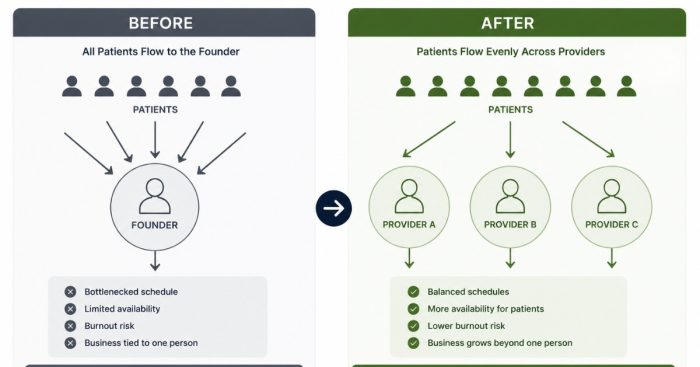
The founding provider stays fully booked.
Meanwhile, the new provider’s schedule remains largely empty.
Eventually, the clinic concludes that hiring additional providers does not work.
In reality, the pricing structure quietly positioned the new provider as the inferior option.
That was exactly the trap facing the million-dollar clinic.
Demand already existed.
The second provider was fully capable.
The only thing preventing growth was a pricing difference the owner believed was helping.
Why does a lower price for a new provider make patients choose the founding provider instead?
Because, in cash-pay medicine, patients read price as a proxy for the likelihood of achieving a result.
They do not see it as a discount they should automatically choose.
Patients visiting a cash-pay anti-aging, hormone, or longevity clinic have already decided they want the outcome.
They also expect to invest in achieving it.
At that point, the question is no longer, “How do I save money?”
Instead, they think, “How do I maximize my chance of feeling better?”
A higher fee for the founding provider immediately communicates greater confidence.
The patient naturally assumes that provider offers the highest chance of success.
Meanwhile, the lower-priced provider becomes the budget option.
Patients often interpret that as the less experienced or riskier choice.
Money rarely becomes the deciding factor after someone commits to a high-lifetime-value program.
Instead of increasing bookings for the new provider, the discount reinforces a hierarchy.
As a result, demand flows back to the founder.
The discount designed to fill the second provider’s schedule actually empties it.
Most clinic owners never recognize that mechanism until someone points it out.
It is also why building a functional medicine & longevity clinic marketing system around the brand—not the founder—is the only reliable path to scaling a practice.
How do you price a new provider so patients book them at the same rate as the founder?
Charge exactly the same price for the new provider’s consultation and membership as you charge for the founding provider.
Matching prices tells patients the value remains consistent regardless of which provider they choose.
Instead of buying one person’s expertise, they begin buying the practice itself.
The moment both providers cost the same, the new provider no longer appears to be the budget option.
Instead, the clinic’s brand becomes the product.
That single pricing change often unlocks the second, third, and fourth provider.
Patient demand finally spreads across the team instead of concentrating on the founder.
Ironically, the discount you believed would encourage bookings was the very thing limiting your growth.
When we worked with Eternity Health Partners, an HRT clinic we grew from $1M/year to $4M/year in four years with 250 active members paying $1,000/month, that consistency—one brand promise, one level of value, and one price across every provider—allowed recurring revenue to scale without making the founder the bottleneck for every appointment.
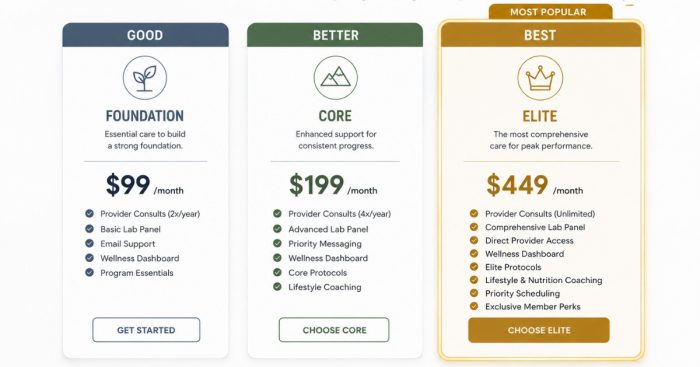
How does a tiered program structure fix under-pricing in a cash-pay clinic?
Tiered programs fix under-pricing by anchoring high and giving patients a structured way to choose more.
Instead of defaulting to the cheapest version of care, patients select the level of investment that best matches their goals.
A single flat membership creates one problem immediately.
Without a price anchor, clinics almost always price the program too low.
A tiered structure changes that.
Present a good, better, and best program with the premium tier clearly visible at the top.
That premium option anchors the patient’s perception of value.
As a result, the middle tier feels more reasonable.
Meanwhile, patients who want the most comprehensive care naturally choose the higher investment level.
Most importantly, build the tiers around the program and the outcome—not around the provider delivering the care.
Every provider should offer the same programs at the same prices.
That approach raises the average transaction value.
It also removes conversations about which provider costs less.
At the same time, every new provider receives the same complete menu to sell from day one.
Ultimately, the under-pricing problem and the provider-scaling problem are two sides of the same issue.
Tiered, provider-neutral pricing solves both simultaneously.
Why should you price a cash-pay clinic as a brand instead of as one provider’s service?
Because a business priced around one provider can never grow beyond that provider.
The clinics that remain stuck with one chair make the founder the product.
By contrast, scalable clinics make the brand the product.
Providers simply deliver a consistent branded experience.
When patients buy the brand, pricing remains consistent across the entire team.
Marketing promotes the practice instead of a single personality.
Likewise, every new provider inherits the credibility of the brand rather than rebuilding trust from scratch through discounted pricing.
That shift changes everything.
The owner no longer has to remain at the center of every appointment.
Instead, patients buy the practice’s promise rather than the founder’s calendar.
Price as a brand.
Staff as a brand.
Market as a brand.
Do that, and the second provider becomes a growth asset instead of another hiring experiment that “didn’t work.”
FAQ’s About the Cash-Pay Clinic Provider Pricing Mistake
What is the single pricing mistake that stops a cash-pay clinic from scaling past one provider?
Charging a lower price for the new provider’s consultation and membership than the founding provider’s.
Although that approach feels logical, patients interpret the lower price as lower value and a lower likelihood of achieving the desired result.
Because they have already decided to buy, they choose the provider who appears most likely to help them succeed.
That usually means selecting the higher-priced founder.
As a result, the founder stays fully booked while the new provider struggles to fill a schedule.
Why does a lower price for a new provider make patients choose the founding provider instead?
Patients in cash-pay medicine view price as a signal of quality rather than a discount opportunity.
Once someone commits to solving a health problem, saving money becomes less important than maximizing the chance of success.
Consequently, the higher-priced founder appears to offer better results.
Meanwhile, the lower-priced provider feels like the riskier choice.
Instead of creating demand for the new provider, the discount reinforces the founder’s position.
How do you price a new provider so patients book them at the same rate as the founder?
Charge exactly the same consultation and membership price for every provider.
Matching prices communicate consistent value across the practice.
Patients begin buying the clinic’s brand instead of choosing between individuals.
That simple pricing change allows appointments to spread naturally across multiple providers and removes the founder as the booking bottleneck.
How does a tiered program structure fix under-pricing in a cash-pay clinic?
Tiered programs create a value anchor.
Instead of offering one flat membership, the clinic presents good, better, and best options.
Patients choose the investment level that fits their goals.
Every provider offers the same programs at the same prices.
As a result, average transaction values increase while conversations about cheaper providers disappear.
Why should you price a cash-pay clinic as a brand instead of as one provider’s service?
A provider-centered business cannot scale beyond that individual.
A brand-centered clinic can.
Consistent pricing, consistent marketing, and consistent patient experience allow every provider to deliver the same promise.
As the brand becomes the product, new providers inherit credibility immediately instead of competing against the founder.
What’s the next step?
If your cash-pay clinic has stalled at one provider—or if you’ve already hired another provider and it “didn’t work”—start by reviewing your pricing.
Look for a two-tier provider discount.
If the new provider charges less than the founder, that pricing difference is likely limiting your growth.
Fortunately, the fix costs nothing.
Charge the same prices across every provider.
Then rebuild your offers into provider-neutral tiered programs that anchor value at the program level instead of the individual level.
Price the brand, not the person.
If you want someone to review your pricing, tier structure, and provider economics together, that is the conversation to book.
We applied this exact approach for Eternity Health Partners, the HRT clinic we scaled from $1M to $4M with 250 members at $1,000/month.
During the call, we’ll map the same opportunity for your practice.