
Should I Price My Cash-Pay Program as a Monthly Membership or a Lump-Sum Total? (Why the Way You Present the Number Books More Patients)
Two clinics can charge the exact same total for the exact same program and book completely different numbers of patients because of how they present the price. One says “$5,000.” The other says “about $830 a month.” Same revenue, same care, very different booking rate.
This is the FAQ on price presentation for cash-pay clinics, drawn from a strategy session where the fix wasn’t lowering the price at all. Instead, it was changing the size of the number patients had to react to before they ever booked.
Should I present my cash-pay program price as a monthly figure or a lump-sum total?
Lead with the monthly figure.
A monthly number books more appointments than a large total, even when the total revenue is identical.
Think about how a truck is advertised during the Super Bowl.
The ad says “$499 a month,” never “$79,000.”
That smaller monthly number removes friction at the exact moment a prospect decides whether to book the first call.
Unfortunately, that’s where many clinics quietly lose potential patients.
A six-month program presented as “$5,000” feels like a wall.
By comparison, the same program presented as roughly $830 per month feels like a decision an average person can comfortably make over the phone.
Importantly, you’re not discounting the program or changing the total amount the patient pays.
Instead, you’re changing the size of the number they react to first.
That simple shift makes all the difference.
One clinic made this exact change and booked 25 new patients in one month instead of 16 the month before.
Notably, lead volume stayed exactly the same.
Only the first number prospects heard changed.
This is one of the least expensive improvements available in patient acquisition because it costs nothing while improving conversion from the leads you already have.

Won’t switching to monthly memberships increase patient churn at my clinic?
No.
Monthly memberships are easy for prospects to understand, and they don’t create a meaningful churn problem in practice.
At first, the concern seems reasonable because monthly payments appear easier to cancel.
However, patients who truly want to leave will do so regardless of how you structure the price.
Meanwhile, the lower monthly number brings significantly more people through the door in the first place.
Rather than making the initial commitment painful, focus on delivering excellent care and creating a smart commitment structure.
For most clinics, that commitment comes from using a financing partner like CareCredit instead of requiring one intimidating lump-sum payment.
As a result, the financing company carries the balance, you receive a chunk of cash up front, and the patient pays over time with interest-free financing.
That structure often reduces the desire to leave because patients have already committed to the program.
Clinics that have operated under both pricing models consistently find that monthly memberships improve front-end conversions without creating the churn disaster many owners expect.
Ultimately, recurring memberships make revenue far more predictable.
That’s also why they form the foundation of a scalable functional medicine & longevity clinic marketing strategy.
How do I keep multiple price tiers without confusing patients?
Keep the tiers.
Don’t flatten everything into one price.
Instead, make each option simple enough that anyone answering the phone can explain it in a single sentence.
Many successful clinics offer several membership levels.
For example, they may have a baseline membership alongside higher-priced tiers with additional services.
Although the prices vary from clinic to clinic, simplicity stays constant.
Confusion doesn’t come from offering choices.
Instead, it comes from unnecessary complexity.
Patients become overwhelmed when the front desk has to explain a complicated matrix of inclusions, exclusions, and program lengths.
By contrast, three straightforward monthly prices with one clear explanation each feel easy to compare.
Present every tier as a monthly payment followed by a one-line description of what’s included.
As a result, patients naturally choose the level that fits their goals.
At the same time, the pricing structure makes the middle option feel like the most sensible choice.
Should I offer an annual membership, and how should I price it?
Yes.
Offer an annual membership and use it as a price anchor.
Doing so makes your mid-length plan feel like the practical, reasonable choice.
When patients compare a 12-month option with a 6-month option, the shorter plan no longer feels like a major commitment.
Instead, it becomes the comfortable middle ground.
That’s exactly how price anchoring works.
To strengthen that effect, price the annual membership with roughly a 10% discount for paying the full year up front.
Ideally, process that payment through a financing partner so you aren’t financing patients yourself.
The annual option serves three important purposes:
- It encourages patients to think long term.
- It rewards prepayment with a simple financial incentive.
- It keeps the financing responsibility off your books.
Even if the annual membership isn’t your most popular option, it still earns its place.
Its primary job is to make the other plans feel easier to choose by comparison.
How does CareCredit help me sell cash-pay memberships?
CareCredit allows patients to pay over time while you receive a chunk of cash up front.
As a result, a larger financial commitment feels much more manageable.
Instead of financing treatment from your own cash flow and chasing missed payments, the financing company carries the balance while you get paid immediately.
Meanwhile, patients experience the program as an affordable monthly payment instead of an intimidating lump sum.
That reduction in financial friction helps more people commit to treatment.
CareCredit also reinforces the monthly-pricing strategy.
Patients experience the cost exactly the way you present it—a manageable recurring payment rather than one overwhelming total.
When used effectively, CareCredit becomes both a closing tool and a cash-flow tool.
For that reason, it pairs naturally with monthly membership pricing.
How do I grow revenue from patients who only buy weight loss or peptides?
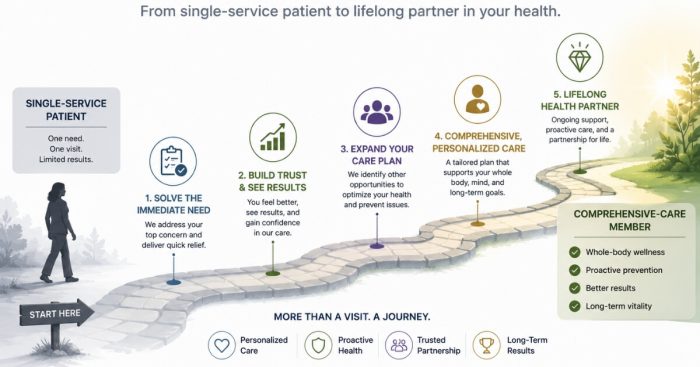
Start by upselling existing weight-loss-only and peptide-only patients into laboratory testing and a more comprehensive health program.
They already trust your clinic, making them the easiest source of additional revenue.
Most of these patients joined months ago, had a positive experience, and continue spending money with you.
However, many simply haven’t been offered the next clinical step.
Begin the conversation with discounted laboratory testing.
Then ask a straightforward question:
“You’re investing a lot in your health with us—when’s the last time we actually looked at your labs?”
That single conversation often transforms a single-service patient into someone receiving comprehensive care.
As a result, they stay longer and generate more lifetime value.
In most cases, deepening an existing patient relationship is both faster and less expensive than acquiring a brand-new patient.
Unfortunately, many clinics overlook this opportunity while continuing to buy more leads.
We saw this same type of existing-patient expansion compound at a longevity and functional medicine clinic where we lifted website leads by 900% and added 100+ inbound calls a month.
However, expanding care for existing patients remains the fastest revenue lever most clinics can pull this week without spending another dollar on advertising.
FAQ’s About Cash-Pay Program Price Presentation
Does presenting a monthly price mean I’m collecting less money up front?
Not necessarily.
With a financing partner, you can still receive a chunk of cash up front while patients experience a manageable monthly payment.
Remember, monthly pricing changes the number patients react to—not the way you collect payment.
For example, you can present “about $830 a month,” finance it through CareCredit, and still receive payment immediately.
The presentation and the collection process are two separate levers.
What’s a realistic revenue lift from changing price presentation alone?
It can be significant because the improvement affects booking rate rather than lead volume.
For example, one clinic kept lead volume exactly the same and increased new patients from 16 to 25 in consecutive months after switching to a monthly-membership presentation with an $899 initial consult and a roughly $799 monthly plan.
Best of all, the change cost nothing while increasing new-patient bookings by more than half.
When should I hire a second provider to handle the extra patients?
Wait until your clinic consistently reaches about 100 new patients per month for roughly three consecutive months.
Hiring sooner can reduce margins, especially when you’ve already collected payment but still owe ongoing care.
By comparison, membership models make expansion easier because recurring revenue arrives alongside the continuing cost of treatment.
How do I move existing program patients onto a membership without upsetting them?
Position the membership as continuity of care instead of introducing it as a new monthly bill.
Start by making memberships the default option for every new patient.
Then, transition existing patients as their current programs come to an end.
When the monthly payment feels reasonable and the ongoing value is clear, most patients adapt quickly.
What’s the next step?
If your program is priced fairly but patients hesitate to book, the problem may not be your price.
Instead, it may simply be the size of the number you present first.
Lead with the monthly figure.
Keep your pricing tiers, but explain each one in a single, straightforward sentence.
Likewise, use an annual plan as a price anchor, and reinforce the commitment with a financing partner instead of an intimidating lump-sum payment.
None of those changes require lowering your prices.
During a strategy call, we’ll evaluate how you’re presenting your offers today and identify where prospects drop off before booking.
Then we’ll rebuild the presentation so the same leads convert at a higher rate.
It’s the same process that helped clinics like an HRT clinic we grew from $1M to $4M a year build a predictable membership base.