
Your Clinic’s Call Volume Doubled — Now What? Front-Desk Capacity, 1,000 Unread Messages, and the $50 Price Move
This is what growth actually looks like from inside a cash-pay concierge practice.
Inbound calls climbed from the 200s a month in January to the 400s by September. The clinic hired another front-desk employee, grew past 200 active members, and started ramping up a second provider.
But behind that growth were 1,000 unread messages, a three-month waitlist, and 82 booked appointments the clinic only had capacity to see 27 of.
Here’s the real consulting-call playbook for fixing capacity without slowing growth.
How do you know your cash-pay clinic’s front desk is at capacity?
When inbound volume roughly doubles and messages from paying members start slipping through, you’re past capacity, not approaching it.
Even if those messages only go unanswered for a single weekend.
The clinic in this call watched monthly inbound calls climb from the 200s to the 400s in eight months.
And it made the right first move: hire another front-desk person.
But the real warning sign wasn’t the call count.
It was the owner opening the CRM one weekend and finding messages from Friday that still hadn’t been handled.
One of those messages came from a paying member.
One or two missed messages out of a full day might sound forgivable.
However, this wasn’t a criticism of any employee.
The original front-desk person “was doing so many people’s jobs at that point.”
And that’s the point.
Capacity problems often masquerade as people problems.
If your best employee has to be forgiven for missed messages, you don’t necessarily have a performance issue.
You have a structural one.
Why does the new front-desk hire keep ending up in the back office?
Because clinical staff will lean on administrative staff if you let them.
And an easygoing owner culture almost guarantees it happens.
The new hire was talented and flexible.
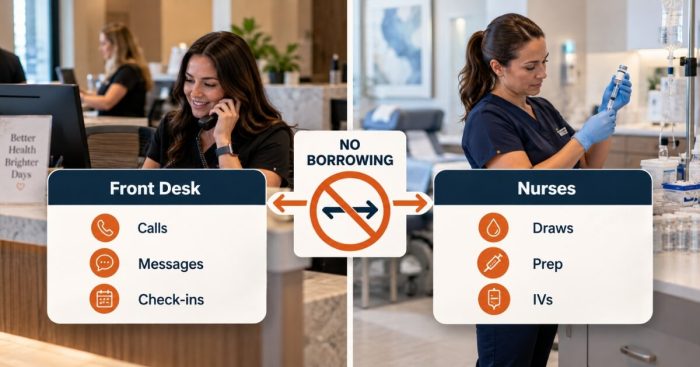
She could draw labs, prepare peptides and testosterone pickups, and cover the front desk.
So whenever a nurse was in the middle of an IV, the new hire got pulled into the back.
Meanwhile, the front-desk role she was hired for kept dissolving.
The fix from the call was blunt.
Reserve the front-desk hire for new-patient and existing-patient communication.
Then, make the nurses handle the lab draws.
“That’s what they get paid for. You can’t sub off your work to an inferior-cost employee — and they will do it if you let them.”
If a draw truly can’t wait, the owner pays the nurse to handle it.
But the default is simple: the front desk stays at the front desk.
Otherwise, the role you designed never becomes a defined position.
Instead, it becomes whoever happens to be available.
This is a roles-and-responsibilities decision, not a personality issue.
The owner has to communicate it explicitly.
That’s especially important when the team culture is “let’s just get it done swiftly.”
It’s a positive attitude, but it can quietly destroy role clarity.
How do you fix 1,000 unread messages in your clinic’s CRM?
Set inbox zero as the standard, assign one person to own it, and enforce mark-as-read discipline.
That way, the unread count actually means something.
On the call, the CRM showed roughly 1,000 unread conversations.
But here’s the twist: most had already been answered.
Staff replied quickly but never marked the conversations as read.
As a result, nobody could tell which messages had been handled and which had been dropped.
That’s almost as dangerous as not answering at all.
The one genuinely missed message from a paying member was hiding among a thousand false alarms.
The fix has three parts.
First, establish the standard.
Unread conversations should reach zero every day.
“I’d like to see it get to zero” is a clear goal the team can work toward.
Second, assign ownership.
Decide who is responsible for the inbox instead of letting two people overlap without clear accountability.
That lack of ownership is how weekend messages get missed.
Third, enforce inbox hygiene.
Replying without marking a conversation as read keeps the dashboard misleading.
When the unread count is accurate, the owner can spot-check the inbox in thirty seconds.
That’s much better than clicking through 500 conversations on a Saturday.
What should you do when your clinic is booked out three months?
Raise prices for new patients only.
Then, treat the waitlist as proof that demand has outrun your current pricing.
Being booked out three weeks is a normal sales cycle for membership medicine.
After all, labs can take about that long anyway.
But being booked out three months is a pricing signal.
The recommendation from the call was to raise everything by $50 for new patients, effective immediately.
That meant increasing monthly memberships from $300 to $350 and from $350 to $400.
Meanwhile, existing members would keep their current rates.
As we put it on the call, “anybody we already did a price increase with, we can’t increase again — that’s not tasteful.”
The owner’s own framing made the decision clear.
The alternative was telling new patients, “we have a waitlist.”
So the real question became: what would make it worth stretching capacity to see them?
If someone is willing to wait 90 days for the opportunity to purchase your services, your price is probably too low.
And the math compounds quietly.
The family plan rises $50 too.
Every future member also enters at the new pricing floor.
That’s how a functional medicine and longevity clinic marketing engine is supposed to work.
Demand generation fills the calendar.
Then, pricing converts the overflow into margin instead of creating an even longer waitlist.

Where should the pricing friction go — at entry or in the membership?
Keep the front door cheap and easy.
Put the increase on the recurring flow, where the real costs live.
The owner also wanted to raise the initial lab fee.
After all, the clinic was barely breaking even on labs once nursing time was included.
But the guidance was clear: don’t stack more friction on the barrier to entry.
The lab offer was already working as a lead magnet.
Instead, put the increase on the monthly membership.
That’s where a $50 raise across the board can more than cover the margin leaks.
However, you also need to understand your per-patient costs before setting the number.
On this call, the owner had discovered a significant difference between treatment protocols.
Progesterone patients cost the clinic $80–$90 a month in prescriptions.
Meanwhile, testosterone-and-estrogen patients cost only $40–$50 a month.
That meant some members looked like $350 in monthly revenue on paper but generated far less margin.
You don’t need to nickel-and-dime patients based on their specific protocols.
Instead, you need a blended membership price that clears your worst-case costs.
A flat $50 increase did exactly that.
How do you protect enrollment while a new provider ramps up?
Give the new provider whatever support she needs to see more new patients.
Then, give patients a script that makes seeing her feel safe.
The scariest number on the call wasn’t the unread message count.
It was the gap between booked appointments and patients actually seen.
Over the previous 90 days, the clinic booked 82 new-patient appointments.
But it only managed to see about 27 of them.
Demand was never the problem.
The problem was the clinic’s capacity to absorb that demand.
So the directive was simple: do whatever it takes to help the new nurse practitioner comfortably take more new patients.
That might mean giving her a dedicated virtual assistant for backend tasks.
It could also mean providing front-desk support on specific days.
Or the owner might need to help finish patient plans after hours.
Whatever the solution, the priority stays the same.
“We don’t want to slow down enrollment.”
But there’s another challenge when a clinic brings in a second provider.
Some patients only want to see the owner.
They’re hesitant to book with someone new, even when that provider has availability.
The solution was a simple script:
“You’re both of our patients. She’s just going to see you first — but she reviews every case with me.”
That statement changed how patients viewed the new provider.
It reassured them that the owner remained involved in their care.
Once the owner started using the script, the front desk adopted it too.
And in this clinic’s experience, every patient who saw the new provider signed up.
Capacity fixes like these are what make growth stick.
And when the phones themselves become the bottleneck you want more of, that’s a solvable problem too.
In fact, we’ve built inbound engines that added 100+ calls a month to a longevity clinic in four months.
FAQ’s About Front-Desk and Patient Capacity at a Growing Clinic
When should a cash-pay clinic raise its prices?
When you’re booked out well beyond your normal sales cycle.
Three weeks out is normal for membership medicine that requires labs.
However, three months out means demand has outrun your current pricing.
At that point, consider raising prices for new patients.
The clinic in this article increased its monthly membership pricing by $50.
Meanwhile, existing members kept their current rates.
Should existing members get the price increase too?
No.
If existing members have already absorbed one increase, raising their rates again can feel like nickel-and-diming.
It also risks damaging the trust you’ve built.
Instead, apply the new pricing to new patients only.
Every future enrollment enters at the higher pricing floor.
Over time, the recurring revenue base compounds without forcing another increase on existing members.
Who should draw labs — the front desk or the nurses?
The nurses.
Clinical staff will sometimes offload lab draws and preparation tasks onto capable administrative employees if allowed.
However, that gradually hollows out the front-desk role.
Reserve front-desk staff for patient communication, scheduling, and check-ins.
Then, pay clinical staff to handle clinical responsibilities.
Clear roles protect the patient experience and prevent communication from falling behind.
What does “inbox zero” mean for a medical practice CRM?
Every patient conversation gets answered and marked as read daily.
And one person has clear ownership of the inbox.
Answering messages without marking them as read is almost as bad as not answering.
That’s because genuinely missed messages become buried beneath hundreds of false unread notifications.
With inbox zero, the unread count becomes a reliable indicator of outstanding work.
How do I get patients to accept a new provider instead of waiting for me?
Use the both-of-ours script:
“You’re both of our patients — she’ll see you first, and she reviews every case with me.”
This preserves the owner’s clinical authority while transferring trust to the new provider.
It also reassures patients that their care remains connected to the physician they already know.
In this clinic’s experience, every patient who saw the new provider enrolled.
What’s the next step?
If your calls are climbing, your inbox is lying to you, and your calendar is booked out past a quarter, congratulations.
You have the good problems.
But good problems still cap growth.
Book a strategy call, and we’ll run your clinic’s capacity math.
We’ll look at booked-versus-seen appointments, pricing, front-desk responsibilities, and your new provider’s ramp-up.
Then, we’ll map the fixes in the order that protects enrollment while your team catches up.