
Should a Cash-Pay Clinic Route Its Inbound Phone Calls? (Who Answers, Who Doesn’t, and the Mistakes That Cost Booked Patients)
A missed phone call at a cash-pay clinic isn’t a minor annoyance — it’s a patient who books somewhere else. Yet most clinics we audit have no deliberate call routing at all: calls ring whichever desk happens to be staffed, roll to a voicemail nobody checks, or forward straight to the owner’s cell at 9 p.m. Here’s the exact routing architecture we build for the clinics we work with — who answers, when, and where every call goes when they don’t.
Who should answer the phone at a cash-pay clinic — the front desk, an answering service, or the owner?
Named staff members answering on softphone apps — not a generic answering service, and never the owner’s personal cell.
A new-patient call at a cash-pay clinic is a high-intent buyer on the line. Your programs run into the thousands, and the caller has questions an outsourced answering service can’t touch: do you treat my condition, what does the first visit look like, can I book right now.
A message-taker converts none of that. By the time the message is returned, the caller has booked with the clinic that answered.
The architecture we build instead assigns every branch of the phone tree to a specific named person.
Each team member answers on two devices at once — the desktop web app on a headset at the desk and the mobile app in their pocket when they step away.
On a recent phone-system build for a functional medicine clinic we work with in Florida, each staff member got an explicit lane: the front-desk hire owned one branch, the patient coordinator owned the other, and the doctor answered nothing.
That last part is the point.
If your routing plan is “whoever is closest to the phone,” you don’t have routing — you have luck.
Should new-patient calls and existing-patient calls go to the same person?
No. Split them at the phone tree because they are two different jobs.
Existing-patient calls are service: scheduling, refills, follow-ups, and directions.
They belong to your front desk.
New-patient calls are revenue. Someone found you, is comparing options, and is ready to talk.
Those calls belong to whoever is best at converting an inquiry into a booked consult — a patient coordinator, not whoever happens to pick up.
The volume behind that distinction can be significant. At one regenerative practice, we saw 3,490 inbound calls tracked, of which 1,310 were first-time patients.
When we rebuilt routing for that Florida clinic, this was the first correction.
Existing patients had been ringing a staff member who had no business fielding them.
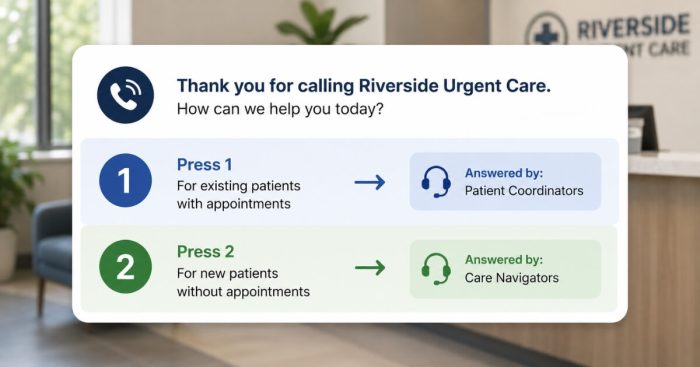
We reassigned the branches on the spot — press 1 (existing) to the front desk and press 2 (new patients) to the coordinator who owns intake.
The new-patient line is the front door of your entire patient acquisition system.
Treating it as an interruption at a busy front desk is how clinics quietly leak booked patients.
What should a medical practice phone tree (IVR) actually say?
Three lines: an emergency disclaimer, press 1 for existing patients, press 2 for new patients. Done.
Here’s the greeting pattern we deploy:
“Thank you for calling [your clinic]. If this is a medical emergency, please hang up and dial 911. If you are an existing patient with us, please press 1. If you are a new patient and interested in becoming part of our clinic, please press 2.”
In front of the phone tree sits one business-hours rule.
During office hours, callers hear the greeting and get routed to a human.
Outside office hours, they skip the tree entirely and go to a dedicated after-hours voicemail.
What you should not build is the six-option, hospital-style IVR — “press 4 for billing, press 5 to hear our hours.”
Every added option costs you callers.
A cash-pay patient is choosing between you and a competitor in real time, so two choices are all the sorting you need.
If both staffers are busy, a short hold message (“all of our team members are currently assisting other patients”) buys your team the ring window without losing the call.
Should I forward my clinic’s phone line to my personal cell phone?
No. Forwarding the office line to your cell feels like dedication; it’s actually a leak in both directions.
The physician who owns that Florida functional medicine clinic was already getting new-lead texts at 8 and 9 o’clock at night.
In her words, it had become basically 24/7.
When a teammate suggested adding her cell to the new phone system as a fallback, we did the opposite — we removed her personal number from the system entirely.
On the platform we build on, an owner’s number is not required for voicemail or routing calls to staff.
There is no technical reason for it to be in the tree, and every human reason for it to stay out.
The failure runs both directions.
After hours, callers reach an exhausted owner on the couch instead of a professional recording that sets expectations for tomorrow.
During business hours, a “ring my cell as backup” rule quietly trains the front desk that someone else will catch whatever they drop.
The correct boundary is structural, not willpower: a business-hours rule, an after-hours voicemail, and the owner’s cell nowhere in the system.
Where should clinic calls go after business hours — and when the front desk misses one?
To two different recordings, for two different failures: an after-hours voicemail and a separate missed-call voicemail, with the ring timeout set to 20 seconds.
After-hours is the easy case.
The business-hours rule sends the caller straight to a recording that sets hours and expectations.
A missed call during business hours is a different event.
The call rang the right person’s desktop and mobile apps, nobody picked up inside the ring window, and it rolled to a missed-call voicemail.
Two recordings matter because “we’re closed” and “we’re with another patient” are not the same message.
The ring timeout is the setting almost everyone gets wrong.
We set it to 20 seconds, the platform’s recommended value.
Anything shorter dumps calls to voicemail while your receptionist is literally reaching for the phone.
Anything longer increases the chance that high-intent callers hang up and dial the next clinic.
A hundred extra calls a month landing on a clinic with no routing architecture isn’t growth — it’s a hundred coin flips.
What call routing mistakes quietly cost clinics booked patients?
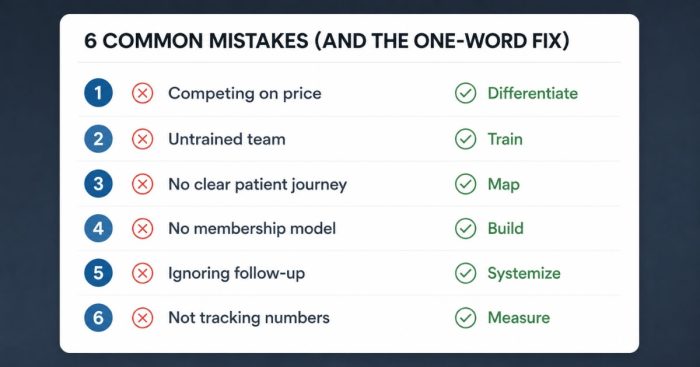
Six mistakes show up over and over — and we’ve caught every one of them live.
- Ring timeout set too short. Calls hit voicemail before anyone can physically answer. Set it to 20 seconds.
- App notifications turned off. On the Florida build, our first live test failed silently. The system “rang,” but no device made a sound because notifications weren’t enabled on the apps. Patients don’t report that — they just book elsewhere.
- The wrong user logged in at a desk. Softphone routing follows the logged-in user, not the computer. If your coordinator is signed in on the front desk’s machine, existing-patient calls ring the wrong lane all day.
- A catch-all that forwards everything to one person. Before signing off, we double-checked the system wasn’t forwarding every call to one staffer’s cell — the classic “why is my phone blowing up?” misconfiguration.
- Killing the old number after a rebrand. That Florida clinic changed its name and phone platform at once. We kept the old number forwarding, so old Google listings and saved contacts still reached the new front desk.
- Never live-testing the tree. Call from an outside line, press every branch, and confirm the right apps ring and both voicemails play. Do it on your quietest day — for most clinics, that’s a Friday.
For functional medicine and wellness practices, this matters even more.
Broad service menus mean inbound calls range from a gut-panel question to a full-body-scan booking, and misrouted calls burn clinical staff time.
Clean routing is the operational base that functional medicine & longevity clinic marketing pours calls into.
Spend on the marketing before fixing the routing, and you’re paying to generate missed calls.
FAQ’s About Cash-Pay Clinic Call Routing
Do I need an answering service for my cash-pay clinic?
Usually not.
An answering service can take a message, but it can’t book a consult, quote your programs, or answer “do you treat this condition.”
In cash-pay medicine, the caller is often deciding between you and another clinic on that first call.
Named staff answering on desktop and mobile softphone apps during business hours, backed by a proper after-hours voicemail, outperforms a generic service.
What ring timeout should I set before a clinic call goes to voicemail?
20 seconds.
That’s the recommended setting we deploy on the phone systems we build.
It’s long enough for a busy front desk to physically pick up, yet short enough that callers don’t abandon the call.
Shorter timeouts dump calls to voicemail while your receptionist is reaching for the phone.
Longer timeouts lose high-intent new patients to the next clinic on their list.
Can clinic calls ring on a desktop computer and a mobile phone at the same time?
Yes.
Modern clinic phone platforms let you route calls to a web app and a mobile app simultaneously — not to a phone number.
Your front desk answers on a headset at the desk, while the same call rings in their pocket when they step away.
We run this setup across clinics we work with, and it removes the biggest excuse for missed calls: “I was away from my desk.”
What happens to my clinic’s phone number when I rebrand or change the clinic’s name?
Keep the old number live and forwarding into the new phone system.
One functional medicine clinic we work with rebranded and migrated phone platforms at the same time.
Because the old number kept forwarding, patients calling from old Google listings and saved contacts still reached the new front desk instead of dead air.
Cut the old number, and you cut every patient who still has it.
How do I test my clinic’s call routing before going live?
Call it yourself from an outside line and press every branch.
On a recent build, the first live test failed silently. Notifications were off, and the ring timeout was too short.
We only caught it because we dialed in before patients did.
Test on your quietest day, verify each branch rings the right person’s apps, confirm both voicemails play, and check that no catch-all is forwarding every call to one person.
What’s the next step?
If your clinic’s phone setup is “whoever grabs it” — or your office line still forwards to your cell after hours — book a strategy call.
In 60 minutes we’ll map your current call flow (who answers, what happens after hours, and where calls die), then design the two-branch routing tree, the voicemail pair, and the staffing assignments for your team.
We build the routing alongside the marketing because they only work together.
Orthobiologics Associates converted 79.4% of leads into booked appointments and generated $309,590 in cash-pay revenue in 10 months without paid ads — conversion like that starts with every single call landing on the right desk.