
Can AI Handle Lead Follow-Up for a Cash-Pay Medical Practice? (Why AI Isn’t Your Closer)
Everyone wants AI to “handle the leads.”
The reality from clinics actually using it is more sobering: when AI books the consult, show rates tank — we’ve seen them fall to around 20%.
When a human books the same consult, 70–90% of patients show up.
Here’s the FAQ on what AI should and shouldn’t do in your clinic’s follow-up — and why the difference is trust, not technology.
Can AI handle lead follow-up for my cash-pay medical practice, or do I still need a human process?
AI can support your follow-up.
It cannot replace the human moments where trust is created — and booking the consult is one of them.
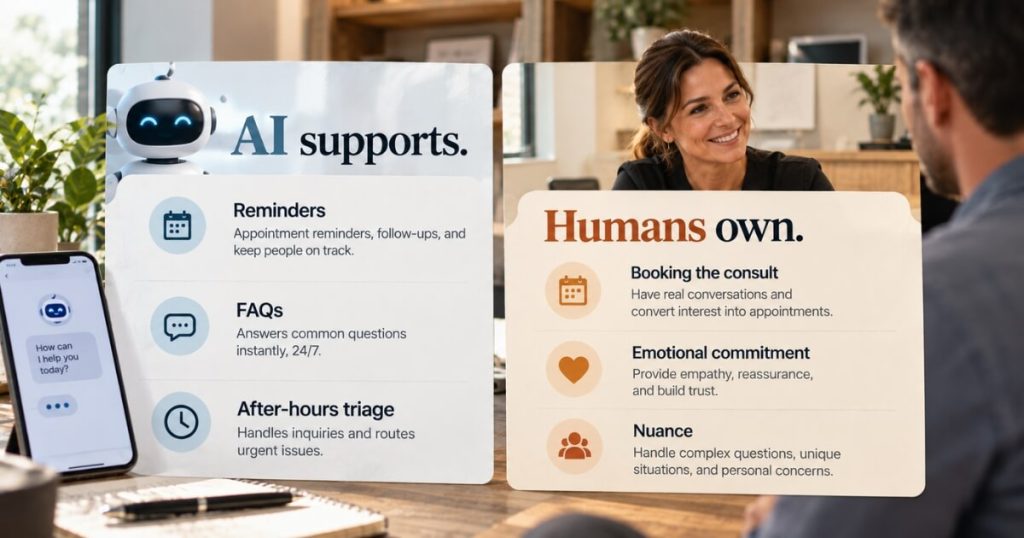
The clinics getting this right use AI for the mechanical layer — instant acknowledgments, reminder texts, simple FAQs, and after-hours triage.
They keep a human on the moment of commitment: the conversation where a lead agrees to show up, pay, and start care.
The clinics getting it wrong hand the whole pipeline to a bot and then wonder why consults book but nobody shows.
The rule that sorts every tool decision: use AI to support your team, not to replace the moments where trust is created.
What happens to show rates when AI books the consult?
They collapse.
We’ve seen AI-booked consults show at around 20% — while human-booked consults routinely show at 70–90%.
That’s not a rounding error.
It’s a 3–4× difference in patients actually walking through the door from the same lead flow and the same ad spend.
And the damage compounds upstream of the visit.
When a bot does the booking, intake forms don’t get filled out, no-shows don’t feel like they broke a commitment, and your providers sit with empty consult slots your marketing already paid for.
A clinic that books 100 consults a month through AI and shows 20 is worse off than one that books 60 through a human and shows 50 — with the same leads.
Why do human-booked consults show up so much more often?
Because people feel like they made a promise to someone, not to a bot.
A booking is a commitment, and commitment is social.
When a real person asked about your knee pain, listened, and said, “Dr. Smith has Thursday at 2 — should I hold it for you?”, not showing up means breaking your word to that person.
When a chatbot slotted you into a calendar, skipping feels like closing a browser tab.
Zero obligation.
That’s also why AI fails at the rest of the close.
It can’t create emotional commitment, it can’t handle nuance — “my wife thinks this is too expensive” — and it can’t make a nervous patient feel understood.
Those are the moments that decide whether a lead becomes a patient.
And they’re the heart of a working patient acquisition system.
What should AI actually do in a clinic’s follow-up process?
Three jobs, all support: reminder texts, simple FAQs, and after-hours triage.
AI is legitimately great at the mechanical layer.
Reminder sequences fire on time, every time.
It can instantly answer “where are you located?” and “do you take insurance?” at 11pm.
After-hours triage can capture the lead, answer the basics, and tee up a human call first thing in the morning.
That layer used to eat hours of staff time, and automating it is pure win.
Notice what all three have in common: none of them is the moment a patient decides to trust you.
AI holds the line until a human can pick it up — it doesn’t replace the human.
What parts of follow-up should stay human?
The moment of booking, every objection, and every conversation where the patient needs to feel understood.
Keep a person on the first real conversation after a lead comes in, the booking itself, and price and hesitation objections.
Keep them on pre-consult rapport — “looking forward to seeing you Thursday — the doctor reviewed your form” — and any patient who sounds unsure.
These conversations are where 70–90% show rates come from.
They’re also where memberships and programs eventually get sold.
This is why the highest-converting clinics staff a dedicated patient coordinator rather than buying more software.
No bot on the market touches that number.
How do I combine AI and human follow-up into one system?
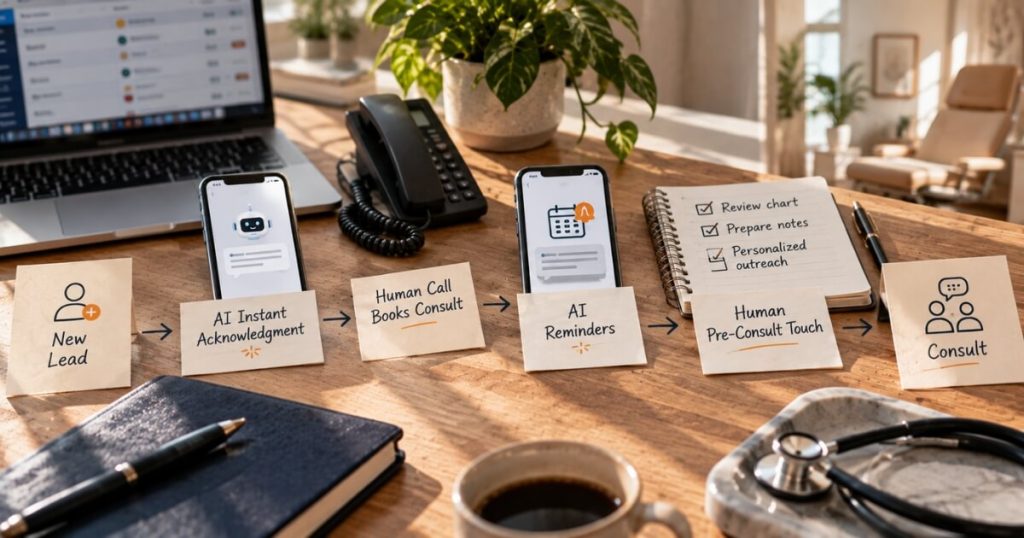
AI wraps the edges; a human owns the middle.
The working pattern starts when a new lead gets an instant AI acknowledgment, so nobody waits in silence.
Then a human calls within minutes to have the real conversation and book the consult.
AI runs the reminder cadence.
A human makes the pre-consult touch.
Meanwhile, after-hours inquiries get triaged by AI with a guaranteed human callback in the morning.
Every mechanical touch automated; every trust moment human.
Volume doesn’t change the rule — it proves it.
A wellness medspa we work with added $6,708,600 in revenue and 3,727 new patients in a single year — lead flow at that scale only converts because humans handle the commitment moments while systems handle everything else.
That division of labor is one of the first things we install in any clinic’s medical practice marketing engine.
FAQ’s About AI Lead Follow-Up for Cash-Pay Clinics
What show rate should a cash-pay clinic expect on booked consults?
With a human-led booking process, 70–90% is the routine range.
If your show rate is materially below that, look at who — or what — is doing the booking and whether anyone is making pre-consult contact.
Those two variables move show rate more than any reminder tool.
Why do AI-booked appointments no-show so often?
Because no commitment was created.
Patients who booked through a bot feel zero obligation to show up — they made an entry in a calendar, not a promise to a person.
The pattern shows up alongside another symptom: intake forms from bot-booked patients don’t get filled out either.
Is AI good for anything in clinic lead follow-up?
Yes — reminder texts, simple FAQs, and after-hours triage.
AI excels at instant, mechanical, always-on touches that hold a lead until a human can talk to them.
Automating that layer frees your team for the conversations that actually convert.
Will AI eventually be able to close consults like a human?
Not yet — and “yet” is doing a lot of work in that sentence.
Today’s tools can’t create emotional commitment, handle nuance, or make a patient feel understood.
Those are the moments that decide show-up and sign-up.
Re-evaluate as tools improve, but benchmark any bot against a 70–90% human show rate before handing it your pipeline.
My team is too small to call every lead — should I just use AI booking anyway?
Fix the staffing before defaulting to the bot.
Even a part-time patient coordinator calling leads for two focused hours a day will usually out-produce full AI automation.
That’s because a 3–4× show-rate difference swamps any volume the bot adds.
Use AI for after-hours capture, and put every daytime lead in front of a person.
What’s the next step?
Before you buy another AI tool, audit your show rate: of the consults booked in the last 60 days, how many actually showed?
If the number is under 70% — or you can’t answer because nobody tracks it — book a strategy call.
In 60 minutes we’ll map which follow-up moments in your practice should be automated, which need a human, and what fixing the split is worth in booked-and-shown patients per month.