
How to Build a Smarter Offer Around Real Patient Needs (Your Joint-Pain Patient Is Also Your Hormone Patient)
Most cash-pay clinics build their offer around a treatment: we do PRP, we do TRT, we do semaglutide. But patients don’t live in treatment categories. The odds are the person in your exam room has joint pain, a weight problem, and a hormone imbalance at the same time — and they’re already spending money on all three somewhere. The smarter offer is built around that whole person, structured as a value ladder they can climb for years.
Why is building my clinic’s offer around one treatment a mistake?
Because your patients’ needs overlap — odds are you have a joint-pain patient, a weight-loss patient, and a hormone patient all in the same body.
That’s the observation most clinic offers ignore.
The 55-year-old who comes in for knee pain almost always has more going on: the extra weight that loads the knee, the low energy and poor recovery that trace back to hormones, and the sleep and inflammation issues layered underneath.
That same person is often already spending money on peptides and supplements on their own, trying to self-solve.
When your offer is a single treatment, you capture one slice of a patient who needed four things — and you send them elsewhere for the rest.
Worse, your marketing has to win a brand-new stranger every time you want new revenue.
An offer built around real patient needs flips this.
One patient, properly served, becomes a joint-pain patient AND a weight-loss patient AND a hormone patient at your practice.
That changes what you can afford to spend to acquire them and how long they stay.
What is a value ladder for a cash-pay clinic?
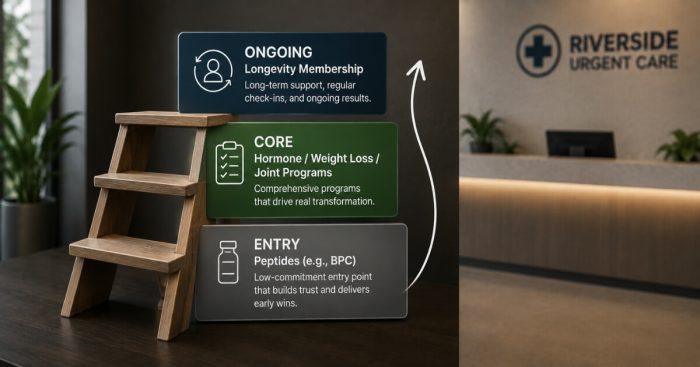
A deliberate sequence of offers — an accessible entry-level product, core treatment programs, and ongoing care — that lets one patient ascend over time.
The bottom rung is the entry product.
Peptides are a natural example — maybe BPC as an entry-level product that gets the patient into the door of longevity and anti-aging.
It’s accessible, low-commitment, and attracts exactly the health-motivated person who will eventually want more.
From there, the core rungs are your treatment programs: the joint-pain protocol, the medical weight-loss program, and hormone optimization.
The top rung is ongoing care — a longevity or wellness membership that keeps the relationship, and the revenue, continuous instead of episodic.
That’s the value ladder where I’d start: entry product in the door, core programs that solve the pain points, membership that never ends.
Structured programs and memberships are the core economics of functional medicine & longevity clinic marketing — because a ladder patient is worth a multiple of a transaction patient.
What makes a good entry-level offer at a cash-pay practice?
Low friction, genuinely useful on its own, and naturally connected to the bigger problems your core programs solve.
The entry product’s job isn’t margin — it’s trust and momentum.
Something like an entry peptide protocol works because the patient who buys it has self-identified as someone who invests in their health and wants optimization, not just symptom relief.
They’re pre-qualified for the longevity conversation before anyone pitches it.
The same logic applies to a comprehensive lab panel, a paid consultation, or a starter program.
Each is worth buying on its own. In addition, each surfaces the exact data and pain points that make the next rung obvious.
Two cautions.
First, the entry offer must connect.
A discounted one-off that has nothing to do with your core programs fills the calendar with patients who will never ascend.
Second, don’t confuse entry-level with free.
A patient who pays something, even modestly, behaves differently from a freebie-seeker.
The rung matters less than the ladder.
Every entry product should have an obvious, natural “here’s what we found, here’s the next step” conversation built into it.
This is also where peptide therapy clinic marketing earns its keep — peptides as a program, not a product, are one of the cleanest on-ramps into long-term care in cash-pay medicine.
Once the offer is built, how do I decide who to market it to?
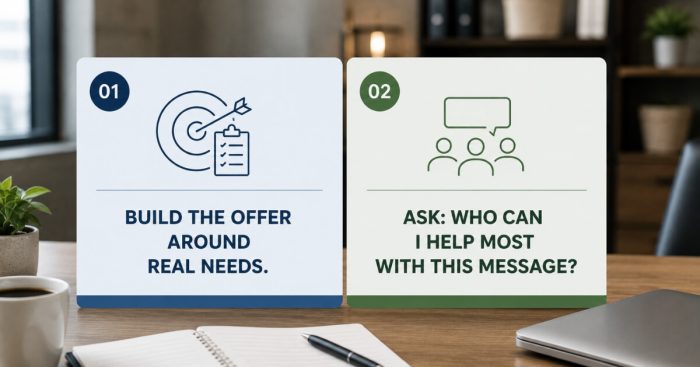
Ask the question in this order: “Now that I have the offer and the core services — who can I help most with this message?”
Notice the sequence.
Offer first, audience second.
Most clinics do the reverse: they pick a demographic, guess what it wants, and end up with generic “wellness for busy professionals” messaging that describes nobody.
When the offer is built around real, overlapping patient needs, the audience question almost answers itself.
You’re looking for the person who has the whole cluster: the achy joints, the stubborn weight, the fading energy, and the willingness to pay for a real fix.
That specificity is what makes the message land.
“We treat knee pain” competes with every orthopedist and chiropractor in town.
“We help the person whose knees hurt, whose weight won’t move, and whose labs keep coming back ‘normal’ feel 15 years younger” — that message finds its person in the feed instantly.
The offer defined the person. The person defined the message. The message did the acquiring.
What does the whole-patient offer do to patient lifetime value?
It multiplies it — the same acquisition cost now buys a patient who can ascend through three or four programs instead of buying one treatment.
Run the comparison.
Treatment-offer clinic: a joint-pain patient buys a course of injections, feels better, and leaves.
One acquisition, one program, done.
Ladder clinic: the same patient enters through the same knee, but the intake surfaces the weight and hormone picture.
The value ladder then gives them an obvious next rung. Two years later, they’re a longevity member who’s done three programs and refers their spouse.
Same marketing dollar. Radically different return.
This is why offer design comes before media buying in every engagement we run.
The clinics that win in cash-pay medicine aren’t the ones with the cheapest leads. They’re the ones whose offer architecture makes every lead worth several times more.
Higher patient LTV doesn’t just mean more revenue.
It means you can outbid every competitor for attention. A patient who’s worth 4× more to you than to the clinic down the street lets you spend 2× as much acquiring them and still win.
FAQ’s About Building a Cash-Pay Clinic Offer Around Patient Needs
What is a value ladder for a medical practice?
A structured sequence of offers a single patient can ascend: an accessible entry-level product (like an entry peptide protocol or comprehensive lab panel), core treatment programs (joint pain, weight loss, hormones), and ongoing membership care at the top.
It turns one acquisition into years of relationship instead of one transaction.
Why should peptides be an entry-level offer instead of a core program?
Peptides like BPC work as an entry rung because they’re accessible, low-commitment, and attract health-investors who want optimization — the exact person who ascends into longevity and anti-aging care.
They can still be programs; their ladder role is opening the door.
Should I define my ideal patient before or after building my offer?
After.
Build the offer around real, overlapping patient needs first, then ask “who can I help most with this message?”
Audience-first thinking produces generic messaging. Offer-first thinking makes the audience — and the message — specific.
Does a broader offer mean marketing more services at once?
No.
You still lead with one sharp entry point — one pain, one promise.
The breadth lives inside the practice as the ladder the patient climbs after they arrive, not in the ad that acquires them.
How does offer design change what I can spend on marketing?
Directly.
If your ladder makes a patient worth several times more over their lifetime, you can pay more per acquired patient than any single-treatment competitor and still profit.
That’s how clinics win auctions in expensive ad markets.
What’s the next step?
If your practice sells treatments one at a time while your patients quietly shop elsewhere for the other three things they need, the offer is the constraint — not the marketing.
Book a strategy call. In 60 minutes we’ll map your current services into a value ladder, identify the right entry product for your market, and define exactly who your message should be built for.