
The Boring SEO Move That Fills Your Peptide Calendar (It’s Not a Funnel — It’s GMB and Reviews)
Most clinic owners who want more peptide patients go looking for a sexy “peptide funnel.”
What actually works is much more boring: a clean website, a dialed-in Google Business Profile, and a ridiculous number of specific reviews.
Here’s the FAQ on why the boring play wins — and the exact five-text action that upgrades your peptide SEO this week.
What is the simplest SEO move a cash-pay clinic can make to fill its peptide consult calendar?
Fix your Google Business Profile and stack specific, results-focused patient reviews.
That’s it.
No funnel software, no ad budget, no 50-page content plan.
A clean website, a dialed-in GBP listing, and reviews that actually describe outcomes will outperform a “peptide funnel” for most cash-pay clinics.
Why?
Because they show up at the exact moment a high-intent patient is deciding who to trust.
Clinics that treat this as the foundation of their medical practice marketing quietly stack peptide patients while competitors chase funnel hacks.
The payoff of getting the boring local basics right is not small.
A longevity and functional medicine clinic we work with increased website leads by 900% and added 100+ inbound calls per month in just 4 months — driven by exactly this kind of unglamorous search-visibility work.
Why do reviews matter more for peptide patients than for other patients?
Because someone Googling peptides is already past “what is it?”
They’re in the “who can I trust to do this safely?” phase.
Peptides are a considered, safety-sensitive purchase.
By the time a patient searches for a provider, they’ve usually done their homework on the compounds and the claims.
What they can’t Google their way to is trust — and that’s what reviews carry.
A profile full of “Great staff!” five-stars tells them nothing.
A review that says, “I came in with an elbow that wouldn’t heal, and three months into a peptide-based plan I’m back to lifting,” answers the exact question in their head.
That’s also why generic review volume doesn’t move peptide bookings the way specific review content does.
Google sees patterns.
Patients see proof.
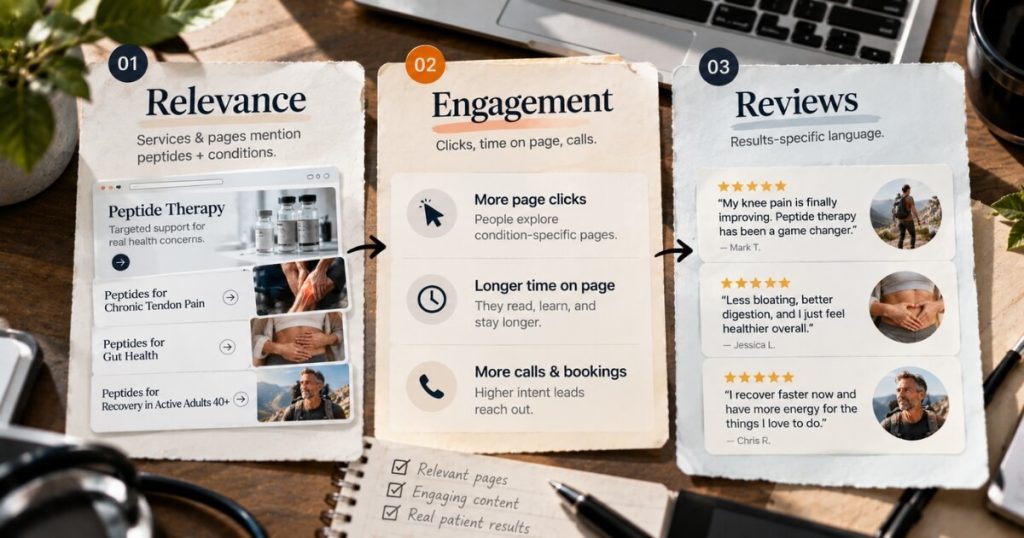
What are the three things Google actually ranks a clinic’s Business Profile on?
Relevance, engagement, and reviews — three boring things, all fixable.
Relevance: do your services, business description, and linked pages actually mention peptide therapy, specific peptide names where allowed, and the conditions they help with?
Engagement: are people clicking your result, staying on the page, calling, and filling out forms?
Reviews: do patients talk about recovery, energy, and performance — and mention peptides or related terms?
Most clinics fail all three quietly.
They have a generic GBP description, no photos that look real, and reviews that say “Great staff!” with nothing about results.
Then they conclude, “SEO doesn’t work.”
It works — it just has nothing to work with.
What should peptide patient reviews actually say?
Three things: the problem they came in with, the outcome they got, and the fact that your clinic uses a peptide-based plan — without medical claims.
The clinics quietly stacking peptide patients coach happy patients — never script them word-for-word — to mention what brought them in, how they’re feeling now, and that the clinic built them a peptide-based plan.
That produces reviews Google can match to peptide-related searches.
Patients can also recognize themselves in them — “chronic fatigue,” “shoulder recovery,” “energy back at 50.”
There are two guardrails.
Patients describing their own experience is fine, but don’t ask them to make outcome promises on your behalf.
Also, never trade discounts or freebies for reviews.
That violates Google’s policy and risks the whole profile.
What should I put on my Google Business Profile to attract peptide patients?
Real photos, peptide-relevant services and description, and regular posts answering peptide FAQs.
Load the profile with real clinic photos — the front of the building, the lobby, and the treatment rooms — not stock imagery.
List peptide therapy in your services with the conditions it supports.
Then use GBP posts the way the winning clinics do: recovery stories with permission, answers to common peptide questions, and explanations of what a first visit looks like.
Every post is another relevance signal.
It’s also another proof point a comparison-shopping patient sees before they ever hit your website.
This pairs with, not replaces, the symptom-first website pages that do the heavy lifting in peptide therapy clinic marketing — the profile wins the trust check, the pages win the search.
How do I get five peptide reviews this week?
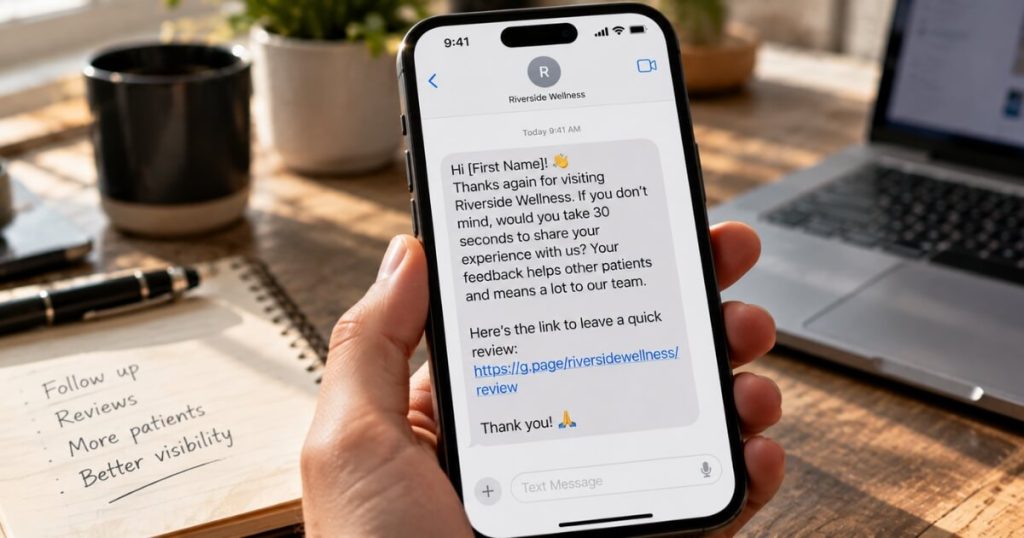
Pick 5 peptide wins from the last 90 days and send them one text.
The verbatim ask:
“Hey [Name], would you mind leaving a quick review on Google and mentioning what you came in for and how you’re feeling now?”
That’s the whole play.
It names the two ingredients that make a review rank — problem + outcome — without putting words in the patient’s mouth.
If 3 of the 5 do it, your peptide SEO just got a real upgrade.
Three reviews that mention actual conditions and actual results will do more for your peptide visibility than thirty generic five-stars.
FAQ’s About Google Reviews and GBP for Peptide Clinics
How many Google reviews does a clinic need to rank for peptide searches?
There’s no magic number — specificity beats volume.
Ten reviews that mention real conditions, real outcomes, and peptide-related terms will outperform fifty that say “friendly staff.”
Aim for a steady drip — 3–5 specific reviews a month — rather than a one-time blast, which looks unnatural to Google.
Is it against Google’s rules to ask patients for reviews?
No — asking is allowed.
What’s prohibited is paying or incentivizing reviews, gating — only asking happy patients through a filter tool — or writing reviews yourself.
A plain ask like “would you mind leaving a quick review and mentioning what you came in for?” is fully within policy.
Can patients mention peptides or their results in a review?
Yes.
Patients describing their own experience — what they came in for, how they feel now, and that their plan included peptides — is their speech, not your advertising.
What you should avoid is coaching them to make medical claims on your behalf, like promising a compound cures a condition.
Does a Google Business Profile matter for a telehealth peptide clinic?
Less than for a brick-and-mortar clinic, but it still matters.
A verified profile with real reviews is a trust asset that shows up when patients search your clinic by name — which nearly all of them do before booking.
Telehealth clinics should pair it with condition-specific website pages since they can’t rely on map-pack visibility.
What if all my existing reviews just say “great staff”?
Start layering specific ones on top — you don’t need to touch the old ones.
Five outcome-specific reviews from recent peptide wins will change what Google associates your profile with and what prospective patients read first.
That’s especially useful because the newest and most detailed reviews get the most visibility.
What’s the next step?
Send the five texts today — it costs nothing and compounds for years.
And if you want the full picture of how SEO and GBP stack up against TikTok, Facebook, Google Ads, Zocdoc, and LSAs for a real cash-pay clinic — and why we put SEO/GBP at the top of that list — book a strategy call.
In 60 minutes we’ll audit your profile, your review base, and your peptide search visibility, and map exactly what to fix first.