
How Do You Diversify a Weight-Loss Clinic’s Paid Ads Across Google and Social So One Platform Can’t Sink Your Lead Flow?
A weight-loss clinic that lives or dies on a single ad platform is one suspension, one policy change, or one cost spike away from a dead calendar. GLP-1 and weight-loss ads run on platforms that disapprove accounts without warning, so concentration is not just risky—it is an existential bet you keep making every month. The clinics that grow steadily spread their paid acquisition across Google, social, and newer channels. They eliminate spend that cannot be attributed to real patients and let organic search compound underneath it all. This is how to build that diversified engine, grounded in real cost-per-lead numbers from a weight-loss clinic we run ads for.
Why should a weight-loss clinic diversify its paid ads across multiple platforms?
Because when one platform controls your lead flow, a single account suspension, policy change, or cost spike can sink your entire business overnight.
Weight-loss and GLP-1 advertising operates on platforms that enforce policies aggressively.
A clinic that depends entirely on one social platform is always one suspension away from zero new patients.
We have seen clinics lose an entire channel overnight.
Some spend months trying to recover it.
The purpose of diversification is resilience.
If one platform goes down, the others continue filling the calendar while you work to restore the lost channel.
You are not trying to make every platform equally important.
Instead, your goal is to make sure no single platform can switch off your patient flow.
That is the foundation of a durable GLP-1 & weight loss clinic marketing strategy.
The platform producing the cheapest leads today may not even be available next quarter.
Build a portfolio instead.
For example:
- Google captures high-intent searches.
- Social media creates awareness.
- Organic SEO compounds over time.
- Newer platforms are tested with smaller budgets.
A clinic with four reliable acquisition channels sleeps much better than one relying on a single advertising account.
What is the best Google Ads setup for a GLP-1 weight-loss clinic?
Run a Google Ads structure that combines:
- Search campaigns
- Display campaigns
- Retargeting
- YouTube
Do not rely on search campaigns alone.
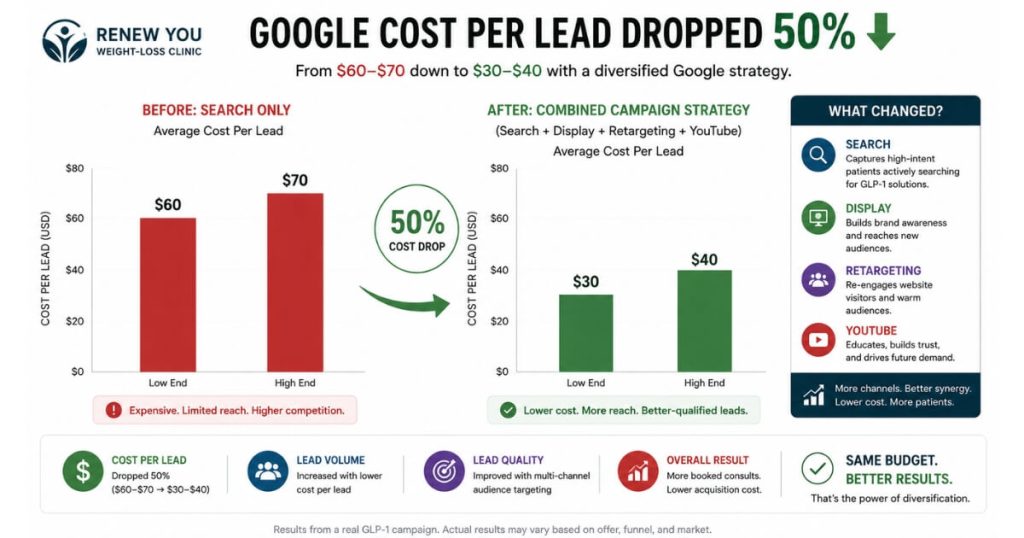
One clinic switched to this combined approach and immediately reduced its Google cost per lead by roughly 50%.
Before the change:
- Cost per lead averaged about $60 to $70.
After the change:
- Cost per lead dropped to roughly $30 to $40.
That is not a small improvement.
It is the difference between a campaign that barely works and one worth scaling aggressively.
There was another benefit.
The combined campaign also improved a separate GLP-1 campaign that had already been running.
Its cost per lead fell to roughly the same $40 range.
The reason is straightforward.
Each campaign type strengthens the others.
For example:
- Search captures high-intent prospects.
- Retargeting brings back visitors who did not convert.
- YouTube expands awareness and reinforces trust.
Together, the entire Google account becomes more efficient.
For a GLP-1 clinic, this integrated Google structure usually becomes the primary acquisition engine.
It is often the fastest path to lowering cost per lead.
How do I know if my Facebook ad spend is actually working for my clinic?
Measure attribution.
Do not rely solely on the agency’s dashboard.
Many reports make advertising appear far more successful than it really is.
One clinic was paying an outside vendor an additional $1,500 every month to manage three or four Facebook campaigns.
Every monthly update looked almost identical.
The agency reported:
- Strong performance
- No major changes needed
- Positive-looking numbers
However, when the actual spend was analyzed closely, almost no real patient revenue could be attributed to those campaigns.
Even worse, the reporting setup caused the agency’s campaigns to appear inside the clinic’s own dashboard.
That made the agency appear more successful than it actually was.
It is easy for clinics to pay for that kind of “ghost performance” month after month.
The real test is simple.
Ask yourself one question:
Can you trace booked, paying patients back to that advertising spend?
If the answer is no, the channel probably is not performing, regardless of how impressive the dashboard appears.
Facebook and Instagram absolutely can work for cash-pay clinics.
In fact, we generated $2 million in revenue from Facebook ads for an orthopedic surgical practice.
The difference was not the platform.
It was the attribution.
Successful Facebook campaigns produce patients you can trace back to the advertising.
They do not simply produce attractive reports.
Should a weight-loss clinic test newer ad platforms like Pinterest or Reddit?
Yes.
Test newer platforms where your ideal patient actually spends time.
This is especially true if your ideal patient is predominantly female.
For example, Pinterest makes sense for clinics targeting women in their 30s.
That audience is highly active there.
GLP-1 advertisements are already appearing naturally inside their feeds.
We launched a Pinterest test for one women-focused clinic based on that observation.
At the time, there was no historical performance data.
It was simply a well-informed hypothesis.
The important part is the process.
Treat every new platform as a test.
Start with a small budget.
Then let the numbers determine whether it deserves more investment.
Do not go all-in before seeing actual results.
Newer advertising platforms often provide two important advantages:
- Less competition
- More flexible advertising policies
That combination can produce lower cost-per-lead opportunities while the window remains open.
Scale only the channels that outperform your current campaigns.
Every additional profitable platform reduces dependence on any single advertising account.
That is exactly how you build a diversified patient acquisition system instead of relying on one source of leads.
How do I measure whether my clinic’s overall marketing is improving, not just one campaign?
Track your Google Search Console performance alongside your paid advertising metrics.
Looking at paid campaigns alone gives you only part of the picture.
Paid advertising can perform well while the overall business barely grows.
Organic search provides the second measurement you need.
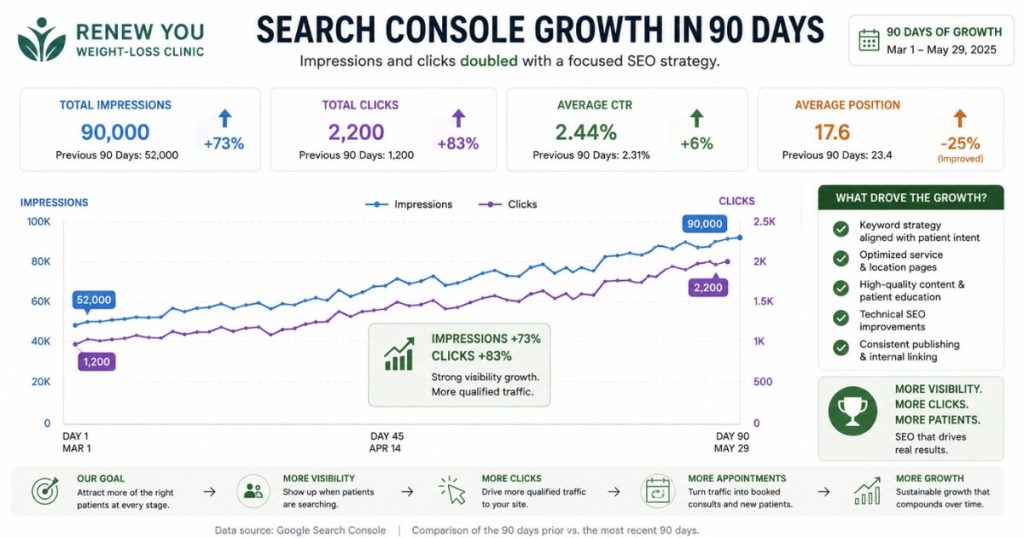
One clinic that was already performing well still doubled its search visibility within 90 days.
Its growth included:
- Approximately 52,000 impressions increasing to nearly 90,000
- About 1,200 clicks increasing to roughly 2,200
- A fourth-place national ranking for its branded category term
That type of growth becomes a long-term business asset.
Paid advertising alone never creates that.
The reason to measure both is simple.
Paid advertising produces leads today.
Organic search lowers your blended acquisition cost over time.
A clinic that only watches cost per lead is flying with one instrument.
Watch both metrics together.
When:
- Organic impressions continue climbing, and
- Paid cost per lead continues falling,
you know the entire marketing engine is becoming healthier.
Judge your marketing using the complete picture.
Measure both paid efficiency and organic growth.
That combination determines whether acquiring patients becomes cheaper and more predictable every quarter.
Should I act on a free audit from another agency about my ad account?
Take the genuinely useful recommendations.
Do not let an outside audit convince you to destroy a system that is already producing results.
One clinic received an outside audit that identified several legitimate issues.
For example:
- Hundreds of pages were not indexed.
- Some advertisements pointed to pages instead of branded funnels.
Those were specific, measurable improvements worth making.
Strong operators are willing to adopt good ideas regardless of where they come from.
However, the audit also recommended rebuilding the entire website strategy from scratch.
That would have meant replacing a system that already ranked fourth nationally.
It would have thrown away years of progress to chase someone else’s completely new vision.
Instead, follow a much simpler rule:
- Keep what is already working.
- Fix the clearly identifiable problems.
- Ignore recommendations that require rebuilding successful systems without evidence.
Cherry-pick the improvements.
Protect the proven assets.
Continue improving what already produces results instead of restarting from zero.
FAQ’s About Diversifying a Weight-Loss Clinic’s Paid Ads Across Google and Social
Why should a weight-loss clinic diversify its paid ads across multiple platforms?
Because when one platform controls your lead flow, a single account suspension, policy change, or cost spike can disrupt your business overnight.
GLP-1 and weight-loss advertising exists on platforms that enforce advertising policies aggressively.
A clinic that depends entirely on one advertising channel is always one suspension away from losing its primary source of new patients.
Diversification protects against that risk.
Build multiple acquisition channels instead, such as:
- Google Ads
- Facebook and Instagram
- Organic SEO
- Emerging platforms
The goal is not to make every channel equally important.
The goal is to make sure no single platform can completely shut off your patient flow.
What is the best Google Ads setup for a GLP-1 weight-loss clinic?
Use an integrated Google Ads strategy instead of relying on Search alone.
A strong structure includes:
- Search campaigns
- Display campaigns
- Retargeting
- YouTube campaigns
One clinic switched to this combined approach and reduced its Google cost per lead by approximately 50%.
The results included:
- Cost per lead dropping from roughly $60–$70
- Down to approximately $30–$40 the following week
The combined strategy also improved another GLP-1 campaign that was already running, bringing that campaign down to roughly the same $40-per-lead range.
Search captures high-intent prospects.
Retargeting brings back visitors who did not convert.
YouTube expands awareness and reinforces trust.
Together, these campaigns create a more efficient Google Ads account than Search campaigns alone.
How do I know if my Facebook ad spend is actually working for my clinic?
Focus on attribution rather than agency reporting.
Many vendor dashboards make advertising appear more successful than it really is.
One clinic paid an outside agency an additional $1,500 each month to manage several Facebook campaigns.
Every report looked positive.
However, once the advertising was analyzed carefully, very little patient revenue could actually be traced back to those campaigns.
The reporting setup even caused the agency’s campaigns to appear inside the clinic’s own dashboard, making the performance look stronger than reality.
Ask one simple question:
Can you trace booked, paying patients directly back to that advertising spend?
If you cannot, the campaign probably is not performing as well as the reports suggest.
Good Facebook advertising generates patients you can measure—not simply attractive dashboards.
Should a weight-loss clinic test newer ad platforms like Pinterest or Reddit?
Yes.
Test newer platforms where your ideal patient already spends time.
For clinics serving predominantly female patients, Pinterest is often worth testing.
The key is to treat every new platform as an experiment.
Start small.
For example:
- Launch a modest budget.
- Measure cost per lead.
- Compare performance with existing channels.
- Scale only if the numbers justify it.
Newer platforms often provide advantages such as:
- Lower competition
- Lower advertising costs
- More flexible policy enforcement
Every successful new platform reduces dependence on a single advertising account and strengthens your overall patient acquisition system.
How do I measure whether my clinic’s overall marketing is improving, not just one campaign?
Track both paid advertising performance and Google Search Console together.
Paid campaigns show how efficiently you are buying patients today.
Organic search shows whether you are building a long-term acquisition asset.
One clinic nearly doubled its search visibility within 90 days.
Growth included:
- Approximately 52,000 impressions increasing to nearly 90,000
- About 1,200 clicks increasing to roughly 2,200
- A fourth-place national ranking for its branded category
Those improvements continue generating value long after the advertising budget has been spent.
Watch both measurements together.
When:
- Organic impressions continue increasing, and
- Paid cost per lead continues decreasing,
your entire marketing system is becoming stronger.
Measure the complete picture instead of evaluating only one campaign at a time.
Should I act on a free audit from another agency about my ad account?
Accept useful recommendations.
Reject unnecessary overhauls.
One clinic received an outside audit that identified several worthwhile improvements.
Examples included:
- Hundreds of unindexed pages
- Advertisements pointing to pages instead of branded funnels
Those issues were specific, measurable, and worth fixing.
However, the same audit also recommended rebuilding the clinic’s entire website strategy.
That would have risked replacing a system that was already ranking fourth nationally.
Instead, follow a simple rule:
- Keep what already works.
- Implement the measurable improvements.
- Ignore recommendations that require rebuilding successful systems without strong evidence.
Continuous improvement beats unnecessary reinvention.
What’s the next step?
If your weight-loss clinic depends on a single advertising account, you do not have a diversified marketing strategy.
You have a single point of failure.
Instead, build a multi-channel acquisition engine.
Start by:
- Building an integrated Google Ads structure that combines Search, Display, Retargeting, and YouTube.
- Auditing Facebook and Instagram using real patient attribution instead of agency dashboards.
- Testing new platforms where your ideal patients already spend time, such as Pinterest for a predominantly female audience.
- Monitoring your Google Search Console growth alongside paid cost per lead.
- Continuing to strengthen every profitable acquisition channel.
That approach ensures no single platform can ever control your patient flow.
If you want a team that builds and balances that multi-platform system for you, that is exactly what we do.
It is the same approach we used to help generate $6.7 million in revenue in one year for a weight-loss medspa, producing 3,727 new patients through multi-channel paid advertising.
We’ll map your current channel mix, identify your biggest single points of failure, and show you exactly where diversification will have the biggest impact.