
How Do You Run a Monthly Performance Scorecard and Know When to Pivot at a Peptide and Hormone Membership Clinic?
Most clinic owners react to a bad month by changing everything at once—prices, offers, lab requirements, and ad channels. They end up unable to tell which change actually made a difference. The clinics that compound do the opposite. They run the same monthly scorecard every month, read the numbers in context, fix only the problem they can clearly diagnose, and wait for a clean month before making a structural change. This is the monthly performance review and pivot framework for a peptide and hormone membership clinic, pulled directly from a real October performance call.
What KPIs should a peptide and hormone membership clinic track on a monthly scorecard?
Track:
- Attended consults
- Close rate
- New members versus à la carte buyers
- Total new leads
- Lead-to-booked rate
- Cancellations
- Average price point
- Net membership change
During one real October review, the numbers driving the conversation were very specific:
- 15 attended consults
- 9 closed out of 15 consults
- 4 new members
- 14 booked appointments from 48 new leads
- A $207 average price point after slipping below $200 the previous month
Each KPI means something by itself.
However, the scorecard only becomes useful when you review every number together.
For example:
- A healthy consult count with a weak close rate usually points to a sales issue.
- A healthy close rate with a poor lead-to-booked rate often points to the front desk or lead quality.
- A declining average ticket may indicate excessive discounting or a shift in service mix.
The single most important KPI for a membership clinic is net membership.
Ask one simple question every month:
Did you gain more members than you lost?
This clinic actually lost more members than it gained during the month.
That mattered far more than raw lead volume because the business depends on recurring revenue.
Build the scorecard once.
Review the exact same numbers every month.
Let long-term trends—not individual months—drive your decisions.
That monthly rhythm is the backbone of disciplined peptide therapy clinic marketing. It is also what separates clinics that scale from clinics that simply react.
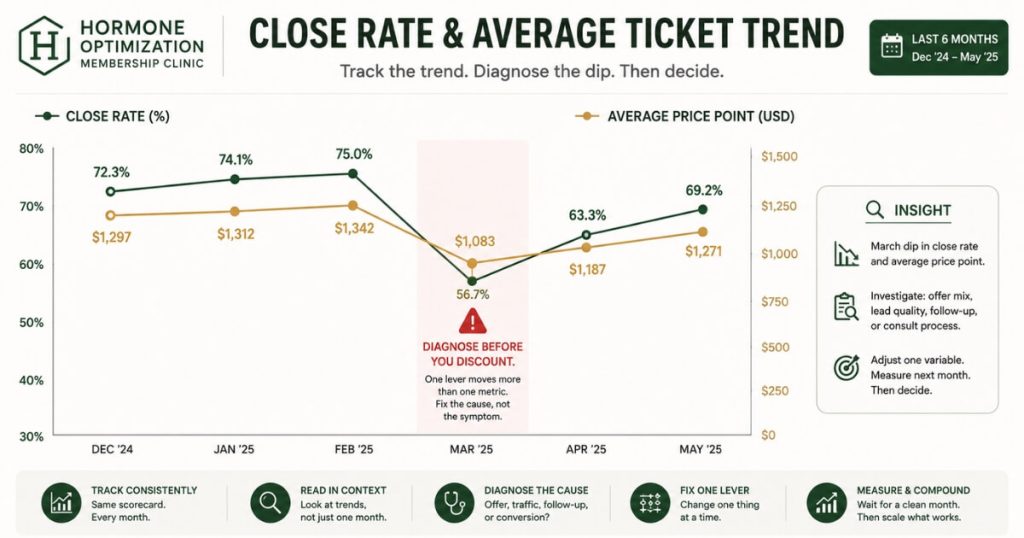
My clinic’s close rate dropped this month. Is it a pricing problem or a sales problem?
Before changing your prices, separate those two issues.
The instinct to blame pricing is usually wrong.
When this clinic’s close rate dropped to 9 out of 15 consults and the average ticket fell to $207, the owner’s first assumption was that pricing had become the problem.
The diagnosis pushed back.
This was not a pricing issue.
It was a consult problem.
More specifically, it was a sales-skills problem.
That distinction matters because the solutions are completely different.
If you mistake a sales problem for a pricing problem and immediately discount your services, several things happen:
- Your margins shrink.
- Your team learns to compete on price.
- Your close rate often stays exactly the same.
Why?
Because the real leak—the conversation happening inside the consult room—never changed.
The correct response was much more straightforward.
The clinic decided to:
- Record provider consults.
- Pull four recordings.
- Review them together.
- Coach the sales conversations directly.
That is a clear, diagnosable problem with a measurable solution.
Discounting is not a strategy.
It is simply a reaction.
Whenever your close rate falls, listen to the consults first.
Most of the time, the offer is not the issue.
The conversation is.
How many leads should convert to booked consults at a membership hormone clinic?
There is no universal benchmark.
However, this clinic viewed 14 booked consults from 48 new leads as concerning.
It was the lowest booking rate they had seen in quite some time.
There was one important catch.
Part of the problem came from inaccurate data.
One staff member was marking spam leads as “Lost” instead of deleting them.
That inflated the total lead count.
As a result, the booking rate looked much worse than reality.
This is one of the biggest traps in performance reporting.
Never judge a conversion rate until you trust the data going into it.
If spam leads inflate your denominator, the booking percentage looks broken even when the actual process is working well.
Start by cleaning your CRM.
That means:
- Delete spam leads.
- Remove duplicates.
- Verify every lead represents a real person.
Only then should you evaluate your booking rate.
Once the data is clean, a declining lead-to-booked rate usually points toward one of two areas:
- Lead quality
- Front-desk booking performance
Tracking and properly attributing every lead is fundamental to a reliable patient acquisition system because you cannot improve a metric you do not trust.
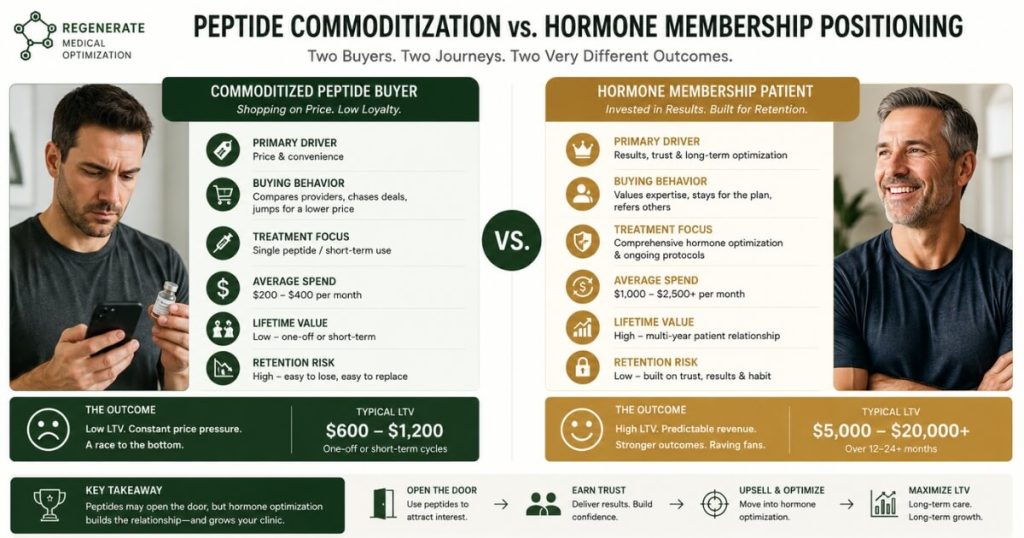
Should my clinic compete on peptide pricing or pivot back to hormones?
If peptides are becoming commoditized in your market, pivot back toward hormones and functional medicine.
This clinic described the situation as an identity crossroads.
Peptides remain popular.
However, they have become widely available.
Today, even estheticians and gym owners are selling them.
Many patients entering through those channels simply want the lowest possible price.
Competing in that race is a losing strategy for a legitimate medical practice.
Instead, the conclusion was clear.
There is greater:
- Revenue
- Lifetime value
- Patient quality
when the clinic leans back into functional medicine and hormone optimization.
That does not mean removing peptides from the menu.
Instead, use hormones and functional medicine as the foundation of the business.
Compete on trust.
Compete on education.
Teach patients why sourcing peptides from qualified medical providers matters.
Share cautionary stories about poor-quality products and unsafe sourcing instead of trying to become the cheapest clinic in town.
Recurring hormone and functional medicine memberships represent the classic high-LTV cash-pay model.
That is exactly how we grew an HRT clinic from $1M to $4M a year over four years, building to 250 active members each paying around $1,000 a month.
One long-term membership patient is worth dramatically more than a one-time discounted peptide buyer.
When should I make changes versus wait for more data after a bad month?
Avoid making structural changes until you have enough data to understand what is actually happening.
Instead, fix only the problem you can clearly diagnose today.
After one disappointing month, this clinic deliberately chose not to overhaul:
- Its peptide offer
- Its lab requirements
The reasoning was disciplined.
They simply did not have enough information.
Changing too many things at once would have made future results impossible to interpret.
Instead, they committed to collecting one more clean month of data before making any major strategic changes.
That approach is the opposite of panic.
Many clinic owners respond to one weak month by changing:
- Pricing
- Offers
- Advertising
- Sales scripts
- Lab requirements
Afterward, they have no idea which change actually mattered.
This clinic changed only one thing immediately.
They improved the sales process.
Providers began recording consults so those conversations could be reviewed and coached.
That is the rule.
Fix what you can clearly diagnose.
Delay structural decisions until clean data confirms the trend.
Remember:
- One month is a data point.
- Two or three consistent months create a trend.
Building that patience into your monthly review separates strategic operators from reactive owners.
It is also one of the core habits of working with experienced medical practice marketing consultants who understand the difference between normal month-to-month variation and genuine business problems.
Is it worth outsourcing video content for a small membership clinic?
Yes.
For busy owner-operators, the biggest advantages are consistency and minimal time investment.
One operator spends approximately $5,000 per month for:
- 16 short-form videos
- 4 long-form videos
They only record twice each month.
The total management time is about two hours.
A smaller clinic can start with a lighter package.
For example, a clinic might invest around $3,500 per month while recording once monthly and still produce a steady stream of educational content.
The biggest benefit is not simply posting more often.
Done-for-you video removes the biggest reason clinics stop creating content in the first place:
The owner simply runs out of time.
The return also extends beyond marketing reach.
Patients watch the educational videos before their appointments.
As a result, they arrive already asking about specific treatments.
That makes consults significantly easier.
Putting your own providers on camera also rebuilds your local brand.
It reminds patients why your clinic became the trusted name in the community.
Video is not simply another marketing channel.
For a membership clinic, it serves two purposes:
- It fuels consults.
- It strengthens positioning.
FAQ’s About a Monthly Performance Scorecard for a Peptide and Hormone Membership Clinic
What KPIs should a peptide and hormone membership clinic track on a monthly scorecard?
Track the same core KPIs every month:
- Attended consults
- Close rate
- New members versus à la carte buyers
- Total new leads
- Lead-to-booked rate
- Cancellations
- Average price point
- Net membership change
In one real October review, the key numbers included:
- 15 attended consults
- A 9-out-of-15 close rate
- 4 new members
- 14 booked consults from 48 new leads
- A $207 average price point after slipping below $200 the previous month
Each number tells part of the story.
Together, they tell you what is actually happening inside the business.
For a membership clinic, the most important KPI is net membership.
Ask one question every month:
Did you gain more members than you lost?
That single number tells you whether your recurring revenue base is growing.
Build the scorecard once.
Review the same KPIs every month.
Let trends—not isolated months—drive your decisions.
My clinic’s close rate dropped this month. Is it a pricing problem or a sales problem?
Separate pricing problems from sales problems before changing anything.
Most owners immediately assume pricing is the issue.
Usually, it is not.
When this clinic’s close rate fell to 9 out of 15 consults and the average ticket dropped to $207, the owner’s first assumption was that pricing had become the problem.
The diagnosis was different.
It was a consult problem.
More specifically, it was a sales-skills problem.
The solution was not discounting.
Instead, the clinic:
- Recorded provider consults.
- Reviewed four recordings.
- Coached the providers.
- Improved the sales conversation.
Discounting a sales problem only teaches your team to compete on price.
It also reduces margins without fixing the real issue.
Whenever your close rate declines, review the consults before assuming the offer or pricing needs to change.
How many leads should convert to booked consults at a membership hormone clinic?
There is no universal benchmark.
However, this clinic considered 14 booked consults from 48 new leads to be lower than expected.
The important detail was that the data itself was misleading.
A staff member had been marking spam leads as Lost instead of deleting them.
That inflated the lead count.
As a result, the booking percentage looked much worse than reality.
Always clean your CRM before judging conversion rates.
Start by:
- Deleting spam leads
- Removing duplicates
- Confirming every lead represents a real person
Only then should you evaluate booking performance.
Once the data is accurate, a declining lead-to-booked rate usually points toward:
- Lead quality
- Front-desk booking performance
Clean data always comes before diagnosis.
Should my clinic compete on peptide pricing or pivot back to hormones?
If peptides are becoming commoditized in your market, pivot back toward hormones and functional medicine.
This clinic recognized that peptides had become widely available.
Today, patients can buy them from:
- Estheticians
- Gym owners
- Other low-cost providers
Many shoppers simply look for the cheapest price.
Competing on price creates a race to the bottom.
Instead, the clinic chose to compete on:
- Trust
- Education
- Medical expertise
Hormone optimization and functional medicine produce:
- Higher lifetime value
- Better patient relationships
- More recurring revenue
Keep peptides available.
Just avoid building your entire business around a commoditized product.
Anchor the clinic around recurring hormone and functional medicine programs where your expertise creates real differentiation.
When should I make changes versus wait for more data after a bad month?
Do not make structural changes until you have enough data to understand the real problem.
Instead, fix only the issue you can clearly diagnose today.
After one disappointing month, this clinic deliberately chose not to change:
- Its peptide offer
- Its lab requirements
Instead, they committed to collecting one more clean month of data.
The only immediate change involved the sales process.
Providers began recording consults so those conversations could be reviewed and coached.
That approach follows a simple rule:
- Fix what you can clearly see today.
- Wait before making structural changes.
- Let clean data confirm the trend.
Remember:
- One month is a data point.
- Two or three consistent months become a trend.
Patience prevents expensive overreactions.
Is it worth outsourcing video content for a small membership clinic?
Yes.
For busy clinic owners, the biggest advantages are consistency and low time investment.
One operator spends approximately $5,000 each month for:
- 16 short-form videos
- 4 long-form videos
They only record twice each month and spend about two hours managing the process.
A smaller clinic can begin with a lighter package.
For example, spending around $3,500 per month while recording once monthly still creates a consistent stream of educational content.
The biggest benefit is not simply reaching more people.
Patients watch the videos before arriving.
They often come into their consults already asking about specific treatments.
That makes the sales conversation much easier.
Putting your providers on camera also strengthens your local brand and reinforces your authority.
Video is much more than a social media tactic.
For membership clinics, it serves two important purposes:
- It generates stronger consults.
- It strengthens long-term positioning.
What’s the next step?
If you run a peptide or hormone membership clinic, the goal is not to react more aggressively when you have a bad month.
The goal is to build a monthly scorecard that helps you understand why the month happened.
Track the same KPIs every month:
- Attended consults
- Close rate
- Net membership
- Lead-to-booked rate
- Average ticket
When a number declines:
- Diagnose the problem before making changes.
- Clean your CRM before judging conversion rates.
- Fix the sales conversation before lowering prices.
- Wait for another clean month before making structural changes.
That discipline is what grows a membership business instead of constantly reacting to short-term fluctuations.
If you want a partner who reviews this scorecard with you every month and helps you decide when to pivot and when to stay the course, that is exactly what we do.
It is the same framework we used to help grow an HRT membership clinic from $1M to $4M per year, including $1.7M in annual membership revenue generated through SEO alone.
We’ll build your monthly scorecard together and show you exactly which numbers deserve your attention.