
What CRM and Website Infrastructure Does a Regenerative Medicine Clinic Need Before Scaling Lead Generation?
Most regenerative and joint-pain clinics try to scale ad spend before they can even measure where their current leads go. The leads arrive from website forms, inbound calls, social DMs, radio, billboards, and Google Business. Then they scatter into an admin inbox, a voicemail, and a stack of DMs where, in the owner’s own words, “that’s where the email dies.” If we call them, great. If we don’t, nobody really knows. Pouring paid traffic onto that is setting money on fire. This is the infrastructure a regenerative clinic needs to build first, in the order we build it, pulled straight from a real onboarding for a joint-pain practice.
What CRM do I need before running ads for my regenerative medicine clinic?
Set up one central CRM and route every lead source into it before you scale spend.
The whole reason this comes first is measurement.
Until your website forms, inbound calls, Google Business Profile, social DMs, radio, and billboards all flow into one platform, you cannot accurately measure what it costs to acquire a patient. That means every advertising dollar is simply a guess.
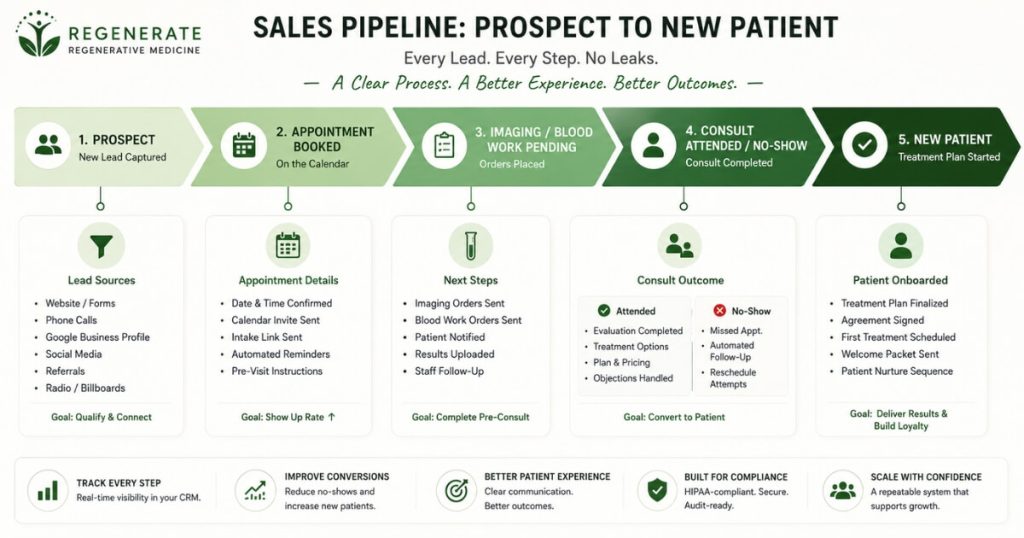
During one onboarding, we mapped this process on a whiteboard as one integrated funnel. The owner immediately recognized the problem.
Leads were ending up in:
- An admin email inbox
- Voicemails
- Social messages
If someone happened to call them back, great.
If not, nobody even knew the lead had existed.
The payoff is much bigger than cleaner reporting.
Simply implementing a CRM and forcing every lead through one system can often grow a practice by 20% to 30%. That growth comes from making sure no potential or existing patient falls through the cracks.
It is essentially found money.
You are recovering leads you already paid to generate but were previously losing.
This is the foundation of any serious regenerative medicine marketing system. It is also why we integrate everything into a CRM before touching paid advertising.
How do I track which marketing source my joint-pain patients actually come from?
Put every inbound source on its own tracking phone number. Then add a “How did you hear about us?” field to your website form so every lead is attributed automatically.
The highest-leverage first step is replacing your Google Business Profile phone number with a tracking number.
For most regenerative clinics competing within a geographic area, local search produces the majority of qualified demand.
From there:
- Give radio its own tracking number.
- Give billboards their own tracking number.
- Give every offline campaign its own tracking number.
- Add a self-reported source field to every website form.
Within a reasonable margin of accuracy, patients will usually tell you exactly where they found you.
Once your sources are tracked, the math finally becomes possible.
For example:
- Spend $3,000 on a magazine.
- Book $10,000 in appointments.
- Cost to book = $300.
Now you know whether to scale that channel or shut it off.
The exact same logic applies to:
- Billboards
- Restaurant advertising
- Paid campaigns
- Local sponsorships
Without source tracking, you are scaling blindly.
You cannot tell the difference between your best-performing channel and your biggest money pit.
Attribution is what transforms marketing from a gamble into a measurable patient acquisition engine.
What sales pipeline stages should a regenerative medicine clinic use?
Use the standard practice pipeline:
- Prospect
- Appointment Booked
- Consult Attended or No-Show
- New Patient
That backbone covers the journey from a name and phone number all the way to a paying patient.
From there, customize the pipeline around your actual workflow.
For example:
- MRI Pending
- Imaging Complete
- Blood Work Pending
- Labs Reviewed
Joint-pain clinics often place MRI or imaging between Appointment Booked and Consult Attended.
Hormone-related services frequently require a Blood Work Pending stage so those patients do not appear stalled when they are simply waiting on lab results.
Build the stages around how your clinic actually moves a patient through treatment.
Avoid using a generic template.
The pipeline matters because it transforms a pile of leads into a diagnosable funnel.
Instead of simply counting leads, you can measure:
- How many booked
- How many attended
- How many became patients
- Which marketing source generated them
When something breaks, the pipeline tells you exactly where.
For example:
- Leads are not booking.
- Booked patients are not showing up.
- Consults are not closing.
That visibility is the difference between a clinic that scales using data and one that simply spends more money hoping something improves.
Do I need email nurture and follow-up automation before scaling lead generation?
Yes.
Build service-specific automated nurture sequences inside your CRM before you turn the lead faucet up.
A regenerative medicine lead is different from a hormone replacement lead.
They should never receive the same emails.
Instead, create:
- A regenerative nurture sequence
- An HRT nurture sequence
Each should typically contain four or five emails that are triggered automatically based on the service the patient requested.
This is also where CRM consolidation pays off.
Once your CRM handles nurture, you can eliminate separate drip software.
There is no reason to pay two different systems to do the same job. Even worse, two systems often contradict each other and create inconsistent patient experiences.
The bigger opportunity is on the back end.
That is where most practices actually make their money.
Automate tasks such as:
- Re-contacting patients after three months
- Offering repeat PRP at 50% off
- Automatically requesting Google reviews after successful outcomes
These automations allow reviews, referrals, and repeat treatments to compound over time.
This is exactly how clinics grow through organic and owned channels instead of relying exclusively on paid advertising.
It is also how we generated $309,590 in cash-pay revenue for a regenerative clinic in 10 months from SEO alone, with a 79.4% conversion rate from leads to booked appointments and zero ad spend.
Follow-up infrastructure increases the value of every lead.
That additional value is what eventually justifies increasing paid advertising.
How do I connect my clinic’s EHR or booking software to my marketing CRM?
Keep one EHR for clinical charting.
Keep one CRM for marketing and lead management.
Then integrate the two systems instead of forcing your staff to work inside overlapping platforms.
Modern all-in-one EHRs integrate well with marketing CRMs such as GoHighLevel.
Your phone system can also live inside the EHR while call forwarding routes tracking numbers into that platform.
During this onboarding, the clinic was moving from an older booking platform to a modern all-in-one EHR.
The plan was never to replace the CRM.
Instead, the systems had separate responsibilities:
- The EHR manages clinical charts.
- The CRM manages leads and automations.
- One integration keeps both systems synchronized.
The mistake to avoid is allowing two platforms to compete for the same job.
When both systems try to manage:
- Contacts
- Phone calls
- Email campaigns
- Automations
your staff ends up entering everything twice.
Eventually the data stops matching.
That destroys the attribution system you worked so hard to build.
Choose the EHR for clinical work.
Choose the CRM for marketing.
Connect them once.
Then retire any tool that duplicates those responsibilities.
What website setup does a regenerative clinic need before paying for traffic?
Build a fast, clean website with:
- A video homepage hero
- Clear conditions-and-services navigation
- A contact form that pushes every submission directly into your CRM
Never send website forms to an email inbox where leads disappear.
Form integration is the non-negotiable piece.
Every submission should automatically create a CRM contact.
That removes manual data entry and ensures nobody slips through the cracks.
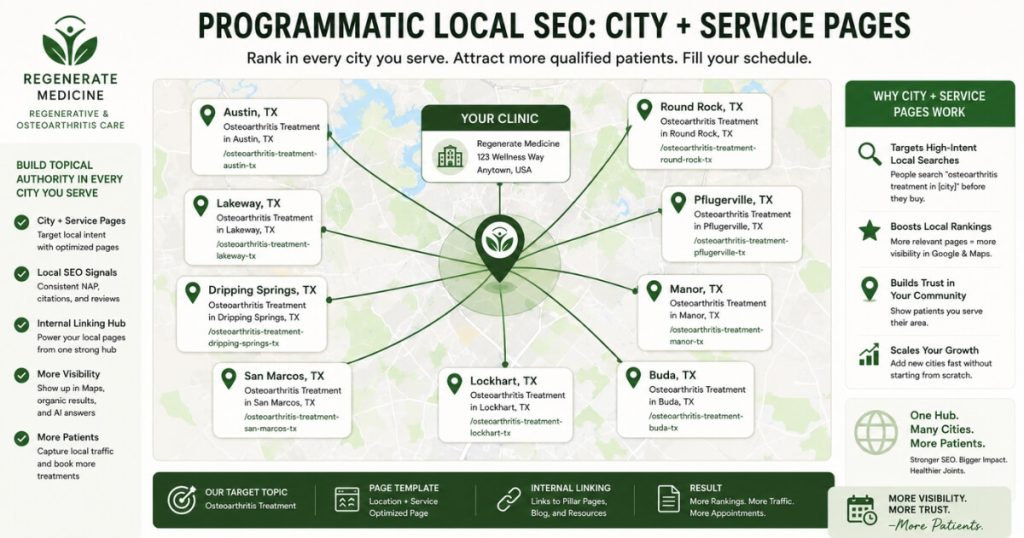
Beyond that, the highest-compounding website improvement is programmatic local SEO.
For example:
- Create an osteoarthritis treatment page for your primary city.
- Duplicate and localize that page for nearby cities.
- Expand it into telehealth-eligible states when appropriate.
Osteoarthritis is one of the most common conditions people search for when looking for regenerative medicine.
Creating city-plus-service pages allows rankings to compound much faster than relying on one generic services page.
The underlying philosophy is simple.
Traffic matters more than almost anything else.
If nobody ever sees your business card, it does not matter how beautiful it looks.
The same principle applies to your website.
A gorgeous site that nobody finds generates nothing.
Build a fast website.
Capture every visitor.
Attribute every lead inside your CRM.
Expand your local SEO footprint.
Only then should you pour paid traffic on top.
At that point, every visitor enters a system that measures, nurtures, and converts them.
FAQ’s About the CRM and Website Infrastructure a Regenerative Clinic Needs Before Scaling Lead Gen
What CRM do I need before running ads for my regenerative medicine clinic?
Set up one central CRM and route every lead source into it before you scale spend.
The goal is simple.
Until your website forms, inbound calls, Google Business Profile, social DMs, radio, and billboards all feed into one platform, you cannot accurately measure your true cost to acquire a patient.
That means every advertising decision is based on guesswork.
Simply implementing a CRM and forcing every lead through one system can often grow a practice by 20% to 30%.
Why?
Because it prevents leads from disappearing into:
- An email inbox
- A voicemail
- A social media message
Build the central system first.
Then scale traffic into it.
How do I track which marketing source my joint-pain patients actually come from?
Put every inbound source on its own tracking phone number.
Then add a “How did you hear about us?” field to your website form so every lead is attributed automatically.
Start with your Google Business Profile.
Replace its phone number with a tracking number because local search is usually the highest-value lead source for regenerative clinics.
Next, assign separate tracking numbers to:
- Radio
- Billboards
- Print advertising
- Every other offline campaign
Once each source has its own number and your website captures self-reported attribution, the math becomes easy.
For example:
- Spend $3,000 on a magazine.
- Book $10,000 in appointments.
- Cost to book = $300.
Now you know whether to invest more or stop spending.
Without source tracking, you are scaling blind.
What sales pipeline stages should a regenerative medicine clinic use?
Use the standard practice pipeline:
- Prospect
- Appointment Booked
- Consult Attended or No-Show
- New Patient
Then customize it around your clinical workflow.
For example, add stages such as:
- MRI Pending
- Imaging Complete
- Blood Work Pending
- Labs Reviewed
Joint-pain clinics often place imaging between Appointment Booked and Consult Attended.
Hormone patients frequently need a Blood Work Pending stage while waiting for laboratory results.
The pipeline lets you measure far more than raw lead volume.
Instead, you can see:
- How many leads booked
- How many attended
- How many became paying patients
- Which marketing source produced them
Stage-by-stage tracking turns a pile of leads into a diagnosable funnel.
Do I need email nurture and follow-up automation before scaling lead generation?
Yes.
Build service-specific automated nurture sequences inside your CRM before increasing lead volume.
A regenerative medicine lead should receive a regenerative nurture sequence.
An HRT lead should receive an HRT nurture sequence.
Each sequence should usually contain four or five automated emails triggered by the patient’s requested service.
The back end is just as important.
Automate activities such as:
- Contacting patients again after three months
- Offering repeat PRP at 50% off
- Automatically requesting Google reviews after successful outcomes
Keeping all of this inside one CRM also lets you eliminate duplicate drip software.
You do not want two different systems trying to perform the same job.
Strong nurture and reactivation systems increase the value of every lead.
That is what eventually makes paid advertising profitable at scale.
How do I connect my clinic’s EHR or booking software to my marketing CRM?
Use one EHR for clinical charting.
Use one CRM for marketing and lead management.
Then integrate them.
Modern all-in-one EHR platforms integrate well with marketing CRMs such as GoHighLevel.
Your phones can also live inside the EHR while call forwarding routes tracking numbers into that system.
Keep each platform focused on one responsibility:
- The EHR manages patient charts.
- The CRM manages leads and automations.
A single integration keeps both synchronized.
Avoid allowing two different platforms to manage the same contacts, campaigns, and phone systems.
That only creates duplicate work and mismatched reporting.
What website setup does a regenerative clinic need before paying for traffic?
Build a fast, clean website that includes:
- A video homepage hero
- Clear conditions-and-services navigation
- A contact form connected directly to your CRM
Never allow website forms to disappear into an email inbox.
Every submission should automatically create a CRM lead.
The highest-compounding website strategy is programmatic local SEO.
For example:
- Build an osteoarthritis treatment page for your primary city.
- Duplicate that page for surrounding cities.
- Expand it into telehealth-eligible states when appropriate.
Those pages compound rankings much faster than relying on one generic services page.
Traffic matters more than almost anything else.
A beautifully designed website that nobody finds is simply a business card sitting in your pocket.
Capture every visitor.
Attribute every lead.
Then scale paid traffic into a system that already converts.
What’s the next step?
If you run a regenerative or joint-pain clinic and are thinking about increasing ad spend, stop and ask yourself one question:
Can you currently say, to the dollar, what it costs to acquire a patient from every marketing source?
If the honest answer is no, your infrastructure needs to come first.
Build the foundation before you scale.
Start by:
- Routing every lead into one CRM.
- Assigning tracking numbers to every marketing source.
- Building the pipeline stages your workflow requires.
- Automating service-specific nurture sequences.
- Automating long-term follow-up.
- Integrating your EHR with your CRM.
- Building a fast website whose forms feed directly into the CRM.
Once that foundation is in place, increasing ad spend becomes a math problem instead of a gamble.
If you want this entire system built and integrated in the right order, that is exactly what we do.
It is the same process we used to generate $309,590 in cash-pay revenue for a regenerative clinic in just 10 months, with a 79.4% lead-to-booked conversion rate and no paid advertising.
We’ll map your funnel during the call and show you exactly where your current leads are leaking.