
What Does a High-Converting Women’s Hormone Landing Page and Quiz Funnel Actually Contain?
Most women’s hormone landing pages fail for the same reason: they lead with the medication, the provider’s credentials, or “book a consultation,” when the woman reading the page is somewhere else entirely. She is exhausted, she can’t button her jeans, she’s been waking up drenched in sweat and snapping at her partner, and her primary care doctor told her it’s “just stress.”
The pages that convert her don’t sell hormones — they name her symptoms back to her, tell her she’s not crazy, and offer a free quiz as the lowest-friction next step. This is the anatomy of a high-converting women’s hormone landing page and quiz funnel, broken down section by section from real, deployed copy.
What sections does a high-converting women’s hormone landing page actually contain?
A high-converting women’s hormone landing page contains six things in order:
- An emotional “feel like you again” headline
- A validation hook (“you’re not crazy, you’re not lazy, and you’re definitely not alone”)
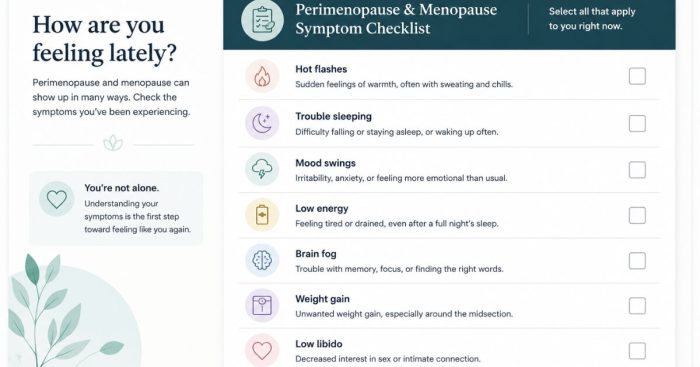
- A symptom checklist the visitor can self-identify with
- A single clear offer (a free hormone quiz, not “book a consult”)
- A description of what the quiz delivers (personalized feedback from a real hormone expert)
- One repeated call to action
The page is built around symptom recognition and emotional validation rather than clinical features.
Instead of leading with the medication, the provider’s credentials, or the price, it begins with the visitor’s lived experience. It names the weight gain that won’t budge, the night sweats, the brain fog, and the irritability. Then it reassures her those symptoms are real and treatable before offering the lowest-friction next step: a free quiz she can take from home in minutes.
Just as importantly, the page deliberately avoids opening with “We offer bioidentical hormone replacement therapy.”
Instead, it opens with “Feel like you again” and “You’re not crazy. You’re not lazy. And you’re definitely not alone.”
Only after she recognizes herself on the page does the clinical detail appear. That sequencing is the whole game. A real functional medicine & longevity clinic marketing funnel is engineered around the patient’s emotional journey, not the clinic’s service list.
Why does a free hormone quiz convert better than a “book a consultation” offer?
Because a free quiz is a low-commitment, high-value first step that matches where the patient actually is—uncertain and seeking answers, not ready to book a paid appointment with a stranger.
A woman who suspects her hormones are off but has been dismissed by her primary care doctor isn’t ready to commit time and money to a consult.
Instead, she is ready to spend two minutes answering questions about symptoms she already lives with in exchange for personalized feedback.
The quiz accomplishes three things at once:
- It converts cold traffic at a much higher rate than a consult offer.
- It qualifies and segments the lead by symptoms and goals before any human time is spent.
- It earns the right to follow up because she raised her hand.
The quiz result—”personalized feedback from a real hormone expert”—also becomes the bridge into the paid consult.
In other words, you are not skipping the booking. Instead, you are sequencing it after value has already been delivered.
The promise on the page is explicit: get personalized feedback from a real hormone expert, in minutes, from the comfort of her home.
As a result, that framing turns a cold visitor into a qualified, segmented, trust-warmed lead before a single staff minute is spent.
What makes women’s hormone ad copy actually convert?
Women’s hormone ad copy converts when it leads with specific, lived symptoms and validates the woman’s experience instead of selling a treatment.
The highest-performing variations open with a recognizable scenario, such as:
- “Eating clean, still moving your body, but suddenly your jeans don’t fit.”
- “Snapping at your kids and don’t know why.”
Next comes the reframe:
“It might be your hormones, not your habits.”
One of the strongest angles is the “not your primary care provider” message because so many women have been brushed off with “you’re just getting older” or “it’s probably stress.”
Copy that names that gaslighting experience and promises “we actually listen” consistently outperforms feature-led copy.
Each ad finishes with the same low-friction CTA—take the free quiz and get expert feedback—rather than “book now.”
At the same time, the discipline is to test five or six angles in parallel:
- The symptoms angle
- The dismissive-PCP angle
- The affordable-luxury angle (“longevity isn’t just for celebrities with $5k-a-month routines”)
- The jean-test angle
- The you’re-not-alone angle
Rather than guessing which message will perform best, run them simultaneously and let the audience choose the winner.
What symptoms should a women’s hormone funnel call out to get self-identification?
The funnel should call out the specific perimenopause and menopause symptoms women actually experience and search for, including:
- Hot flashes or night sweats
- Poor sleep
- Low sex drive
- Weight gain, especially around the midsection
- Brain fog or memory issues
- Mood swings or irritability
- Feeling sluggish or “off”
Listing these as a checklist does much of the conversion work.
The visitor scans the list, recognizes herself in three or four items, and begins to feel that her problem is both real and solvable.
The key is specificity.
“Hormone imbalance” is abstract and doesn’t trigger self-identification. By contrast, “gaining weight without changing your diet,” “waking up drenched in sweat,” “snapping at your partner,” and “just tired all the time” are concrete and unmistakable.
Frame each symptom as something she has been told to “just deal with.” Then tell her she doesn’t have to.
That validation is what moves her from reading to taking the quiz.
The emotional promises pair naturally with the symptom checklist and complete the story:
- Fit back into your favorite jeans
- Sleep through the night
- Reignite your sex drive
- Get your energy and confidence back
Each promise mirrors a symptom on the checklist and helps the visitor picture a better future.
How do you structure the offer ladder behind a women’s hormone quiz?
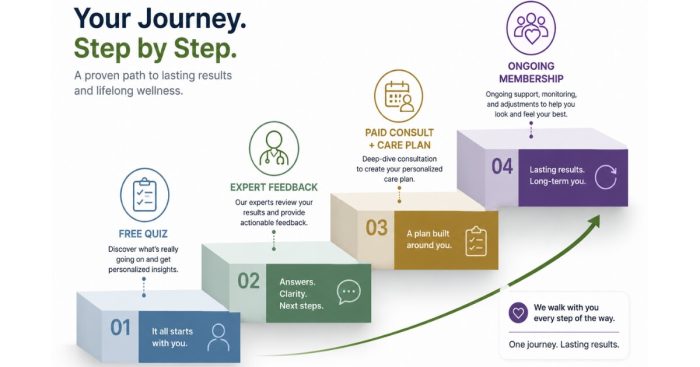
The quiz is step one of a simple value ladder:
- Free hormone quiz
- Personalized feedback from a hormone expert
- Paid consultation and care plan
- Ongoing membership for BHRT, peptides, supplements, and lifestyle care
The funnel works because every step delivers value before asking for the next commitment.
First, the free quiz captures the lead and segments her by symptoms and goals.
Next, the personalized feedback—delivered by a real clinician, not an automated result—builds trust and reinforces the “we actually listen” promise made in the ads.
That trust is what converts her into a paid consultation and a personalized care plan.
From there, she enters an ongoing program. That is where the lifetime value lives because women’s hormone care is recurring, high-LTV care rather than a one-off transaction.
Build the ladder backward from the membership.
The quiz exists to feed a recurring program, so every step should be designed to graduate her toward it.
This is exactly the recurring-revenue model we built with Eternity Health Partners, an HRT clinic we grew from $1M to $4M in four years with 250 active members paying $1,000/month—the front-end offer exists to feed a membership, and the membership is where the business actually compounds.
FAQ’s About a High-Converting Women’s Hormone Funnel
What sections does a high-converting women’s hormone landing page actually contain?
A high-converting women’s hormone landing page contains six things in order: an emotional “feel like you again” headline, a validation hook (“you’re not crazy, you’re not lazy, and you’re definitely not alone”), a symptom checklist the visitor can self-identify with, a single clear offer (a free hormone quiz, not “book a consult”), a description of what the quiz delivers (personalized feedback from a real hormone expert), and one repeated call to action.
The page is built around symptom recognition and emotional validation rather than clinical features.
Rather than leading with the medication, the provider’s credentials, or the price, it begins with the visitor’s lived experience. It names the weight gain that won’t budge, the night sweats, the brain fog, and the irritability before offering the lowest-friction next step: a free quiz she can take from home in minutes.
Why does a free hormone quiz convert better than a “book a consultation” offer?
Because a free quiz is a low-commitment, high-value first step that matches where the patient actually is—uncertain and seeking answers, not ready to book a paid appointment with a stranger.
A woman who suspects her hormones are off but has been dismissed by her primary care doctor isn’t ready to commit time and money to a consult.
Instead, she is ready to spend two minutes answering questions about symptoms she already lives with in exchange for personalized feedback.
The quiz converts cold traffic at a much higher rate than a consult offer. It also qualifies and segments the lead before any human time is spent while earning the right to follow up because she raised her hand.
The quiz result becomes the bridge into the paid consult, so you are sequencing the booking after value has already been delivered.
What makes women’s hormone ad copy actually convert?
Women’s hormone ad copy converts when it leads with specific, lived symptoms and validates the woman’s experience instead of selling a treatment.
The highest-performing variations begin with recognizable situations before reframing them with “it might be your hormones, not your habits.”
The “not your primary care provider” angle remains especially effective because many women have been told they’re “just getting older” or that it’s “probably stress.”
Copy that validates those experiences and promises “we actually listen” consistently outperforms feature-led messaging.
Each ad should finish with the same low-friction CTA—take the free quiz and get expert feedback—rather than “book now.”
Test multiple angles simultaneously, including symptoms, dismissive-PCP messaging, affordable luxury, the jean-test angle, and the you’re-not-alone angle, then let the audience determine the winner.
What symptoms should a women’s hormone funnel call out to get self-identification?
The funnel should call out the specific perimenopause and menopause symptoms women actually experience and search for, including hot flashes or night sweats, poor sleep, low sex drive, weight gain around the midsection, brain fog, memory issues, mood swings, irritability, and feeling sluggish or “off.”
A checklist helps visitors recognize themselves quickly.
Specific symptoms outperform vague phrases like “hormone imbalance” because they feel real and familiar.
Frame each symptom as something she has been told to “just deal with,” then explain she doesn’t have to. That validation is what moves her from reading to taking the quiz.
How do you structure the offer ladder behind a women’s hormone quiz?
The quiz is step one of a ladder: free quiz, personalized feedback from a hormone expert, paid consultation and care plan, and finally an ongoing membership for BHRT, peptides, supplements, and lifestyle care.
Every step delivers value before asking for the next commitment.
The free quiz captures and segments the lead.
Then personalized clinician feedback builds trust and reinforces the “we actually listen” promise.
That trust converts into a paid consultation and personalized care plan before leading into an ongoing membership, where the lifetime value of women’s hormone care is created.
Build the ladder backward from the membership because every step should move the patient toward that recurring program.
What’s the next step?
If you run a women’s hormone, functional medicine, or longevity clinic and your landing page leads with your services instead of her symptoms, you are leaving most of your traffic on the table.
Rebuild the page around the journey: validation headline, symptom checklist, free quiz, expert feedback, and recurring program.
Test five or six ad angles in parallel and let your audience choose the winner.
Then build the offer ladder backward from the membership because that is where the lifetime value lives.
If you want a funnel that converts cold traffic into recurring members instead of one-off consults, that is the conversation to book.
We built exactly this kind of recurring-revenue engine for Eternity Health Partners, the HRT clinic we scaled from $1M to $4M with 250 members at $1,000/month, and we will map your women’s hormone funnel on the call.