
Should You Launch Google Ads and SEO at the Same Time for a New Longevity & Weight-Loss Clinic? (What Happened in the First 12 Days)
Most new cash-pay clinics treat Google Ads and SEO as a sequence — do the website first, turn on ads later — and they bleed three months waiting for organic to index. The clinics that scale fastest launch both as one system. This is the field report from a longevity and weight-loss clinic that went live, ranked number one in a target city within 12 days, and then layered a small paid campaign on top to push new patients from 50 a month toward 100 to 200. Here is exactly how the two channels were stacked, what they spent, and the compliance tactic that keeps the GLP-1 ads alive.
Should a new cash-pay longevity and weight-loss clinic launch Google Ads and SEO at the same time, or do one first?
Launch them together — SEO as the always-on foundation and Google Ads as the fast-feedback layer on top — because they solve two different problems on two different clocks.
SEO is the long-term moat.
It produces the leads most ready to buy and compounds for years, but the industry average to see results is around six months.
Paid ads buy you patient volume right now while SEO indexes.
The mistake new clinics make is treating it as an either/or decision and burning their first three months waiting for organic to kick in.
In practice, a clinic that had fallen from 70 to 80 new patients a month down to about 50 after pausing its paid ads got organic moving fast — number one in a target city for a real search term within 12 days of going live.
It then layered a small paid campaign back on to push the new-patient number from 50 toward the 100-to-200 range.
SEO carries the quality and the long-term cost-per-acquisition.
Paid ads carry the speed.
Run both, but run them as one predictable patient acquisition system, not two disconnected projects.
How fast can a brand-new clinic website actually rank on Google?
Faster than the six-month industry average if the technical SEO is right from day one — we ranked a clinic number one for a city-plus-service search term within 12 days of the site going live.
The site had been live for 11 days when an inbound patient found the medical-weight-loss city page directly from Google search, went straight to it, and booked.
Search Console impressions had already jumped roughly 18 to 20 percent in the first two weeks, before anyone pushed hard on it.
The speed comes from the launch architecture.
City-specific landing pages were built for the highest-search-volume cities.
Those cities were chosen by search volume, then population density, then income, so the pages sit where people are actually searching for the solution.
Every city page carries unique content and unique headers.
The city name is baked into the H1 and headers, so there is no duplication risk even though the pages share a template.
The sitemap was submitted to Google, and local-business schema was in progress.
You cannot promise 12 days for every term.
However, a clinic that launches with that foundation ranks in weeks, not the default six months.
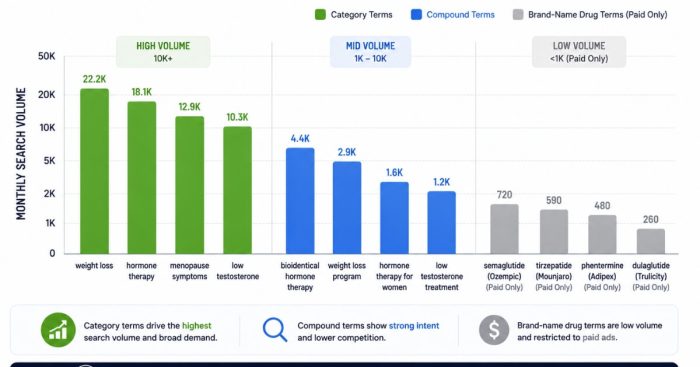
Which weight-loss keywords should a clinic actually target, and which ones are a trap?
Target the molecule and category terms the market is already solution-aware about — and stay completely off the brand-name drug terms.
In Minnesota, weight-loss injections pulled 1,000 to 10,000 monthly searches statewide.
Medical weight loss pulled 100 to 1,000.
Meanwhile, the compound-name searches — semaglutide, tirzepatide, GLP-1, and retatrutide — ranged from 1,000 up into the 10,000-to-100,000 band.
Those compound terms are far more valuable per search because the buyer already knows what the product is and is choosing where to get it.
The market is solution-aware enough now that it knows what this stuff is.
The trap is the brand names.
Patients in many markets call every weight-loss injection Ozempic.
However, there is no gray-hat or white-hat way to rank organically for a trademarked drug name you do not sell, and you do not want the brand name on your site anyway.
If you want that brand-search traffic, the only legitimate route is bidding on it in a paid campaign.
You can bid on Ozempic, Mounjaro, or Wegovy as keywords even though you cannot rank for them organically.
Retatrutide is the sleeper.
It draws roughly as much search volume as semaglutide, so even a clinic that does not sell it should publish content to capture that demand.
This category-versus-brand discipline is the core of effective GLP-1 & weight loss clinic marketing, and it is what keeps your domain clean while still capturing the search demand.
How do you run Google Ads for GLP-1 weight loss without getting your account banned?
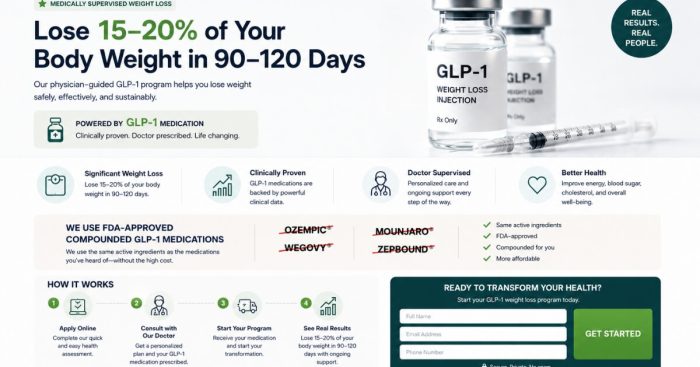
Send paid traffic to a purpose-built landing page that uses category language — GLP-1, not the brand names, and no FDA-approved claims — because the platform scans your landing page, and brand-drug or FDA wording is exactly what gets accounts and clinics flagged.
The clinic in this story had previously been shut down for going after semaglutide and tirzepatide on a landing page that was not properly certified for restricted pharmaceutical advertising.
The fix is a clean landing page.
Lead with the offer — a GLP-1 program that helps patients lose 15 to 20 percent of body weight in 90 to 120 days.
Say GLP-1 freely because that is allowed.
Strip out any FDA-approved verbiage.
Keep the brand drug names off the page entirely.
After the opt-in, route the lead to a thank-you page with the scheduling link embedded (SimplePractice, in this case).
Call everyone who opts in but does not self-schedule.
Structurally, run a Performance Max campaign so one budget covers search, retargeting, display, and YouTube at once.
That campaign type has produced strong results for weight-loss offers.
Local Services Ads are excellent quality because they are Google-validated and pay-per-call.
However, you cannot control the volume, so they are a complement, not the engine.
This is the same multi-channel paid discipline behind a weight-loss and medspa clinic where we added $6.7M in revenue in one year across 3,727 new patients.
How much should a new clinic spend per day on paid ads at launch?
Start at 100 to 200 dollars a day, not 50 — because you get data and feedback faster and you can optimize faster at the higher number.
The temptation at launch is to dribble in 50 dollars a day to feel efficient.
However, a campaign starved of budget takes far longer to gather enough conversion signal to optimize against.
That actually wastes money by extending the learning phase.
At a cash-pay weight-loss clinic, the break-even math is forgiving.
Roughly one new patient a day covers a 100-dollar-a-day spend.
That break-even cushion is exactly why you can afford to spend enough to learn fast.
Set the new paid leads to flow into the same CRM pipeline as your website leads.
Tag them by source — Google Ads versus website — so you can see new-versus-booked for each channel separately and optimize against real numbers instead of guesses.
One clean signal of how strong the inbound side already was: the clinic logged 34 new leads in a single month with 22 of them booked, on phone handling so good the advice was to keep the front-desk team off a rigid script and let them keep converting.
After weight loss, which cash-pay services should a clinic add to diversify and raise patient LTV?
Layer in TRT, HRT for women, and functional gut-health programs on top of weight loss.
These are higher-LTV, recurring, lower-maintenance verticals that protect you from any single-category disruption.
The clinic in this story made these its four big pushes for exactly that reason.
Weight loss is the volume engine, but the owner wanted to diversify around it in case anything disrupted compounded GLP-1 supply.
The build is an easy lift because the systems already exist.
The weight-loss patient journey was already mapped in the CRM.
The TRT journey is not too dissimilar.
It follows a clean, evidence-based template:
- Initial labs.
- Repeat labs at 30 days.
- Titrate at 30 days.
- Labs again at six months.
One reference men’s clinic runs 800 men on TRT and enrolls 60 new a month on a journey like that.
HRT for women is a large opportunity in markets where it is done poorly.
Functional gut protocols with GI-map testing capture a research-heavy, high-consideration patient.
That kind of recurring, high-LTV roster defines smart functional medicine & longevity clinic marketing.
Each new vertical reuses the same city-page SEO architecture.
It also reuses the same CRM pipeline and the same paid-ads infrastructure.
As a result, diversifying costs far less than launching from scratch.
That compounding system is what took VYVE Wellness, a longevity and functional-medicine clinic where we increased website leads 900% and inbound calls by 100+ per month in just 4 months.
FAQ’s About Launching Google Ads and SEO Together for a Cash-Pay Clinic
Should a new cash-pay longevity and weight-loss clinic launch Google Ads and SEO at the same time, or do one first?
Launch them together — SEO as the always-on foundation and Google Ads as the fast-feedback layer on top — because they solve two different problems on two different clocks.
SEO is the long-term moat.
It produces the leads most ready to buy and compounds for years, but the industry average to see results is around six months.
Paid ads buy you patient volume right now while SEO indexes.
The mistake new clinics make is treating it as an either/or decision and burning their first three months waiting for organic to kick in.
In practice, a clinic that had fallen from 70 to 80 new patients a month down to about 50 after pausing ads got organic moving fast.
It ranked number one in a target city for a real search term within 12 days of going live.
The clinic then layered a small paid campaign back on to push the new-patient number from 50 toward the 100 to 200 range.
SEO carries the quality and the long-term cost-per-acquisition.
Paid ads carry the speed.
Run both, but run them as one system, not two.
How fast can a brand-new clinic website actually rank on Google?
Faster than the six-month industry average if the technical SEO is right from day one — we ranked a clinic number one for a city-plus-service search term within 12 days of the site going live.
The site had been live for 11 days when an inbound patient found the medical-weight-loss city page directly from Google search.
The patient went straight to it and booked.
Search Console impressions had already jumped roughly 18 to 20 percent in the first two weeks before anyone pushed hard on it.
The speed comes from the launch architecture.
City-specific landing pages were built for the highest-search-volume cities.
Those cities were chosen by search volume, population density, and income, where people are actually searching for the solution.
Every city page has unique content and unique headers, so there is no duplication risk.
The sitemap was submitted to Google, and local-business schema was in progress.
You cannot guarantee 12 days for every term.
However, a clinic that launches with that foundation ranks in weeks, not the default six months.
Which weight-loss keywords should a clinic actually target, and which ones are a trap?
Target the molecule and category terms the market is already solution-aware about.
Stay completely off the brand-name drug terms.
In Minnesota, weight-loss injections pulled 1,000 to 10,000 monthly searches statewide, while medical weight loss pulled 100 to 1,000.
Meanwhile, compound-name searches such as semaglutide, tirzepatide, GLP-1, and retatrutide ranged from 1,000 up into the 10,000-to-100,000 band.
Those compound terms are far more valuable per search because the buyer already knows what the product is and is choosing where to get it.
The trap is the brand names.
Patients in many markets call every weight-loss injection Ozempic.
However, there is no gray-hat or white-hat way to rank organically for a trademarked drug name you do not sell.
If you want that brand-search traffic, the only legitimate route is bidding on it in a paid campaign.
You can bid on Ozempic, Mounjaro, or Wegovy as keywords even though you cannot rank for them organically.
Retatrutide is the sleeper because it draws roughly as much search volume as semaglutide.
How do you run Google Ads for GLP-1 weight loss without getting your account banned?
Send paid traffic to a purpose-built landing page that uses category language — GLP-1, not the brand names, and no FDA-approved claims.
The platform scans your landing page, and brand-drug or FDA wording is what gets accounts and clinics flagged.
The clinic in this story had previously been shut down for going after semaglutide and tirzepatide on a landing page that was not properly certified for restricted pharmaceutical advertising.
The fix is a clean landing page.
Lead with the offer, say GLP-1 freely because that is allowed, strip out any FDA-approved verbiage, and keep the brand drug names off the page entirely.
After the opt-in, route the lead to a thank-you page with the scheduling link embedded.
Then call everyone who opts in but does not self-schedule.
Run a Performance Max campaign so one budget covers search, retargeting, display, and YouTube at once.
Local Services Ads are excellent quality, but you cannot control the volume, so they are a complement, not the engine.
How much should a new clinic spend per day on paid ads at launch?
Start at 100 to 200 dollars a day, not 50, because you get data and feedback faster and you can optimize faster at the higher number.
The temptation at launch is to dribble in 50 dollars a day to feel efficient.
However, a campaign starved of budget takes far longer to gather enough conversion signal to optimize against.
That actually wastes money by extending the learning phase.
At a cash-pay weight-loss clinic, roughly one new patient a day covers a 100-dollar-a-day spend.
That break-even cushion is exactly why you can afford to spend enough to learn fast.
Set the new paid leads to flow into the same pipeline as your website leads, tagged by source, so you can compare new-versus-booked for each channel and optimize using real numbers instead of guesses.
After weight loss, which cash-pay services should a clinic add to diversify and raise patient LTV?
Layer in TRT, HRT for women, and functional gut-health programs on top of weight loss.
These are higher-LTV, recurring, lower-maintenance verticals that protect you from any single-category disruption.
The clinic made these its four major growth areas because weight loss is the volume engine while diversification protects the business.
The weight-loss patient journey was already mapped in the CRM, and the TRT journey follows a similar structure.
One reference men’s clinic runs 800 men on TRT and enrolls 60 new each month on a journey like that.
HRT for women is another large opportunity, while functional gut-health programs capture research-heavy, high-consideration patients.
Each new vertical reuses the same SEO architecture, CRM pipeline, and paid advertising infrastructure.
As a result, expanding into new services costs far less than starting over.
What’s the next step?
If you are launching a cash-pay longevity or weight-loss clinic — or relaunching one that fell from 70-plus new patients a month down to 50 after you paused your ads — the move is not to pick SEO or paid.
It is to launch them as one system.
Let city-page SEO index in the background while a tightly compliant GLP-1 paid campaign buys you volume now.
Feed both into one CRM pipeline that you can actually read.
That is how a clinic ranks number one in a target city in under two weeks.
It is also how it diversifies into TRT, HRT, and gut health without rebuilding from scratch.
It is the same compounding engine behind VYVE Wellness, where we lifted website leads 900% and added 100+ inbound calls a month in 4 months.
If you want someone to map the launch — the keywords, the landing pages, the daily budget, and the channel stack — for your specific market, that is the conversation to book.