
How Much Should a TRT or Men’s Hormone Clinic Spend on Ads Per Month — and How Do You Know the Spend Is Actually Working?
Almost every men’s hormone clinic owner asks the ad-budget question backwards. They ask “what should I spend?” when the only question that matters is “what does it cost me to add a member who stays?” A TRT clinic is a recurring-membership business, not a lead-generation business—and that single distinction changes the entire budget conversation. This is the field-tested answer, pulled from real monthly ad reporting at a two-market men’s hormone clinic, on how to set a monthly ad budget, which numbers actually tell you the spend is working, and why you judge a TRT campaign by members added—never by leads or clicks.
How Much Should a TRT or Men’s Hormone Clinic Spend on Ads Per Month to Start?
Most single-location men’s hormone clinics should start in the $1,500 to $4,500 per month per market range.
The right number inside that band is the one that buys you a stable, predictable cost per new member at your current sales close rate.
Do not start with a number pulled from a competitor or a podcast.
Instead, start with the unit you actually sell—a recurring TRT membership—and work backwards.
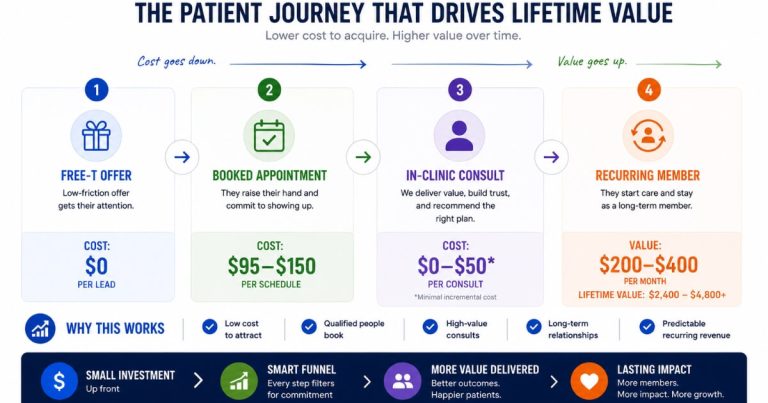
If your membership is $200 to $400 per month and a member stays for a year or more, you can afford to acquire that member for several hundred dollars and still produce an excellent lifetime value.
The budget is downstream of the unit economics, not the other way around.
At one men’s hormone clinic running two markets, the productive paid-ad zone landed around $1,500 to $1,610 in one market and $1,500 to $1,525 in the second.
During one month, one market pushed to roughly $4,300 to chase additional volume.
The lower, steadier spend produced:
- Cost per lead in the high-$30s to high-$50s.
- Cost per scheduled appointment between roughly $95 and $150.
The lesson is simple.
A smaller, consistent budget that you actually optimize beats a larger budget that you constantly turn on and off.
This is exactly the kind of math we build into men’s hormone clinic marketing for every TRT client.
Pick a number you can sustain for 90 straight days.
Get your cost per scheduled appointment stable.
Then scale.
What Ad Metrics Actually Tell a Men’s Hormone Clinic Whether the Spend Is Working?
Cost per lead and cost per scheduled appointment tell you whether the advertising is working.
Cost per new member and member retention tell you whether the business is working.
You must watch all four.
Cost per lead is your first gauge.
At a real two-market men’s hormone clinic:
- One market produced a $48.79 cost per lead.
- The following month, it produced $55.84.
- The second market came in lower at $37.73.
That proves the same offer performs differently by geography.
It also proves you cannot judge an advertising campaign from one market alone.
The second gauge is cost per scheduled appointment.
Across those same months, it ranged between roughly $95 and $150.
This number exposes a leaky front desk because a strong cost per lead combined with a weak cost per scheduled appointment almost always means:
- Phones are not being answered.
- The booking script is weak.
- Leads are not being converted into appointments.
The third—and most important—metric is cost per new member.
TRT is a membership business.
A lead that never becomes a member is a cost, not an asset.
The fourth metric is retention.
That same clinic grew active members from roughly 645 to 676 in a single month while losing only two cancellations.
That retention is what makes the advertising budget financially defensible.
Track:
- Cost per lead
- Cost per scheduled appointment
- Cost per new member
- Member retention
When you monitor all four together, the budget question answers itself.
The clinics that struggle are usually watching only cost per lead while flying blind on everything downstream.
Why Should a TRT Clinic Measure Ad ROI by Members Added Instead of by Leads or Clicks?
Because a TRT clinic does not sell leads.
It does not sell clicks.
It sells recurring memberships.
The only number that pays the rent is a member who stays and pays month after month.
A lead is a promise.
A member is revenue.
The trap many hormone clinics fall into is celebrating a low cost per lead while ignoring whether those leads actually become members.
At one real men’s hormone clinic, a free-testosterone-test offer generated:
- 33 booked appointments in one market.
- 16 booked appointments in another.
New members finished at:
- 25 in one market.
- 24 in the other.
Meanwhile, the active member base—the number that compounds over time—sat between roughly 645 and 676 members.
The advertising spend that month was justified because of member growth, not because of lead volume.
When you measure success by members added, you naturally begin protecting the parts of the funnel that actually create members:
- The offer.
- Speed to lead.
- Consult close rate.
- Retention.
Instead of obsessing over the cheapest click, you focus on recurring revenue.
This is the same recurring-revenue engine we built at Eternity Health Partners, an HRT clinic we grew from $1M to $4M a year with 250 active members at $1,000/month.
The clinics that scale compare cost per acquired member against lifetime value.
Everyone else compares cost per lead and wonders why a “cheap” campaign never made money.
Should a Men’s Hormone Clinic Run a Free Testosterone Test as the Front-End Ad Offer?
Yes.
A free or low-cost testosterone test is one of the strongest front-end offers in the men’s hormone category because it converts a problem-aware man into a scheduled, in-clinic lead before you ever pitch the membership.
The free-testosterone offer works because it lowers commitment to almost zero while still requiring the patient to show up.
Showing up is one of the strongest predictors of whether he eventually becomes a member.
At one men’s hormone clinic, the free-testosterone offer generated:
- 33 booked appointments in one market.
- 16 booked appointments in another.
Those booked appointments become the raw material for the provider consultation and the membership presentation.
The mistake many clinics make is treating the free testosterone test as the product instead of the doorway.
The free test gets the man into the clinic.
The labs, provider consultation, and membership presentation convert him into a recurring patient.
Pair the offer with fast follow-up because free-testosterone leads cool quickly.
A same-day or next-day phone call can be the difference between roughly a 30% show rate and a 60% show rate.
The offer is the hook.
The follow-up and the consult create the member.
How Does a TRT Clinic Know When It Is Ready to Increase Its Monthly Ad Budget?
Increase the budget only after your cost per scheduled appointment and your show rate have remained stable for 60 to 90 days.
Your front desk must also be capable of handling more volume without dropping calls.
Scaling advertising before the funnel is stable simply buys more expensive chaos.
The signal that you are ready is consistency.
You want:
- Cost per lead staying within a tight monthly range.
- Cost per scheduled appointment remaining stable.
- A booking team that is not already overwhelmed.
At one men’s hormone clinic, one market increased spending to roughly $4,300 after several months operating around $1,500 to $1,610.
That increase only made sense because the underlying cost-per-lead and member-conversion numbers had already been proven.
When you increase the budget, do it gradually.
Raise spending by roughly 20% to 30% at a time.
Then monitor cost per scheduled appointment for two to three weeks before increasing again.
Large budget jumps reset the advertising platform’s learning phase and often increase acquisition costs.
Scale proven unit economics—not optimism.
If you do not know your cost per acquired member, you are not ready to spend more.
You are only ready to lose more.
What Is a Realistic Cost per New Patient for a Cash-Pay Men’s Hormone Clinic?
A realistic cost per new patient for a cash-pay men’s hormone clinic falls in the low hundreds—often $200 to $400 per acquired member.
That number is only good or bad relative to membership lifetime value, never on its own.
The correct way to evaluate acquisition cost is as a fraction of what each member is worth over time.
If a TRT member pays $200 to $400 per month and stays for a year or longer, paying $300 to acquire that member is only a fraction of the lifetime revenue they generate.
That is excellent economics.
At one real men’s hormone clinic, the cost per scheduled appointment ranged between roughly $95 and $150.
Because not every scheduled appointment becomes a member, the true cost per acquired member naturally sits above that range once you factor in:
- Show rate
- Consult close rate
- Membership conversion
The result lands in the low hundreds per new member.
Real ADvice’s internal benchmark across cash-pay practices is acquiring a new patient for under $300.
High-lifetime-value services like TRT and HRT comfortably support that acquisition cost because recurring revenue compounds month after month.
Stop asking whether your acquisition cost is high in absolute dollars.
Instead, ask whether it is high relative to twelve or more months of membership revenue.
For a healthy TRT membership, it almost never is.
FAQ’s About Setting a Men’s Hormone Clinic Ad Budget
How much should a TRT or men’s hormone clinic spend on ads per month to start?
Most single-location men’s hormone clinics should start in the $1,500 to $4,500 per month per market range.
The correct budget is the one that produces a predictable cost per new member at your current close rate.
Do not copy a competitor’s budget.
Instead, work backward from your recurring membership economics.
If members pay $200 to $400 per month and stay for at least a year, you can afford to spend several hundred dollars acquiring each one while remaining highly profitable.
At one men’s hormone clinic operating across two markets, the most productive spending levels stayed around $1,500 to $1,610 in one market and $1,500 to $1,525 in the second, before one market temporarily increased to roughly $4,300.
The consistent spending produced cost per leads in the high-$30s to high-$50s and cost per scheduled appointments between $95 and $150.
Run a budget you can maintain for at least 90 days, stabilize your numbers, and then scale.
What ad metrics actually tell a men’s hormone clinic whether the spend is working?
Watch four numbers:
- Cost per lead
- Cost per scheduled appointment
- Cost per new member
- Member retention
Cost per lead shows whether advertising is attracting interest.
Cost per scheduled appointment reveals whether your front desk and booking process are converting those leads.
Cost per new member measures whether your business is actually producing revenue.
Retention tells you whether those members continue paying.
At one real two-market clinic, cost per lead ranged from $37.73 to $55.84, while cost per scheduled appointments stayed between $95 and $150.
Meanwhile, active membership increased from roughly 645 to 676 members with only two cancellations.
Looking at all four numbers together gives you the true picture of advertising performance.
Why should a TRT clinic measure ad ROI by members added instead of by leads or clicks?
Because leads and clicks do not produce recurring revenue.
Members do.
At one men’s hormone clinic, a free-testosterone offer produced 33 booked appointments in one market and 16 in another.
Those appointments became 25 and 24 new members.
Meanwhile, the recurring member base grew to roughly 645 to 676 active members.
That recurring revenue—not lead count—made the campaign profitable.
When you measure members instead of leads, your priorities naturally shift toward:
- Better offers
- Faster follow-up
- Higher consult close rates
- Stronger retention
That is how sustainable growth happens.
Should a men’s hormone clinic run a free testosterone test as the front-end ad offer?
Yes.
A free or low-cost testosterone test remains one of the strongest offers in men’s hormone marketing.
It lowers commitment while still bringing qualified prospects into the clinic.
At one clinic, that offer generated 33 booked appointments in one market and 16 in another during a single month.
Those appointments became opportunities for providers to present a recurring membership.
The free test is not the product.
It is the doorway.
Success still depends on:
- Fast follow-up
- Strong provider consultations
- Clear membership presentation
Without those pieces, even the best offer underperforms.
How does a TRT clinic know when it is ready to increase its monthly ad budget?
Increase spending only after your funnel has been stable for 60 to 90 days.
Specifically, you should see:
- Stable cost per lead
- Stable cost per scheduled appointment
- Consistent show rate
- A front desk capable of handling more volume
One men’s hormone clinic increased one market from roughly $1,500 monthly spending to approximately $4,300 only after proving its conversion numbers at the lower budget.
When scaling, increase spending gradually by about 20% to 30%.
Then monitor cost per scheduled appointments for several weeks before increasing again.
Scale proven economics—not hope.
What is a realistic cost per new patient for a cash-pay men’s hormone clinic?
A realistic acquisition cost generally falls between $200 and $400 per acquired member.
Whether that number is good depends entirely on lifetime value.
If members pay $200 to $400 every month and remain patients for a year or longer, acquiring one for around $300 represents outstanding economics.
At one men’s hormone clinic, scheduled appointments cost between $95 and $150.
After accounting for show rates and consult conversion rates, the final acquisition cost landed in the low hundreds per member.
Real ADvice’s benchmark across cash-pay practices is acquiring new patients for under $300, especially in recurring-revenue businesses like TRT.
Always judge acquisition cost against lifetime membership revenue—not against the acquisition cost alone.
What’s the Next Step?
If you are running a men’s hormone or TRT clinic and cannot immediately tell someone your:
- Cost per lead
- Cost per scheduled appointment
- Cost per acquired member
- Member retention
then your advertising budget is still a guess.
The solution is not automatically spending more.
The solution is understanding the numbers well enough that your ideal budget becomes obvious.
That is exactly the analysis behind Eternity Health Partners from $1M to $4M a year on the back of a 250-member recurring base.
We’ll break down your acquisition funnel, identify the bottlenecks, and show you exactly where your budget should be.