
How Do Patients Research and Choose a Stem Cell Clinic in 2026 — and How Do You Make Sure Yours Is the One They Find?
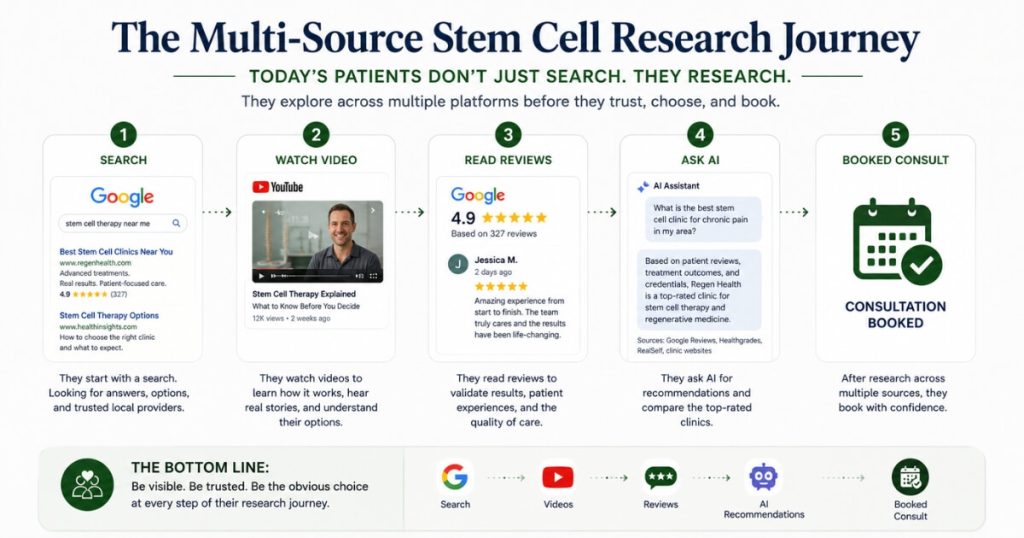
The way patients find a stem cell clinic has changed. They no longer call the first name they hear. Instead, they run a weeks-long research process across Google, YouTube, reviews, and increasingly AI tools like ChatGPT, Gemini, and Perplexity. Then they choose the clinic that shows up credibly everywhere they look. For an established regenerative practice, that’s an enormous opportunity. The same trust you’ve built is exactly what gets you found and recommended. Here’s how the modern stem cell buyer journey works and how to make your clinic the one patients land on.
How do patients research and choose a stem cell clinic in 2026?
They run a weeks-long, multi-source research process before they ever call. Then they choose the clinic that shows up credibly everywhere they look.
A typical regenerative patient starts by searching their condition and treatment on Google. They watch provider videos on YouTube to judge expertise. They read reviews to gauge trust. Increasingly, they also ask an AI tool for recommendations and comparisons.
They’re skeptical and the stakes are high. As a result, no single touchpoint convinces them.
The clinic that wins is the one that appears consistently and credibly across all of them.
That’s why an established practice with strong SEO, real educational content, visible provider authority, and a wall of reviews compounds over time. It is present at every step of a process designed to filter out anyone who isn’t trustworthy.
The patient doesn’t pick the cheapest clinic. They pick the one they’ve seen, learned from, and come to trust across weeks of research.
Being present at every stage is the heart of modern stem cell clinic marketing.
Where does an AI tool like ChatGPT or Gemini pull its stem cell clinic recommendations from?
From the same trust signals that rank you in search: authoritative, well-structured content, clear answers to patient questions, reviews, and a credible, consistent presence across the web.
AI search tools synthesize answers from content they can read and trust. They favor pages that directly answer real questions, use clean structure and schema markup, and come from sources with established authority.
In practice, the clinic publishing honest, well-organized educational content that answers patient questions is far more likely to be surfaced and cited. The same is true when that content is marked up so machines can easily parse it.
A clinic with a thin website and a few service pages is far less likely to earn that visibility.
The work that makes you findable and credible to a skeptical human researcher is largely the same work that makes you visible to an AI assistant.
That work comes down to depth, structure, honesty, and authority.
You can’t game it. You earn it by being genuinely the most useful and credible source on your topic.
How do you make sure your stem cell clinic is the one patients find?
Be present and credible at every stage of the journey. Rank in search, show up on YouTube, earn reviews, and publish well-structured content that both people and AI tools can find and trust.
Start with SEO and Google My Business. You need to appear when patients search for their condition and treatment.
That’s how a regenerative clinic generated $309,590 in 10 months from search alone.
Build provider authority through video. That’s the approach we used to help Dr. Joy Kong become the #1 stem cell expert on YouTube.
Then publish content that directly answers the questions patients ask.
Include FAQ sections and clean structure so the content is easy to surface and cite.
Finally, accumulate reviews. Reviews signal trust to patients, search engines, and AI tools alike.
The clinic that is credible across every channel a patient checks is the clinic that gets chosen.
Being the most visible and most trusted source is the entire strategy.
What’s the biggest visibility mistake stem cell clinics make in 2026?
Relying on paid ads while neglecting the durable trust assets that actually get a clinic found and recommended.
Ads can be disapproved overnight in this category.
They also disappear the moment you stop paying.
More importantly, an AI assistant answering “what’s the best stem cell clinic near me?” isn’t reading your ad account.
It’s reading your content, your reviews, and your authority.
The clinics losing visibility are the ones with thin websites, little educational content, few reviews, and no provider presence.
They’re betting everything on a channel that doesn’t build lasting credibility.
The fix is to invest in assets that compound.
That means SEO, structured educational content, provider authority, and reviews.
These assets make you findable and credible to both the skeptical patient and the AI tools they increasingly trust.
They also continue working long after any single ad campaign ends.
FAQs About How Patients Find a Stem Cell Clinic in 2026
How do patients research and choose a stem cell clinic in 2026?
They run a weeks-long, multi-source research process before calling. Then they choose the clinic that shows up credibly everywhere.
They search their condition on Google. Also, they watch provider videos on YouTube. They read reviews. Increasingly, they ask AI tools like ChatGPT, Gemini, and Perplexity for recommendations.
No single touchpoint convinces a skeptical, high-stakes patient.
The clinic that appears consistently and credibly across all of those channels wins.
Patients choose the clinic they’ve seen, learned from, and come to trust. They don’t simply choose the cheapest option.
Where does an AI tool like ChatGPT or Gemini pull its stem cell clinic recommendations from?
From the same trust signals that rank you in search.
These include authoritative, well-structured content, clear answers to patient questions, reviews, and a credible web presence.
AI tools favor pages that directly answer real questions. They also favor clean structure, schema markup, and established authority.
A clinic publishing honest, organized educational content is far more likely to be surfaced and cited than a clinic with a thin website.
You earn that visibility by being the most useful and credible source available. You can’t game the system.
How do you make sure your stem cell clinic is the one patients find?
Be present and credible at every stage.
Rank in search. Show up on YouTube. Earn reviews. Publish well-structured content that people and AI tools trust.
Start with SEO and Google My Business. One regenerative clinic generated $309,590 in 10 months from search alone.
Build provider authority through video. That’s how Dr. Joy Kong became the #1 stem cell expert on YouTube.
Answer patient questions with FAQ content and clean structure.
Then continue accumulating reviews.
The clinic that’s credible across every channel a patient checks is the clinic that gets chosen.
What’s the biggest visibility mistake stem cell clinics make in 2026?
Relying on paid ads while neglecting durable trust assets.
Ads can get disapproved. They also disappear when you stop paying.
Meanwhile, AI assistants aren’t reading your ad account. They’re reading your content, reviews, and authority.
The clinics losing visibility tend to have thin websites, little educational content, few reviews, and no provider presence.
The solution is to invest in SEO, structured content, provider authority, and reviews.
These assets compound over time and continue working long after a campaign ends.
What’s the next step?
Patients now make decisions across Google, YouTube, reviews, and AI tools before they ever pick up the phone.
They choose the clinic that’s credible at every step.
For an established regenerative practice, that’s good news.
Your expertise and track record are exactly what make you findable and recommendable.
The job is to make that expertise visible everywhere patients and AI tools look.
Do that with structured, honest content that answers the questions they’re already asking.
That’s the trust-first, search-led system behind $309,590 in 10 months from search alone.
If you want to make sure your clinic is the one patients and AI tools find, that’s the conversation to book.