
What’s the Difference Between Strategy and Tactics in Building a Cash-Pay Medical Practice — and Why Should I Care?
Strategy Is the “Why” You’re Doing Something. Tactics Are the “How” You Do It.
Cash-pay clinic owners stall at $80K, $200K, and $700K monthly revenue because they confuse the two — they hand their team a “strategy” the team can’t execute, or they get lost in tactics no one ever connected to a strategy.
Inside a cash-pay medical practice, the phrase:
“We need to be more strategic.”
usually means nothing unless the owner separates the why from the how.
In simple terms:
- Strategy is the direction
- Tactics are the execution
First, the owner needs to communicate the why clearly to leadership.
Then, the team needs to execute the how consistently every week.
Below is the working definition we use with every clinic we consult. In addition, you’ll see HRT, functional medicine, and regenerative medicine examples, plus the weekly cadence that keeps strategy and tactics aligned.
What is the difference between strategy and tactics in scaling a cash-pay medical practice?
Strategy is the why.
More specifically, it is the high-level reason you’ve decided one direction is better than another.
Meanwhile, tactics are the how.
They include the:
- Scripts
- Ad copy
- Hiring criteria
- Calendar blocks
- Software workflows
- Execution steps
that make the strategy real.
Example of a Strategy
For example:
“We are going to dominate the men’s HRT market in metro Phoenix by becoming the membership clinic the local CrossFit and Jiu-Jitsu communities recommend.”
That is a strategy because it explains:
- The market
- The positioning
- The audience
- The long-term direction
Example of the Tactic Stack
The tactic stack underneath that strategy might include:
- Sponsoring three Jiu-Jitsu tournaments per quarter
- Partnering with two CrossFit gyms for free InBody scans
- Running a $50/day TikTok campaign targeting men 35–55 in zip codes 85016–85254 using the “Tired Dad” angle
In other words, those are tactical actions supporting the larger strategy.
Why Clinics Get Stuck
When owners skip the strategy step, teams execute tactics without context.
As a result, the work starts to feel like busywork.
On the other hand, when owners skip the tactics step, they create:
- Leadership offsites
- Strategy decks
- Planning documents
without execution.
Ultimately, both mistakes lead to:
- Stalled growth
- Burned-out teams
- Inconsistent revenue
Why do cash-pay medical practice owners often fail at strategy AND tactics simultaneously?
Most owners fail at both because they try to handle:
- Strategy thinking
- Tactical execution
at the same time.
For example, the owner who is:
- Seeing 30 patients per week
- Personally writing Meta ad copy
- Personally training the NPC
- Personally negotiating the lease
has almost no remaining bandwidth for strategic thinking.
Because of that:
- Strategy gets squeezed into reactive late-night thinking
- Tactics get executed by an exhausted owner
We see this pattern repeatedly in clinics between:
$200K and $700K monthly revenue.
The Real Solution
The fix is not:
“Work harder.”
Instead, owners need to:
- Put two dedicated strategy hours on the calendar weekly
- Protect those hours aggressively
- Delegate at least one major tactical workstream
Usually, that delegated workstream becomes:
- Ad management
- NPC training
- Content production
- Clinic operations
As the clinic grows, the owner’s role should evolve into:
- Strategist
- Reviewer
- Editor of execution
—not the person doing every task.
What is a “strategy” example at a cash-pay HRT, functional medicine, or regenerative clinic?
HRT Clinic Strategy Example
A real HRT strategy might look like this:
“We will build the highest-LTV men’s HRT membership in our city by anchoring on a $400/month all-inclusive program that includes labs, weekly check-ins, and a peptide add-on, marketed exclusively to high-income professional men 38–55 through SEO, podcasts, and partner referrals — because that avatar pays for 18+ months, refers two friends, and is least sensitive to price.”
That single paragraph immediately tells leadership:
- The avatar
- The pricing model
- The channels
- The economic reasoning
Functional Medicine Strategy Example
Similarly, a functional medicine clinic strategy could be:
“We will become the go-to functional medicine practice for autoimmune women 40–60 in metro Denver by productizing a 6-month autoimmune reversal program at $5,500, marketed through long-form YouTube content and a referral relationship with three local integrative pharmacies — because we close 40% of consults in this avatar and they refer 1.4 patients in year two.”
Regenerative Medicine Strategy Example
Likewise, a regenerative clinic might decide:
“We will own the alternative-to-knee-surgery conversation in our metro by ranking page-one for 25 condition-specific keywords and running an inbound-call funnel for orthopedic surgeons who don’t operate on partial tears.”
All three examples are:
- Short
- Specific
- Decision-forcing
Most importantly, they explain why the clinic is pursuing that direction.
What is a “tactic” example for the same clinic — i.e. what does “how” look like in practice?
For the HRT strategy above, the tactic stack might include:
- Publishing 2 SEO-optimized blog posts weekly
- Guesting on 4 podcasts per quarter
- Running a $30/day Meta retargeting campaign
- Paying the NPC a $50 bonus per closed membership
- Training the front desk to triple-attempt inbound calls within 5 minutes
- Reviewing membership churn reports every Monday
Importantly, every tactic should have:
- A clear owner
- A clear deliverable
- A clear review checkpoint
Tactics Must Be Specific
Tactics are granular.
Therefore, vague tactics usually signal unclear thinking.
For example:
“Run ads.”
is not a tactic.
However:
“Run a $30/day Meta retargeting campaign on website visitors using the Tired Dad video with the ‘Free 7-Question Low T Self-Assessment’ offer, reviewed every Friday.”
is a tactic.
The difference matters.
The first version stalls quickly.
Meanwhile, the second version can operate for years because it is measurable and repeatable.
How do I communicate strategy to my team so they actually implement it?
The best approach is simple:
Communicate strategy in:
One written page per quarter.
That page should clearly define:
- The avatar
- The offer
- The acquisition channels
- The success metric
Afterward, translate that strategy into a weekly leadership scoreboard.
What Fast-Growing Clinics Actually Do
The fastest-moving clinics in our portfolio do not rely on:
- 40-page strategic plans
- Endless meetings
- Corporate slide decks
Instead, they use:
- A one-page strategy document
- A Monday scoreboard meeting
Every Monday, leadership reviews metrics such as:
- New consults
- Close rate
- Membership retention
- Cash collected
As a result, the team aligns around measurable outcomes rather than abstract conversations.
Why Internal Visibility Matters
Additionally, strategy should be visible to the entire staff — not just leadership.
The:
- Front desk
- NPC
- Providers
all perform better tactical work when they understand the why.
For example:
A receptionist who understands the clinic strategy is:
“Concierge HRT for high-income men 38–55.”
handles inbound calls differently than a receptionist who believes the clinic serves:
“Everyone.”
We’ve seen this play out across our portfolio — the clinics that publish strategy internally outperform the ones that keep it in the owner’s head.
When should I as the owner work on strategy vs. tactics — and when should I delegate each?
In most clinics, strategy remains owner work.
Generally, owners cannot fully delegate strategy until they have:
- A trusted second-in-command
- Multiple years of tenure
- Proven strategic judgment
Until then, the owner should personally own:
- Quarterly strategy
- Revenue targets
- Avatar definition
- Offer positioning
- Senior-role hiring
Time-Block Strategy Work
Ideally, strategy work should happen:
- Monday mornings
- Before clinic hours
- For at least 90 uninterrupted minutes
During that block:
- No patients
- No phone calls
- No interruptions
Delegate Tactics Quickly
Meanwhile, tactics should be delegated aggressively as the clinic grows.
Typical delegation thresholds include:
- Ad management → delegated around $50K/month ad spend
- NPC training → delegated once you have 3 NPCs
- Content production → delegated once you’re producing 4+ pieces weekly
- Operations → delegated around $200K/month clinic revenue
Otherwise, the owner becomes the operational bottleneck.
The pain management practice we added $2.095M in revenue to in 10 months scaled because the owner stopped hand-managing tactical execution and allowed the systems to run.
What’s a weekly cadence for managing the strategy/tactic balance at a cash-pay medical practice?
A strong weekly cadence keeps both strategy and tactics moving together.
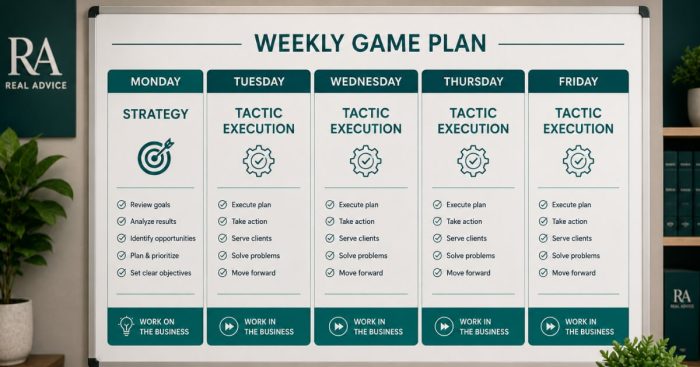
Monday: Strategy + Leadership Alignment
7:00–8:30 AM
The owner handles solo strategy work:
- Review the one-pager
- Review the scoreboard
- Journal what’s working
- Journal what’s failing
Then:
9:00–9:30 AM
Leadership holds a scoreboard meeting covering:
- 4 key metrics
- 3 wins
- 3 issues
- Ownership assignments
Tuesday–Thursday: Tactical Execution
Next, the clinic focuses on execution.
During those days:
- Providers see patients
- NPCs run consults
- Marketing manages campaigns
- Operations manage schedules
Friday: Tactical Rollup
3:00–4:00 PM
Departments review:
- Last week’s commitments
- Current blockers
- Next week’s commitments
Saturday + Sunday: Recovery
Finally, the owner protects:
- Family time
- Training time
- Recovery time
No clinic work.
Without recovery, strategic thinking declines rapidly.
Why This Cadence Works
If the Monday strategy block disappears, the team becomes rudderless within weeks.
Likewise, if the Friday tactical rollup disappears, execution drifts.
Finally, if the Monday scoreboard meeting disappears, leadership discovers problems far too late.
However, clinics that maintain all three consistently for 12 weeks usually see:
- Better close rates
- Higher retention
- Increased cash collected
because the team finally understands both:
- What they’re doing
- Why they’re doing it