
How to Get Your First Patients at a New Clinic Location (When Paid Ads Are Bleeding You Dry)
On a strategy call last week, the owner of a four-location weight-loss and HRT clinic said it plainly: “We’ve seen two total patients between the four clinics. Paid search is bleeding us dry without any meaningful movement.”
He’s a physician who built his first location to $80,000 a month — and almost none of it came from ads.
What follows is the exact local playbook we walked through on that call: the same one that took another new clinic location from zero to 180 members at $200 a month.
Why isn’t paid search working for my new clinic location?
Because a brand-new location has no reviews, no local authority, and no reason for a cold click to trust you yet.
As a result, every lead costs a fortune, and most never book.
Paid search works when it sits on top of an established local presence.
On the call, we had deliberately limited paid search to one state just to pressure-test the booking process.
The test itself worked fine.
Five leads came in, two self-scheduled a 10-minute medical fit call, and both showed up and committed to moving forward.
That’s a healthy funnel.
The problem is the math around it.
When a location has zero reviews and zero local reputation, you’re paying cold-traffic prices for warm-traffic outcomes.
Meanwhile, the clinic stays in the red.
The clinics that open strong flip the order.
They build local trust signals first, then let paid traffic land on top of them.
The rest of this article is that sequence.
What’s the fastest way to get patients at a new clinic location without paid ads?
Boots on the ground.
Get your team physically into the neighborhood, handing out cards, meeting business owners, and asking for referrals.
The owner on this call built his original location to $80,000 a month before we ever started working together.
And his description of how he did it is worth quoting:
“It was just our team on the ground there meeting people and bringing people in. I was talking to people in the hair salon. It really was word of mouth and meeting our neighbors.”
Fleshed-out Google Business Profiles and a steady stream of reviews did the compounding.
But the first members came from humans, not campaigns.
That’s not an accident of one market.
They used exactly this kind of local groundwork: gym TV ads, yard signs matched to the local patient base, and relentless community presence.
That’s over $400,000 a year in recurring revenue from a location that started with zero patients and no ad budget worth mentioning.
By the end of the call, the plan was concrete.
Nurses would visit every gym within 10 miles of each location, armed with a one-page presentation for the gym owner.
Not someday.
This week.
How do gym partnerships bring in cash-pay patients?
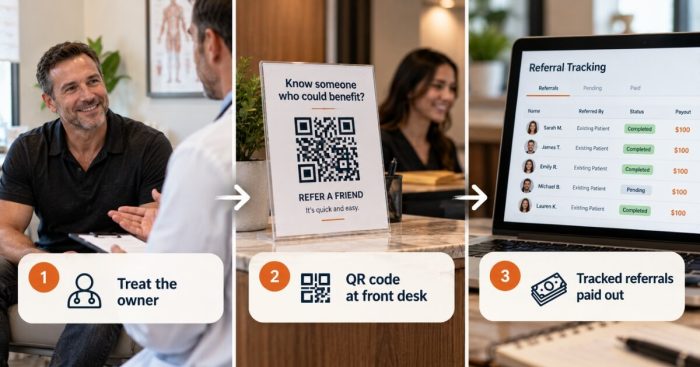
Offer the gym owner free treatment, then set up a tracked referral program with a unique QR code at their front desk.
Here’s the model we shared from a clinic in Scarsdale, New York.
The clinic was doing about $20,000 a month when we started.
They approached one-off, privately owned bootcamp gyms and offered to take care of each owner for free.
Then, they placed an offer with a unique QR code at each gym’s front desk.
Every gym received its own QR code, which we could build in about ten minutes through the CRM.
As a result, every lead could be attributed to the exact gym it came from.
The gym owner could also receive a per-patient referral fee with real tracking behind it.
Gym members are the ideal patient pool for weight loss, HRT, TRT, peptides, and longevity.
They’re already paying monthly for their health.
And at the top end, this model scales further than most owners believe.
Their affiliates aren’t healthcare providers.
They’re podcasters and local personalities with an audience.
One important caveat: referral compensation in healthcare is regulated.
Keep affiliates outside clinical roles and have your attorney review the structure for compliance in your state.
Do TV ads inside gyms actually work for a clinic?
Yes — for $300 to $500 a month, gym TV ads reliably produce four to six patient calls a month in the markets where we run them.
Chains like Planet Fitness sell advertising slots on the TVs inside their facilities.
It’s one of the most underpriced local placements a cash-pay clinic can buy.
Every viewer is local, already invested in their health, and seeing your offer mid-workout.
In the Mississippi market where we run these ads, the clinic gets four to six calls a month from the placement.
At $500 a month, we’d happily buy more if there were more TVs available.
However, there’s one honest caveat from the same call.
A different owner had tried TV ads in smaller local gyms for three and six months with zero leads.
The difference is volume and fit.
A high-traffic budget gym puts your offer in front of thousands of local members.
And the creative has to name the patient’s problem, not your brand.
Pair the screens with the unglamorous strategies that keep working.
That includes yard signs, sidewalk signs, and offers written in the language of the local patient base.
How should I set up Google Business Profiles for a new clinic location?
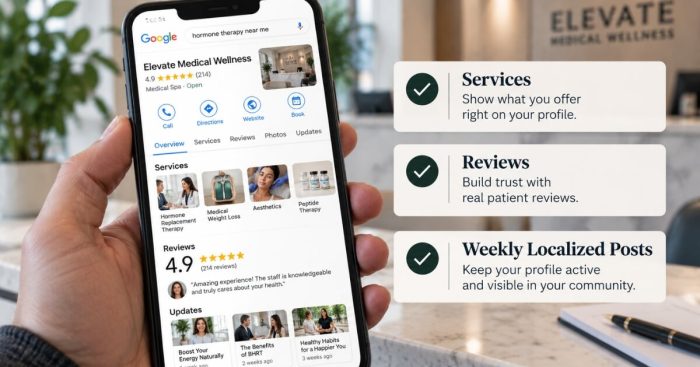
Fully built out, aggressively localized, and deliberately varied.
Each location needs its own services, products, photos, and posts.
Never launch four identical profiles on the same day.
The owner on this call ranks #1 in ChatGPT for “TRT clinic Minneapolis,” and his Google Business Profile system is a big reason why.
At the flagship location, his cadence includes two blog posts and two Google Business Profile posts per location each week.
Every profile is a little different because, as he puts it, “Google likes it when it’s not all the same.”
Services and products are fully built out.
Meanwhile, reviews continue flowing in.
In his words, the optimized profiles and early reviews are “where you get the bulkier patients.”
They’re also what help an AI model comfortably recommend a clinic.
That means visible reviews, clear services, and a customer experience that backs everything up.
For the new locations, the marching orders were simple.
Build each profile to the flagship’s standard, but localize it to its specific market.
Also, stagger the buildout rather than launching identical profiles simultaneously.
This is the foundation layer of medical practice marketing for a multi-location clinic.
Everything else in this playbook feeds it.
That’s because every gym referral and TV-ad caller who Googles your clinic lands on that profile before booking.
Should I still write blog content for a brand-new location, or is that wasted effort?
Write it — but treat it as a 3-to-6-month authority play, not a patient-this-week play.
And never let it displace the boots-on-the-ground work.
Here’s the honest state of AI search we laid out on the call.
Informational content, like a “tirzepatide and alcohol” article, is what AI models say gets you recommended.
However, that content now lives in a clickless environment.
You earn impressions in AI answers, but not necessarily measurable website traffic.
What still produces trackable patients is intent content.
Think “TRT near me,” “TRT Tampa,” and condition-and-city service pages.
You need both types of content, and neither delivers results overnight.
We’ve published close to 400 blogs on our own site using call transcripts, scripts, and client work as raw material.
Now, we rank across the board.
But that traction took months.
That’s exactly why gym partnerships and Google Business Profile optimization come first for a location that needs patients now.
The efficient version for a busy clinic owner is simple.
Delegate the drafting, then review the content yourself to keep the medical voice credible.
After publishing, repurpose every post to LinkedIn from your personal profile, with a link back to the website.
Authorship from a real physician profile builds authority.
And that extra step takes about 30 seconds per post.
FAQ’s About Getting Patients for a New Clinic Location
How much do gym TV ads cost for a medical clinic?
Around $300 to $500 a month per gym in the markets where we buy them.
At that price, four to six patient calls a month makes the placement one of the cheapest local channels available to a cash-pay clinic.
A single converted HRT or weight-loss member typically covers months of the advertising cost.
What should I offer a gym owner in a referral partnership?
Free treatment for the owner personally, plus a tracked per-patient referral fee.
The unique QR code at the front desk is what makes the system work.
Every referral is attributable to its source.
As a result, payouts are easy to track, and the gym owner can trust the numbers.
However, keep referral partners outside clinical roles.
Also, confirm that the compensation structure complies with healthcare referral laws in your state before launching the program.
How long does it take a new Google Business Profile to produce patients?
Expect months, not weeks.
Reviews are the accelerant.
Your profile should be fully built out on day one.
That includes services, products, photos, and localized descriptions.
Then, support it with staggered weekly posts and a steady review-generation habit.
The clinics that win in local and AI search combine strong profiles with a review base that makes the recommendation feel safe.
Do yard signs really work for a medical practice?
In the right market, yes.
The Mississippi clinic that grew to roughly 180 members at $200 a month used yard signs as one of its core local channels.
Those signs were written specifically for its conservative, male patient base.
The unglamorous 80% — signs, cards, and community presence — is usually what compounds first at a new location.
Should a new location run paid ads at all?
Use a small paid test to validate your booking process, not to fill the schedule.
Five leads that produce two booked-and-shown consultations prove the funnel works.
However, cold traffic will remain brutally expensive until the location builds reviews and local authority.
Build the trust layer first.
Then, scale advertising spend on top of it.
What’s the next step?
If you’ve opened a new location — or you’re planning one — and the patient count isn’t moving, the fix is almost never “more ad spend.”
It’s the local trust layer.
That means gym partnerships with tracked QR codes, underpriced placements like gym TVs, and Google Business Profiles built to flagship standards.
It also means having a team that’s physically present in the neighborhood.
Book a free strategy call, and we’ll map the local channel plan for your specific market.
We’ll also show you what to put in front of gym owners and identify what’s missing from your Google Business Profile buildout.